

A new NPR podcast dares to ask ‘Are We Doomed?’
Ben Bradford
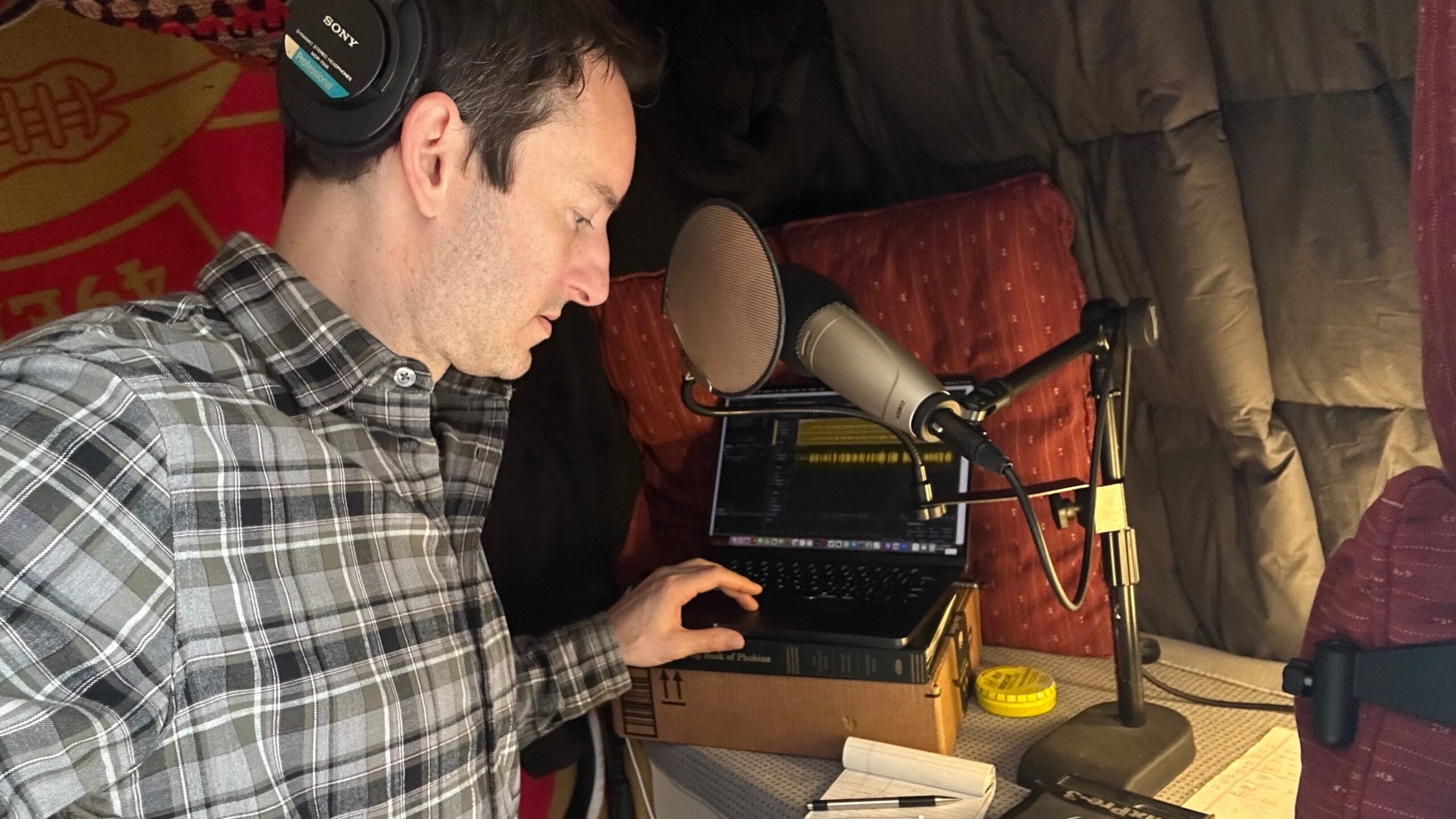
"Are We Doomed?" creator Ben Bradford listens to an interview in his closet studio in his Los Angeles apartment.
A new NPR podcast wants listeners to contemplate the end of the world — but not just the Hollywood depictions they might be thinking of.
It’s true that episodes of Are We Doomed? take on dramatically destructive threats like asteroids, nuclear bombs and a supervolcano under Yellowstone National Park. But over the course of its 48 episodes to be released this year, the podcast will also examine subtler threats such as pesky mosquitoes, angry hippopotamuses and the planet running out of sand.
Creator and host Ben Bradford, a former public radio reporter, is producing the show through Nuance Tales, the podcast production company he founded in 2020. The previous critically acclaimed podcasts he has produced through Nuance Tales include Of the People, Engines of Outrage and Landslide, which won the Signal Awards’ Best Writing and Best Music prizes.
Bradford says he wants Are We Doomed? to explore both old and new fears about how the world might end. “We as a society are clearly very interested in doom, the apocalypse and the end of the world,” he says. “We have a history of media about it because it speaks to our cultural anxieties.”

Like his previous podcasts, which explored the impact of America’s political past on the present, Bradford wants Are We Doomed? to “use the past to help us think [about] where we are going in the future.”
Released April 28, the debut episode, “How to Start a Nuclear War,” broke down how a nuclear attack could destroy the planet. “Let’s Design the AI That Kills Us All,” the show’s second episode released the same day, examined the three steps that could result in AI wiping out humanity.
Daniel McCoy, NPR’s senior director of network growth, says the network took interest in the show due to its potential to analyze prescient themes like technology, government and the climate crisis from a new perspective. Are We Doomed? also “threads the needle very nicely” between being both engrossing and cost-effective on the production side, he says.
Thanks to producer Lindsey Kilbride, editor Tracey Samuelson and sound designer and engineer Jay Siebold, Are We Doomed? “sounds great but isn’t overly laborious to be produced and doesn’t require [Bradford] to fly all over the place for reporting,” McCoy says.
Avoiding ‘very depressing’
Bradford says he believes that now is the perfect time to release Are We Doomed? because the show can interrogate the “growing feeling across society that things are falling apart and are less good than they used to be.”
In “Let’s Design the AI That Kills Us All,” Bradford probes how AI was supposed to make our lives easier, yet it ended up threatening job security across numerous industries and could soon have the potential to override human orders and take over the world.
“I really thought that episode was going to be a lark,” says Bradford. Instead, Katja Grace, co-founder of the research project AI Impacts, told Bradford that AI posed the single greatest threat to humanity. “When I finished the episode, I remember thinking, ‘I don’t love this,’” he says.
But while Are We Doomed? explores these topics in a well-reported and informative manner, each episode is also humorous and entertaining. “I didn’t want people to listen and then want to run away into the mountains scared,” says Bradford. “I was conscious of making the show in a way where people who are listening will continue to listen, as opposed to listening to it and going, ‘That was fun but very depressing. I never want to hear it again.’”
Each episode also features an expert who provides the origin story for the threat being discussed. They then inspect how this threat to humanity became so ominous. In one of the show’s recurring segments, “The Doom Meter,” Bradford ranks the severity of each threat. Then, in the segment “Are We Doomed? Solves It,” each guest attempts to defuse their topic’s danger in one conversation.
Episodes also explore and dissect conspiracy theories about the end of the world, which Bradford uses to segue into discussing the rise of disinformation. “That just plays into us figuring out what are the biggest risks and how these threats bubble up through this miasma of information,” he says.
Bradford says he believes that NPR is the perfect home for dissecting the subject of misinformation. He explored this topic in his 2025 podcast miniseries Engines of Outrage, which investigated how right-wing media ecosystems in the 1970s evolved into outrage-driven content on social media.
Bradford said his main takeaway from that project was understanding the value of the kind of reporting NPR does. “I wish more people understood [NPR’s] process and [could] hear how stories are chosen, discussed and picked over for accuracy for presenting facts and viewpoints related to a story,” he says. “I think there’d be a far higher level of trust in that type of journalism today.”
Before starting Nuancle Tales, Bradford reported for Marketplace and filed stories for NPR while a reporter at CapRadio in Sacramento, Calif. When he began working on Landslide, he applied for an NPR Network initiative to partner with a member station on the show. That paired him with WFAE in Charlotte, N.C., and connected him with NPR’s McCoy.

“He immediately stood out as passionate about his work, and he quickly proved to be a great and engaged partner who followed through and delivered on his commitments,” says McCoy.
McCoy was so impressed by Bradford’s work that he decided NPR would work directly with Bradford and Nuance Tales to produce Are We Doomed? “We always trust that our stations are making great podcast content. But Ben had already proved to us that he was editorially first class,” says McCoy. “So as soon as we knew about Are We Doomed?, even though he didn’t have a station partner, I wanted NPR to partner again with Ben to make great content and approach such an interesting question in a unique way.”
McCoy says that NPR trusts Bradford enough to provide little editorial oversight over Are We Doomed? Instead, it’s focused on using its experience with distribution, sponsorship, sales and marketing to get Are We Doomed? out to as many listeners as possible through the NPR App, Spotify and Apple. National Public Media will sell sponsorship for the show and share the revenue with Bradford.
McCoy says he’s confident that Are We Doomed? can find an audience, noting that Bradford’s past shows performed well on NPR’s app. Promos for Are We Doomed? will appear on the NPR app in the “New and Noteworthy” section and under “Recommended Episodes” on the Podcasts tab. The NPR One stream will also include an episode of the podcast for a period of time.
In addition, Bradford plans to appear on NPR shows to promote and discuss Are We Doomed? “One of the things that’s really incredible about NPR is they have this massive portfolio of shows, and their listenership trusts what they make and is loyal to their shows,” says Bradford.
Broadening audience via YouTube
Weekly episodes are key to making an impact and keeping listeners interested. “If you take time off, the listenership goes down,” says Bradford. His team finished some episodes of Are We Doomed? before the show’s launch. To expand the show’s reach and have “a bit of a reprieve [from the] fast-paced production schedule,” Bradford says he’d love to organize a feed swap with another show. The technique inserts an episode of each show in the other show’s feed to reach new listeners.
“We don’t have anything planned,” Bradford says. “But I think if there’s an episode of a great show that would absolutely appeal to our sensibilities and our listeners, we’re potentially open to that.”
Bradford acknowledges that breaking through is still difficult, especially with so many podcasts in production. “When a new podcast comes out, the name of the game is discovery,” says Bradford. “That’s really, really hard, because everyone can do a podcast, which is a blessing and a curse.”
That’s why Bradford also hopes to find an audience for Are We Doomed? on YouTube. Working with animator Alborz Kamalizad, Bradford will turn each podcast episode into an animated video, enhancing the show’s discussions with quirky humor. In the video for “How to Start a Nuclear War,” Bradford turns into the planet Earth as he discusses the “stunningly stupid” destructive chain reaction a nuclear bomb would set off.
Bradford decided to create the animations because more and more people — younger listeners in particular — are consuming podcasts on YouTube. “They frequently have them on in the background,” he says. “Then if something sparks their interest, they’ll watch the video at home or listen to it on audio when they’re in the car.”
So many people use YouTube daily that Bradford hopes its algorithm will get Are We Doomed? videos in front of people who wouldn’t otherwise encounter them and don’t usually watch public media content.
“We live in a time where it’s hard to find good information. It’s easy to find entertaining information. I am hoping we provide both, where we tell fun stories that give trustworthy information about big topics — and increase the attention, however slightly, on both,” says Bradford. “I hope we raise awareness and educate listeners about the huge challenges humanity faces, but do so in a way that inspires the will to tackle them rather than suppresses it.”