
Take your reporting for a walk: Why public media should pilot walking tours
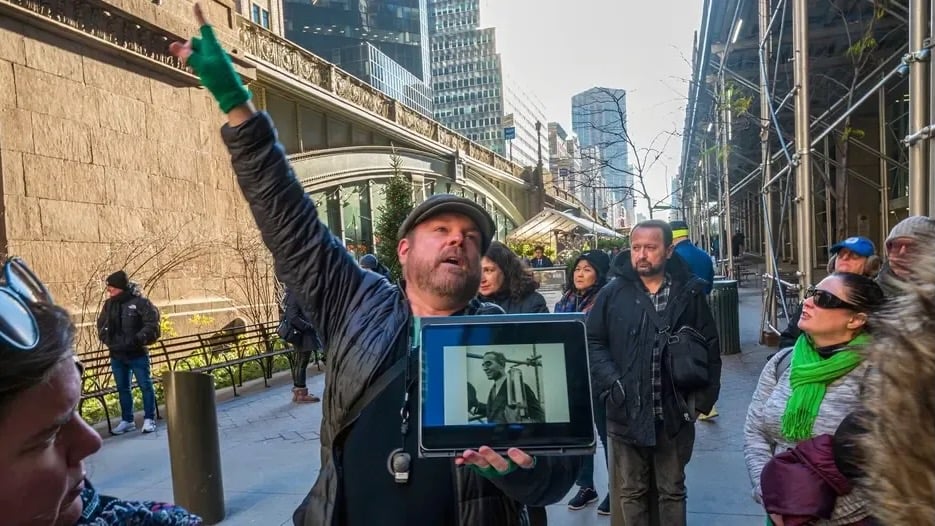
Untapped New York
Justin Rivers, chief experience officer at Untapped New York, leads a walking tour.
Through broadcast and now digital platforms, public media stations provide their audiences with a sense of place. From the Catskills to L.A., stations of all sizes use their proximity to serve local communities.
What if our journalists and staff stepped outside with local residents, bringing reporting to life through a walking tour?
Tours offer the opportunity to build trust, boost audience engagement, generate revenue and communicate local news and information.
As public media professionals, we talk about meeting audiences where they are. Usually, we mean this digitally — through social media, podcasts, smart speakers and mobile apps. But meeting people where they are can also be literal.
A tour guide for journalists
As a 2025 Reynolds Journalism Institute Fellow, I developed A Tour Guide for Journalists, a free digital resource designed to help local newsrooms, niche publications and public media organizations test walking tours through a pilot.
The core thesis is simple: Walking tours are an untapped, highly impactful medium for local journalism.
For public radio and television stations, which already possess deep community roots, trusted editorial brands and narrative storytelling capabilities, this model is a natural extension of public media’s mission.
Greater Public’s Research Unmet Needs study found “a powerful craving for community and live local connection” along with a “trust vacuum.” The findings indicate that public media is well-positioned to meet the unmet needs, even though it was not widely recognized by respondents.
Walking tours offer a solution for all stakeholders. Tours can help residents learn more about their community and connect in person. They can make public media more visible, more consistently.
Tours as journalism
Good tours and good journalism are fueled by discovery, curiosity and the desire to provide a new perspective on the world around us.
Like a deep-dive audio feature or a multipart digital series, tours arrange facts, different perspectives and context into a compelling narrative arc. Tours also offer some distinct advantages: They can be more easily updated and keep attendees engaged for an hour or more, when the average time spent on a web article is seconds.
Walking tours intersect with community listening and the movement to “show our work” to build trust. Similar to a “pop-up newsroom,” if a reporter or a station representative leads a group of residents through a neighborhood, the invisible wall between the newsroom and that community vanishes.
On a tour, audience engagement happens in real time, with information flowing in both directions. It’s also audience development, attracting attendees who are unfamiliar with your station but curious about their community.
This isn’t tourism; the target audience is local residents with the potential to become loyal users and sustainers of your service. Expanding into experiential journalism further positions the organization as a community convener.
There’s a business case to be made, too.
Beyond community engagement, there are multiple ways to generate revenue from walking tours, especially if your organization is trying to diversify its revenue sources or focusing on donor retention. Offer paid tours, like a traditional tour operator, or integrate the tours into another revenue stream.
Public radio and television stations are pioneers of the membership model. A journalism walking tour could be a high-value, low-cost benefit for sustaining members or major donors. There’s opportunity for underwriting and corporate sponsorships, as well as grant funding.
Walk the talk
The potential of tours to help address some of our industry’s challenges is a theory. But it is a theory I’m testing myself as an editor turned tour guide.
I first learned about a publication offering tours in 2021 while participating in CUNY’s Entrepreneurial Journalism Creators Program. After launching Future Tides, an independent digital publication covering the Pacific Northwest maritime community, I looked to tours as a complement to digital storytelling.
With limited time and resources, I wanted to find a way to make the complex environmental, political and commercial dynamics of Seattle’s waterfront tangible to local residents.
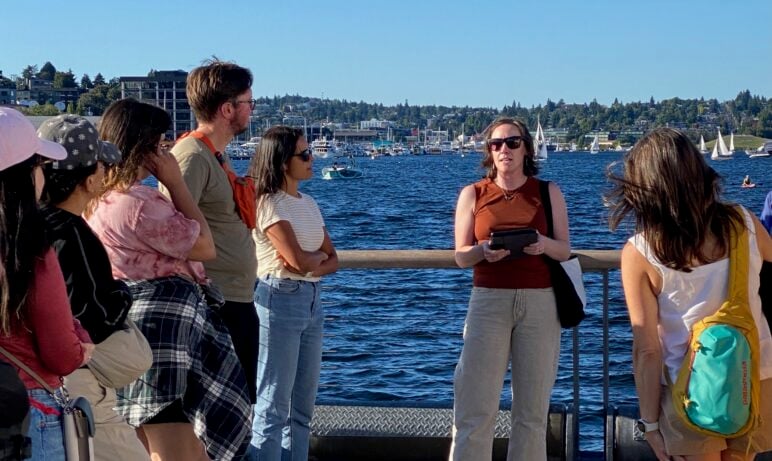
In 2024, I launched a walking tour pilot, iterating between each tour. I found the experience energizing. My research and reporting for both the tour and Future Tides’ coverage built on one another. I met subscribers in person, and new people discovered Future Tides. I’m now leading the third season of tours, with a goal to double attendance again.
Parallel to my work with Future Tides, I serve as the director of digital strategy at KNKX Public Radio, based in Seattle and Tacoma, Wash. Every day, I think about how to meet audiences in digital spaces — and the limitations of those digital interactions.
While public media newsrooms must continue to invest in digital delivery, I also see tours as an exciting and actionable opportunity. Whether it’s local history, arts and culture, or specialized beat reporting, the work of developing a tour starts with your station’s reporting.
Starting small
If adding a new initiative feels impossible, A Tour Guide for Journalists is designed with limited staff, funding and resources in mind. It emphasizes a lightweight, iterative framework using product thinking.
It also outlines a clear distinction between tours and events, which can have high upfront costs and demanding logistics. Before committing to a full-fledged tour operation, make sure it works for your organization and goals by launching a limited pilot.
The guide breaks down this process into manageable components. Here’s what that might look like for a public media station:
- Route: Develop a concise, 60- to 90-minute walk covering four to six strategic stops within a mile or two. Consider top-performing stories, the passions of individual contributors and local geography to identify a compelling location. The guide covers practical strategies for assessing a route’s physical accessibility, transportation options and guest comfort.
- Content: The script is where your newsroom’s editorial expertise shines. A journalism tour is about connecting the past to the present and connecting the headlines to a physical place. Background information that you might take for granted, or as evident, might be perfect for a tour.
- Marketing: Public media stations already have a dedicated megaphone, making it easy and low-cost to promote a pilot tour. Use a combination of on-air promos, email newsletter mentions and social media posts. If your tour is designed to bring in new audiences, adjust your marketing plan to focus on that goal.
The staffing of these tours can also be flexible. While it might be incredibly powerful to have a reporter lead a tour, it doesn’t have to rest entirely on the editorial team. Operations staff, events coordinators, membership managers or even trained station volunteers can lead the walks, provided the editorial newsroom guides the development of the script content.
Take the first step
The modern media ecosystem demands that we think expansively about how we deliver information. Linear broadcasting and digital screens are essential, but they can also be isolating. Gathering in person to look and talk about local news with individuals in our communities is a simple, yet impactful act.
A Tour Guide for Journalists features case studies from a publisher with over 20,000 annual tour attendees, a freelance writer who partners with tour organizers, and multiple independent local news publishers who are experimenting with tours right now. Will you join them?
Public media has all the raw ingredients to deliver memorable, engaging tours all around the country. Visit journalismtours.com, spend a few hours with the brainstorming exercises and start designing your station’s first pilot. Let’s take our reporting, our audiences and our public service mission out into the streets. It’s time to take a walk.
Cara Kuhlman is the founder of Future Tides and leads digital strategy at KNKX Public Radio. A graduate of the University of Oregon, she has edited a neighborhood blog, worked at a tech media startup and was a 2025 Reynolds Journalism Institute Fellow.