
New Illinois law creates firewall between public media, state university licensees
Robert DuBois
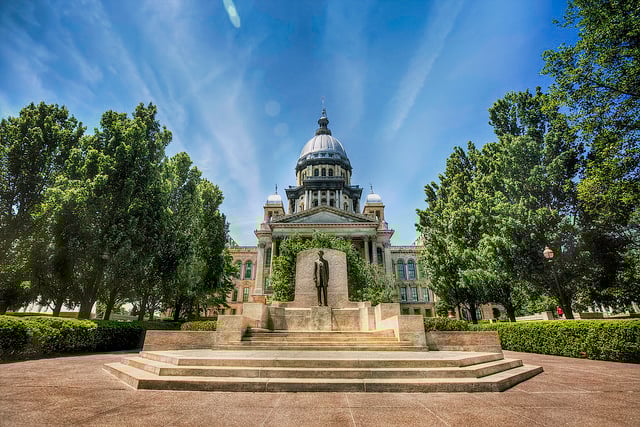
The Ilinois State Capitol in Springfield.
Illinois Gov. JB Pritzker signed a bill into law Friday that provides protections for public media journalists at stations licensed to state universities.
The law revises the state’s College Campus Press Act, which provides speech protections to college journalists, by extending those same protections to public media.
“All public media produced at a State-sponsored institution of higher learning is a public forum for expression by the employees producing the media, including journalists and editors, at the institution of higher learning,” the act now says. “Public media produced at a State-sponsored institution of higher learning is not subject to prior review by public officials of the State-sponsored institution of higher learning.”
Gabe Rottman, VP of policy at the Reporters Committee for Freedom of the Press, called the law “first-of-its-kind legislation to safeguard the editorial independence of public media” in an Illinois Public Broadcasting Council press release.
The law provides legal protection for public media employees if a violation occurs. It also clarifies that content produced by a public media station licensed to a state university does not represent the institution.
The bill was first introduced last year but failed to pass.
Heather Norman, president of the Illinois Public Broadcasting Council and GM of Tri States Public Radio in Macomb, said that no specific incident prompted stations in the state to push for the law but that they saw a chance to ensure protections preemptively.
“There’s no guarantee you’re always going to have a government or administration at your university that understands what the boundaries are,” she said.
She said she believes the law will help bolster the reputation of universities and newsrooms in their communities. “A community doesn’t have to think, ‘Well, they’re not reporting on that because the university won’t let them.’ That is not the case,” she said.
Peter Dominowski, executive director of the University Station Alliance, called the law “a clear victory for the First Amendment and Freedom of the Press for university-licensed stations in the state of Illinois.”
“While we know that laws themselves don’t guarantee compliance in any situation, hopefully this will reduce interference, make people think twice and reduce also any sort of chilling effect that institutions or political figures might want to impose on reporting and journalism at university-licensed stations” in Illinois, he said.
R.C. McBride, executive director of WGLT in Normal, said that “most, if not all, of our colleagues in Illinois” have great relationships with their public university licensees. “But you just never want to take things for granted,” he said.
“It’s encouraging to know that there is a lot of support out there for the First Amendment and for a free press, and for local journalism and for national journalism and for public media,” he said. “… We really did get a lot of encouragement for the work that we’re doing every day.”
Melissa Libert, assistant executive director and development director at WGLT, said a lot of time went into educating lawmakers. “I think we took a lot of things for granted that we assumed the lawmakers knew about our structure,” she said.
She added that stations in other states could take on similar efforts.
“A lot of public media advocacy efforts right now are focused on funding, which is not a bad place to be focused,” Libert said. “And if that’s not a possibility in your state, this is a great thing that you can take the lead on. It’s time-consuming, but it’s valuable work. And even if it takes multiple tries, the relationships and the advocacy work [are] super worthwhile.”
The law takes effect Jan. 1, 2027.