

Nice Above Fold - Page 408
Calif. judge orders Pacifica's ousted leader to end occupation of network's offices
Summer Reese, former executive director of the Pacifica Foundation, was ordered to vacate the network’s headquarters Monday after an Alameda County Superior Court judge sided with the majority of the Pacifica board who fired her in March. Reese’s continued occupation of Pacifica’s national office “constitutes trespass and a nuisance,” wrote Judge Ioana Petrou in her ruling. Petrou ordered that Reese leave Pacifica’s headquarters immediately, as her presence there was impeding the foundation from conducting its normal business. “The Court finds that the current situation is not only far from ideal, but completely untenable,” Petrou wrote. After Pacifica’s board voted March 14 to dismiss Reese, she questioned the validity of the firing and broke into the foundation’s headquarters with a team of supporters.Koch protester takes stage at PBS meeting, gets handcuffed and shown out
PBS staff asked Current to stop photographing as Brant Olson was put against a wall and handcuffed.Subject of ITVS's Invisible War thanks pubTV programmers
Kori Cioca said the film's distributor gave her emotional support after she was raped while serving in the U.S. Coast Guard.

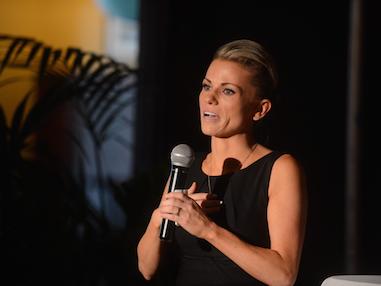
Tuesday roundup: Headlee joins GPB, revamped History Detectives premieres July 1
Plus: A Frontline filmmaker wins a WGBH fellowship, and Wait Wait makes a cameo on The Simpsons.Monday roundup: Tiny Desk Concerts heading to Roku, Carl Kasell's greatest hits
Plus: PBS's retired longtime chief engineer receives a prestigious industry award.NPR names media exec and venture capitalist Jarl Mohn as new CEO
Philanthropist, investor and former cable TV executive Jarl Mohn will join NPR as its new c.e.o. July 1, the network’s board announced Friday. Mohn has served on the board of KPCC in Los Angeles since 2002 and is currently chair. He has worked mainly in commercial media, with a run as g.m. of MTV Networks from 1986–90. From 1990–98 he was c.e.o. of E! Entertainment Television, which he also founded. At NPR, Mohn will replace interim c.e.o. Paul Haaga, who stepped into the role in September 2013 after the departure of Gary Knell for the National Geographic Society. Haaga, who has also served on KPCC’s board, helped recruit Mohn for the job.

CPB fines WJFF $15,000 for open-meeting violations
The Jeffersonville, N.Y. community radio station came under heavy scrutiny after a former g.m. cancelled programs in closed meetings.Pubmedia symposium examines how to define, quantify impact
“Impact” is a feel-good media buzzword of the moment, increasingly required by the funders of many projects and invoked by some PTV stations, news organizations and documentary producers as key to demonstrating the social good derived from their work. But defining the concept and then measuring whether a media project has demonstrated its value remain elusive challenges for many. During “Understanding Impact,” a two-day symposium convened last month at American University in Washington, D.C., participants explored a number of the ad hoc systems for tracking impact that are taking form. Organizations including the Center for Investigative Reporting in Emeryville, Calif., and KETC, the Nine Network of St.With retirement ahead, EP of PBS NewsHour reflects on her start in broadcasting
Linda Winslow rose from covering a fireman's muster in small-town Massachusetts to leading a signature news program on public TV.Friday roundup: WSJ profiles dapper Nippers; PBS unveils fall schedule
Plus: A PBS Kids app helps parents track screen time, and a KUOW story keeps it clean when discussing cow parts.Vermont Public Radio urges Montreal listeners to oppose college station's repeater
A request by a Canadian college radio station to mount a 100-watt repeater in Montreal has triggered stiff opposition from Vermont Public Radio, whose coverage in the market would suffer interference if the signal were approved. The Concordia Student Broadcasting Corporation, a nonprofit connected to Montreal’s Concordia University, operates CJLO 1690 AM. An area near one of Concordia’s campuses receives the AM signal infrequently if at all. An engineer looked for room on Montreal’s crowded FM band to accommodate a 100-watt repeater, which would fill the hole in the AM signal. The proposed signal, 107.9 FM, is also used by VPR’s Burlington station, about 100 miles away.Vermont PTV should be sanctioned for closed meetings, CPB IG finds
CPB’s Inspector General has recommended that the corporation sanction Vermont Public Television in response to 22 open-meeting violations by VPT’s board dating from July 2011. In the May 5 report, IG Mary Mitchelson said that while 17 of the meetings were closed for appropriate reasons, such as personnel matters, the station failed to provide written explanations for why the meetings were not open to the public. The IG’s conclusions were based on interviews of board members who attended the meetings in question as well as an examination of documents detailing what business was transacted, the report said. Following the IG’s recommendation, the decision on whether or how to penalize the station rests with CPB’s management.GPB coming to Atlanta airwaves with WRAS-FM deal
In a channel-sharing agreement announced Tuesday, Georgia Public Broadcasting will expand its public radio service into the Atlanta market starting June 1 via Georgia State University’s 88.5 WRAS-FM. GPB Radio will program the station with a news format from 5 a.m. to 7 p.m., providing Atlanta with its first public radio outlet to air news in midday hours. The city’s WABE, operated by Atlanta’s public school system, airs NPR’s newsmagazines but also schedules classical music from 9 a.m. to 3 p.m. weekdays. “We wanted to bring something that is not currently in the market,” said Bert Huffman, v.p. of development for GPB.Chicago's WFMT to leave Public Radio Satellite System for PRX
The Chicago network cited rising costs of satellite carriage and a desire to expand internationally as reasons for the move.PBS plans digital video service as premium for station members
Public television stations are hoping that special access to a rich library of PBS programs will convince viewers to become members and entice members to keep contributing. The multiplatform subscription program, with the working title MVOD (Membership Video on Demand), will be built atop COVE, PBS’s local-national video site. PBS is backing the initiative with $1.5 million in its fiscal 2015 budget. MVOD will feature past seasons of signature PBS general-audience series and provide stations with the ability to add locally produced series, said Ira Rubenstein, head of PBS Digital. “I think of it as Amazon Prime or Netflix, but only for station members,” he said.

Featured Jobs


Current is an editorially independent, nonprofit service of the American University School of Communication. We're funded by your subscriptions, your donations, advertising, and a generous grant from the Wyncote Foundation.