

Regional newsroom expands collaboration in eastern Kentucky
Justin Hicks / KPR
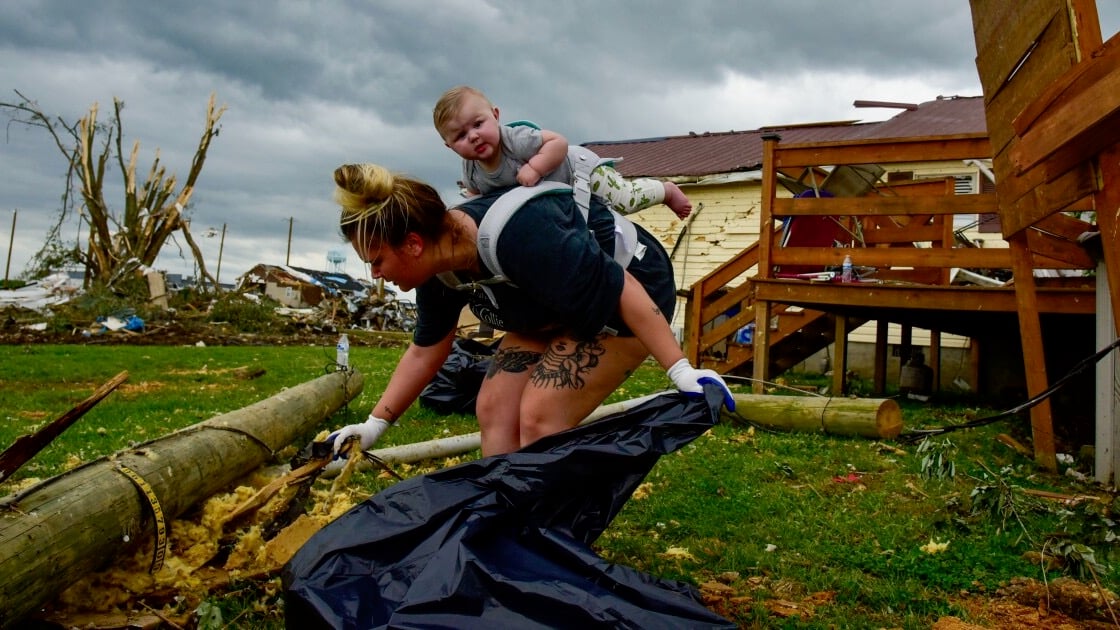
After a tornado swept through Laurel County, Ky., in May 2025, Kaitlyn Robinson picked up storm debris with her daughter, Olivia, strapped to her back.
A news collaboration launched by public radio’s Appalachia + Mid-South Newsroom and two newspaper groups in eastern Kentucky is providing free news reporting to communities that have little or no access to local coverage.
The Appalachia News Exchange includes newspapers within Nolan Group Media and the Kentucky Lantern, a States Newsroom affiliate based in Frankfort, the state capital. AMSN, an NPR collaborative regional newsroom that launched in 2024, includes seven public radio stations from Kentucky, West Virginia and Tennessee.
Exchange partners can republish each other’s news reports on any platform as long as the coverage isn’t paywalled. The newsrooms also plan to collaborate on sourcing and reporting on multi-regional stories. To participate in the exchange, news organizations must be independently owned.

“The Appalachia News Exchange is all about creating a healthy news ecosystem,” said Ryan Van Velzer, managing editor of collaboratives at Louisville Public Media, including AMSN. He also oversees the content sharing for the news exchange. ANE aims to eventually build partnerships in Tennessee and West Virginia.
The initial focus on sharing news coverage across eastern Kentucky was intentional. The Medill Local News Initiative’s 2025 study on the availability of local journalism found that five of the six Kentucky counties with no local news outlet are in the eastern half of the state.
Limited access to local coverage created fertile ground for misinformation to take root and spread in the region. “There’s so much false myth and disinformation out right now and so many things that are being promulgated as truth that are absolute lies and falsehoods,” said Jay Nolan, owner of Nolan Group Media.
He hopes the exchange will help combat this problem. “We are very committed to making sure we tell the truth to the people of the region, and Appalachia News Exchange gives us the opportunity to do that.”
‘Everybody wants more content’
Jeanne Marie Hibberd, director of corporate and community support at WEKU in Richmond, Ky., came up with the idea for a news exchange among outlets in eastern Kentucky two years ago. She realized that “everybody wanted more content, but nobody could really afford to hire more reporters.”

One of her goals was to extend the reach of high-quality journalism produced by Kentucky Public Radio stations into eastern Kentucky communities, she said. The exchange also helps to “get more local voices amplified out to what KPR is doing and what AMSN is doing.” KPR, a consortium of Kentucky stations, also facilitates content sharing and operates a news bureau in the state capitol.
Nolan sees similar benefits for participating newspapers because reporters will get bylines on their stories wherever they’re published.
“It’s going to help newspaper people have more visibility and a larger platform as well,” he said. “But, most importantly, … local news that people need to know will be available to them, that they might not have got any other way.”
‘What funders want us to be doing’
As a regional newsroom within the NPR Collaborative Journalism Network, AMSN aims to strengthen news reporting across three Appalachian states. CPB provided $650,000 in May 2025 to support staff costs for a video journalist, project manager and four shared positions. Its journalists also collaborate with NPR editors to produce coverage for national programs.
AMSN stations include Louisville Public Media; WEKU; WKU Public Radio in Bowling Green, Ky.; WKMS in Murray, Ky.; Nashville Public Radio; WUOT in Knoxville, Tenn.; and West Virginia Public Broadcasting.
Van Velzer hopes to extend opportunities for national coverage to Appalachia News Exchange partners. “We work closely with NPR. Our stories regularly appear on the national airwaves,” he said.
Once the broader news collaborative gets going, he said, it’s reasonable to believe that reporting originating from one of Nolan’s newspapers or the Lantern could eventually be picked up as a national story.

Since the exchange is set up to share stories that participating newsrooms are already producing, it can operate without additional staff costs, according to Kenya Young, CEO of Louisville Public Media, AMSN’s lead station. But the exchange also opens opportunities for pursuing new funding in the future.
“It certainly lends to a coalition that’s willing to think about funding opportunities, perhaps down the line,” Young said. “I do think this is what funders want us to be doing.”
“This is the way of the future for media in general and for how we are going to not only survive but thrive in new spaces,” Young said.
Since the exchange lays the groundwork for deeper collaboration between reporters in the region, it will help stabilize the local news ecosystem overall, according to Hibberd and Nolan. Relationships across newsrooms could help ANE partners cover underreported stories or respond to emergencies, such as the flash floods that swept over eastern Kentucky in 2022.
“We can do things collaboratively we can’t do individually,” Nolan said.