Filmmaker and product developer aim to transform civic journalism with publishing hub
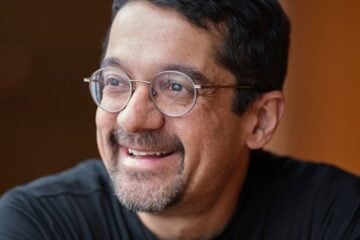
Courtesy of Margaux Maxwell and Arya Surowidjojo
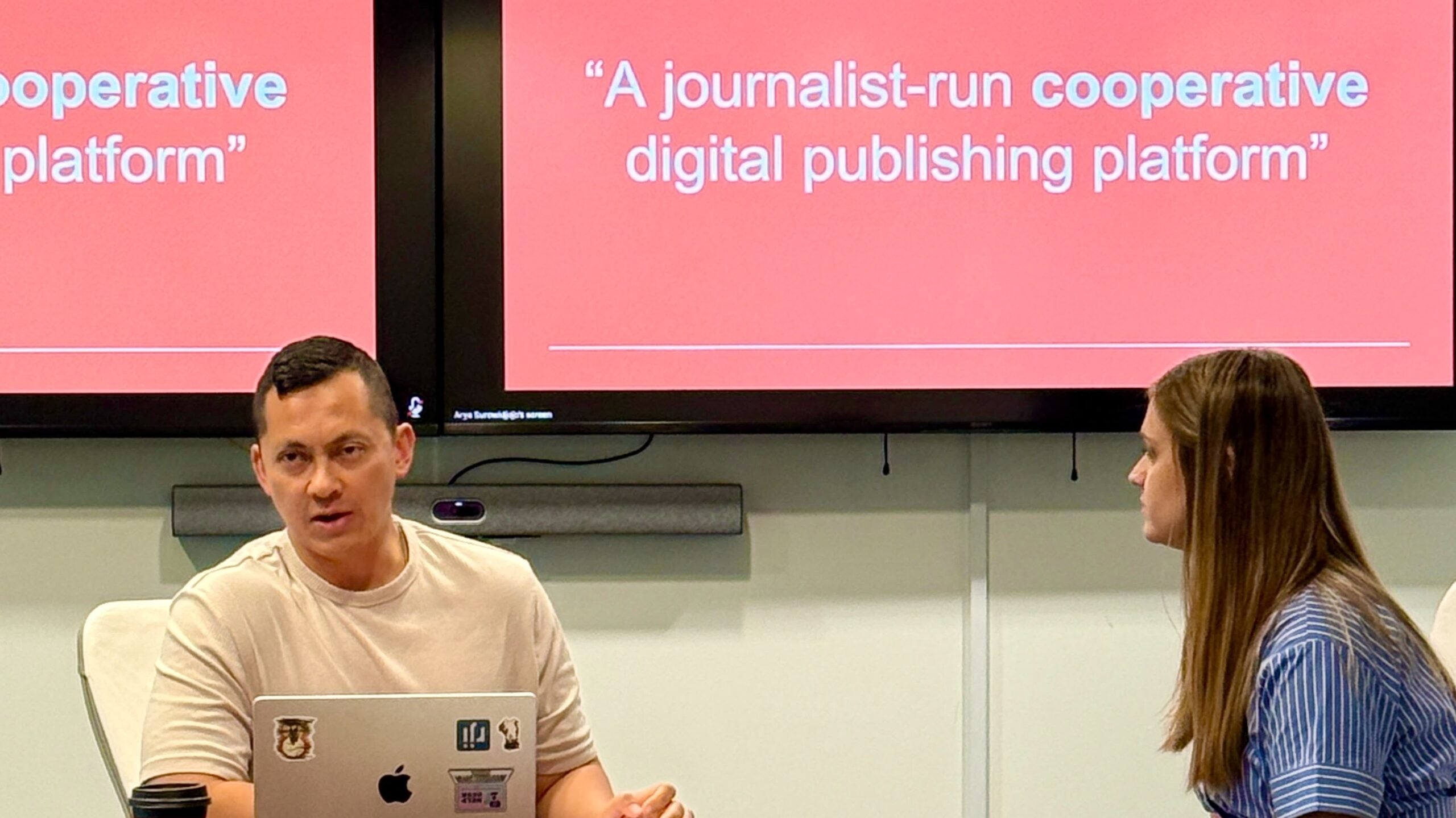
Arya Surowidjojo and Margaux Maxwell speak at the Reynolds Journalism Institute in Missouri June 30.
With help from a fellowship, two public media colleagues have teamed up to build a journalism hub that aims to provide a runway for both seasoned and amateur journalists to produce community-focused reporting.
Margaux Maxwell, director of platform and product for Oregon Public Broadcasting, and Arya Surowidjojo, a documentary filmmaker and EP of OPB’s history series Oregon Experience, began working on the digital publishing hub last month with support from the Reynolds Journalism Institute at the Missouri School of Journalism. The Institute named them RJI Professional Innovation Fellows in May.
The fellowship provided $75,000 for them to build a free open-source platform. Once finished, it will function as a collaborative space for independent journalists and creators to publish their work and benefit from shared infrastructure and editorial support.
Maxwell and Surowidjojo will continue to work at OPB during the eight-month fellowship, which allows them to develop the platform independently of their day jobs.
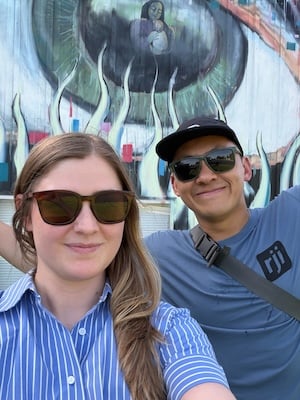
“Our question was, ‘When you step away from a newsroom, when you step away from this support, what do you lose?’” said Maxwell, whose previous jobs include working on local news coverage at the Seattle Times. “How can we provide support to independent journalists as they sort of step away from these support systems? And how do we not make it so that they’re forced to rely then on these corporate publishing platforms like TikTok and Instagram, whose algorithms are not really built with journalism’s values in mind? … Can we provide a safety net somewhere else for this collective kind of infrastructure to thrive?”
“Existing tools address pieces of the problem,” Maxwell said, pointing to Substack and newsletter tools like Beehiiv, but “there is no journalist-owned collective infrastructure, governance, or community accountability altogether. … We’re really trying to take pieces of the puzzle and … put them back together as something that truly is built for journalists specifically.” Their plan also calls for creating a shared layer for publishing that allows journalists to publish on their own domains.
The pair aim to work in phases, developing the platform and then testing it with a small group of independent and creator journalists, Maxwell said. Once piloting is done, they’ll assess what’s needed to proceed to full launch.
Inspired by public media futurism
Maxwell and Surowidjojo trace the inspiration for their idea to the 2024 Public Media Development and Marketing Conference in San Diego.
During the opening session of the conference, NPR CEO Katherine Maher spoke about public media’s role to create a “common civic fabric” that encourages constructive discourse. Her remarks lit a fire under Surowidjojo, he recalled. He began asking big questions about public media’s purpose, what audiences want and how public media could transform itself as a system.
Surowidjojo and Maxwell began talking about the future of public media over a meal at a Joe’s Crab Shack. The conversation expanded into their concerns about what was happening to the larger news media ecosystem. Would legacy media organizations survive the waves of consolidation, newsroom closures, hedge fund ownership and layoffs? If they can’t, who or what will emerge as the primary source of news and information in communities?
“We’re being asked — those who are working within the public media ecosystem — to think about public media futurism,” he said, referring to Maher’s appearance at the PMDMC. “We need to reimagine public media’s form and function — but through the lens of its original mission. It’s empowering citizens, it’s amplifying different voices and serving as a vital civic hub. But what does that look like now?”
The algorithms on digital platforms feed people the news, but it’s not always what they need or want to see — much less trust. Creators also face the threat of demonetization on social media sites. The pressure to build and engage audiences directly and indirectly influences the news content they produce and share.
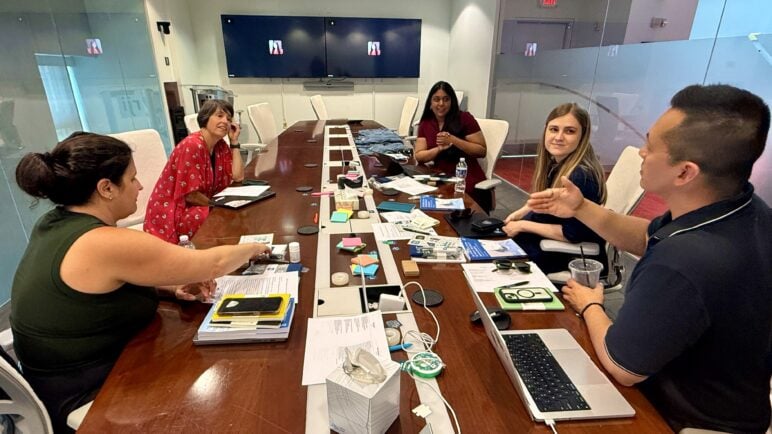
Maxwell said her experience in local newsrooms got her thinking about creating new ways for more people to report and share news about their communities — and be supported in that work. She saw an opportunity for “public media to really be a big player in the solution to this problem,” she said. “Public media is in such a strong position when you look at the ecosystem overall. I think it’s often overlooked as a potential driver of new sustainability … because … it has historically been so much more than news and journalism.”
Features planned for the platform include optional editorial mentorship, peer review of reporting and legal risk review for journalists working on complicated stories. Additional resources include tools for secure document management and Freedom of Information Act tracking, and guidance and support for physical and digital safety planning.
“Following user surveys, our goal is to first identify how we can seamlessly integrate editorial and legal support into the platform,” Surowidjojo said. He and Maxwell will then determine whether tools will include things like direct connections to attorneys with media expertise.
Open to all types of journalism
Maxwell and Surowidjojo have discussed their ideas for the platform with OPB colleagues and they initially conceived of the hub as a resource for journalists within the Pacific Northwest. But with the RJI Fellowship they are thinking of national and even international reach.
Though they’re developing the platform independently from their work at OPB, “there’s definitely opportunity for integration with OPB” and other regional news organizations throughout the country, Maxwell said.
Maxwell and Surowidjojo continue to think about big questions that will guide development of the platform, such as who qualifies as a creator journalist and how much training and support will be needed for a journalist to publish their stories. The proliferation of “news influencers” who lack traditional journalism credentials yet deliver news analysis to loyal audiences on YouTube and Patreon has opened up a whole new path for independent creators. The developers also want to create a collaborative space for citizen journalists.
“On our platform we definitely want to welcome all types of journalists and journalism,” Maxwell said. “And that includes, you know, people who are living in their communities and say they want to hold power to account in their neighborhood.”
“We do want to have some guard rails around what is and what is not allowed on our platform,” she added, pointing to criticism about Substack. The platform has come under scrutiny for contributors who distribute white supremacist and extremist content.
“We do want to have some sort of application process, but we definitely want to be much more expansive in the way that we are thinking about journalism,” Maxwell said.
Surowidjojo described his “untested conviction” that public media’s future should be centered on creating “radical accessibility for anyone with a clarity of community service purpose and a sense of the audience they want to hit.”
“If not public media, who will create a funnel for an individual who’s not a trained journalist [but] has something to say that they think might better their community?” he asked.
The goal is to get people who care about the places they live in to stop thinking, “I’m not a journalist” when they see something. The platform aims to bring these people into the media ecosystem so they can participate.
‘Decentralized newsroom model’
TikTok, YouTube, Instagram, LinkedIn and other social platforms each have their own rules for content that’s good to go — or not.
“If I am an independent journalist holding power to account and my work lives primarily on Instagram, for example, Meta can decide it does not like what I publish and deplatform me overnight,” Maxwell said.
Since journalists will own what they publish on the collaborative platform, Maxwell and Surowidjojo mulled over whether they need an official publisher to provide guardrails ensuring that the reporting is above board.
The platform is “meant to be a decentralized newsroom model,” Maxwell said. “This is not meant to be an institution in any way.” Focusing on whose name is in the masthead would be the wrong play. “When we look at community trust and the way that community trust is moving,” eschewing such traditional norms is very important, she said.
Still, she recognizes that “securing community trust is going to be a big … area of research for us.” Operating without a masthead means that “we’re starting with no trust. How do we build that?”
One solution is to partner with organizations that can provide guidance on legal resources, such as FOIA requests. “We will absolutely be in deep partnership with many, many entities,” Maxwell said. “And then we could even have some kind of situation where this is like RSS- or feed-based somehow … where news organizations are getting this content onto their platforms.”
Looking ahead to the user testing phase that will wrap up the fellowship, Surowidjojo said he’s intensely curious about what the pair have yet to learn. “That might take us off in a direction that we didn’t think needed considering, but actually becomes a crucial component of this,” he said.