
Ex-NPR colleagues team up on podcast about cannabis and aging
Robert Vye
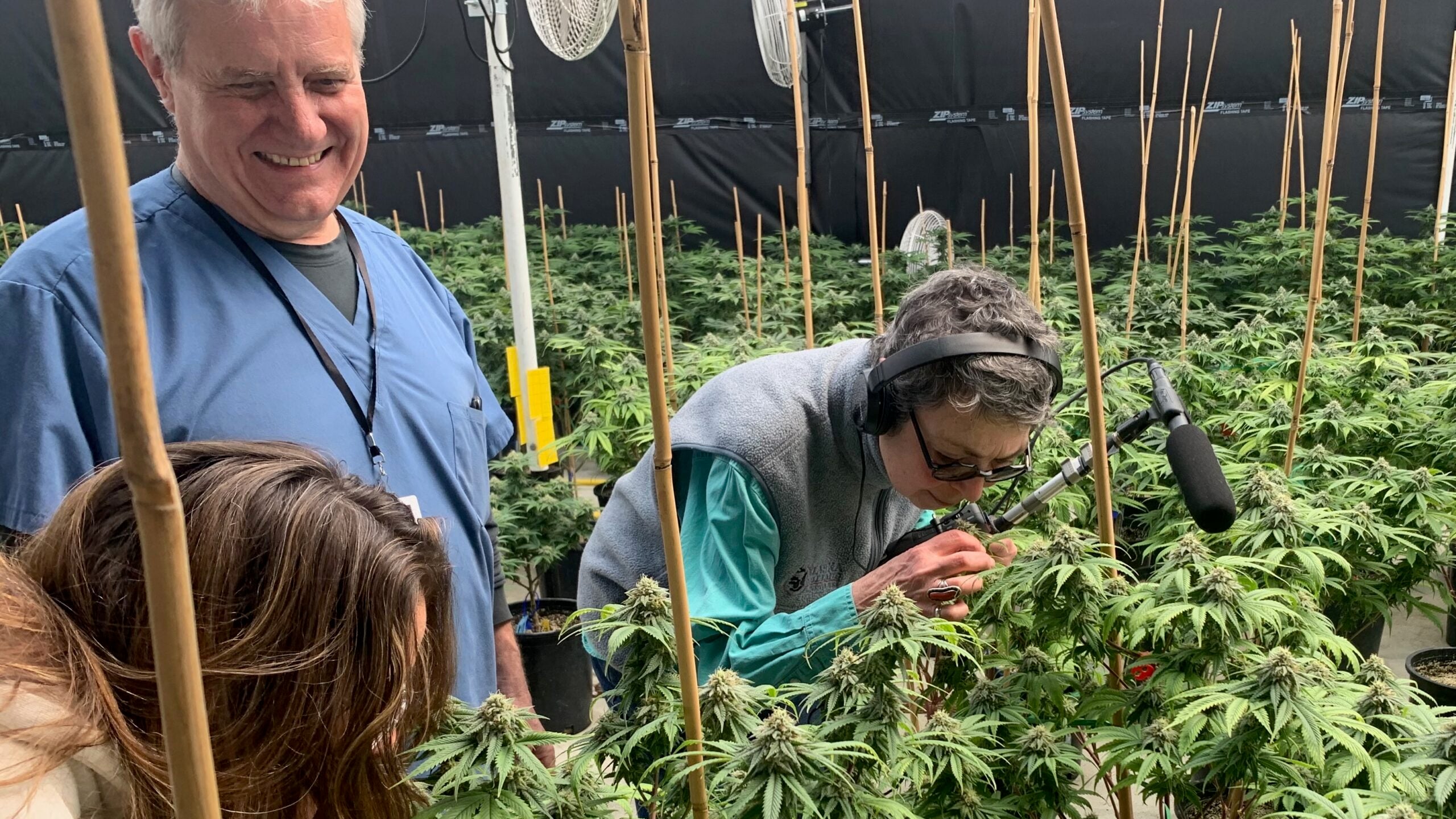
Karen Michel examines plants at Hudson Valley Jane, a cannabis farm in Ancram, N.Y.
A former NPR freelancer and the editor she worked with for 30 years are collaborating on a new podcast exploring cannabis use among the AARP set.
Ganja Granny is the brainchild of veteran independent producer Karen Michel. It’s being edited by Tom Cole, who was a senior editor on the network’s arts desk. Michel worked with Cole from when he started on the desk in 1991 until his retirement in 2021.
“I’m at the point in my life where I wanted to do a project that matters to me,” Michel said. “It was like, ‘This is what I was destined to do. And if not now, when?’ I just feel the doors are open and the cuffs are off. I’m going to have a good time with it.”
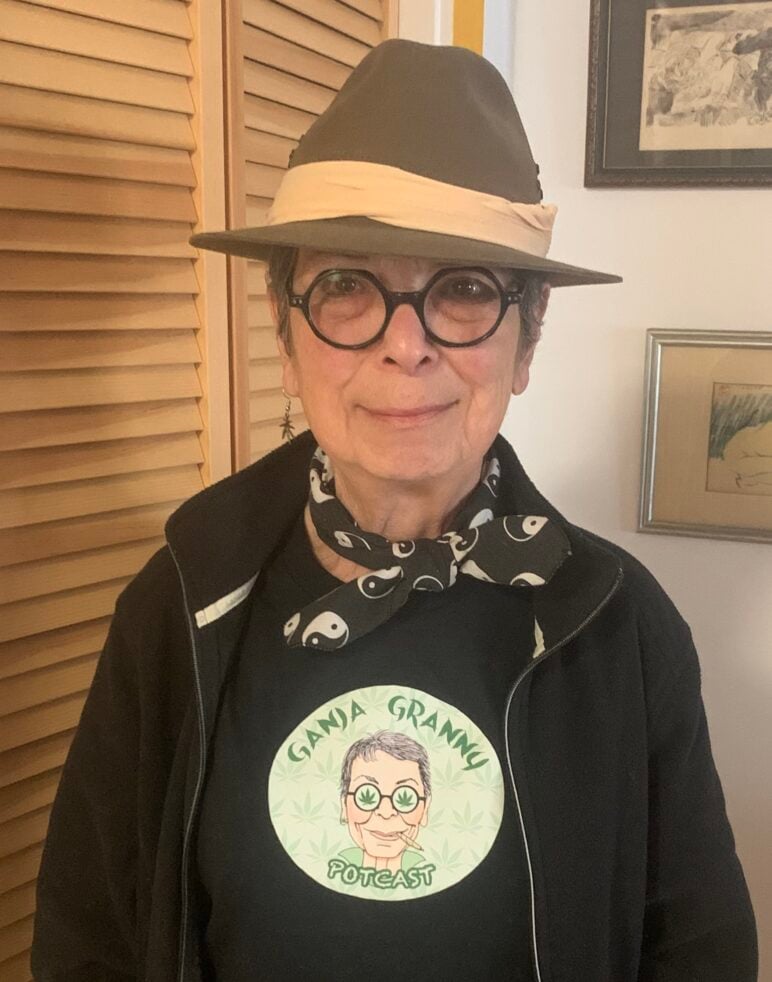
A self-described audio anthropologist, Michel’s decades-long career in public radio includes stints as a Fulbright Fellow and a National Endowment for the Arts Media Arts Fellow. She has taught at Columbia’s Graduate School of Journalism and Duke University’s Center for Documentary Studies.
Michel has long identified herself as a journalist and an artist. Her undergraduate degree is in studio art, and she has exhibited her photography and drawings in the U.S. and England. Although she has occasionally worked as a consultant on podcast projects and produced a podcast series for the New Age-y Omega Institute of Holistic Studies in Rhinebeck, N.Y. Ganja Granny is Michel’s first solo podcast.
Michel lives in Beacon, N.Y., in the Mid-Hudson Valley, where she grows her own cannabis. Medical marijuana was legalized in New York in 2014, seven years before recreational weed was decriminalized. She was one of the early recipients of a New York state medical marijuana card, qualifying as a result of her diagnosis of fibromyalgia, a chronic disorder affecting the brain and spinal cord that results in pain and fatigue.
But Michel became a cannabis enthusiast long before her fibromyalgia diagnosis 40 years ago. She started smoking weed at the age of 16.
“I think cannabis is wonderful for its curative properties,” Michel said, quickly adding, “I’m not opposed to getting high, God knows.”
Not your grandfather’s cannabis
The idea for the monthly 15-minute podcast arose at a dinner party. “We were eating, drinking wine, smoking weed, and somehow the podcast came out of that,” Michel said.
Michel said she wanted to focus on older cannabis users because the plant has proven effective in treating maladies such as insomnia, discomfort from menopause and lack of sex drive. She said there are a myriad of issues worth exploring through Ganja Granny.
“Cannabis has changed hugely since we were kids, and old folks need to know that,” she said. “The higher THC content may actually have an advantage because less can be consumed and then smoke inhalation will not be as problematic. There are a huge number of different strains of cannabis that do different things. There are different means of consumption, and they affect you in different amounts of time. Older people need an education, and I’m trying to provide a kind of crash course for people.”
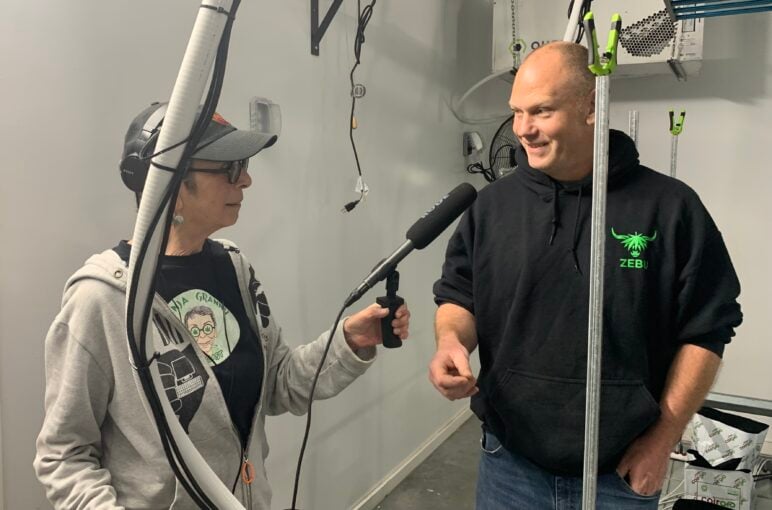
The first episode of Ganja Granny takes listeners to a growing facility and cannabis dispensaries. It explains aspects of selling weed, such as pricing and weights. We hear from dispensary owners, dispensary employees, cannabis customers and a former emergency room doctor who now has a cannabis medical practice.
The physician, Dr. Ken Weinberg, has been using cannabis to treat elderly residents of assisted-living facilities suffering from dementia. He tells Michel that a lot of his older patients grew up amid the “reefer madness” scare about the drug’s supposed dangers and don’t want to get high.
One dispensary owner describes how she turned to cannabis to stimulate her appetite while undergoing chemotherapy. The pathos is balanced by laughable moments, including one in which a cannabis entrepreneur explains that using low-dose marijuana edibles helped her “stay married and not strangle my children.”
Ganja Granny strives to convey the degree to which cannabis has entered the mainstream. Michel reports that older customers are the fastest-growing segment of cannabis consumers, citing an AARP study that found one in five people over 50 have consumed cannabis in the last year. A budtender she interviews informs Michel that the pediatrician who took care of him when he was a kid is now a cannabis advocate.
Michel is clearly an insider in this scene. When she explains that the buds are the part of the marijuana plant that is smoked, she describes buds displayed at a greenhouse as “kind of hard, a bit springy and mighty sticky.” Then she relays that she licked her fingers after handling them.
Reporting, not evangelizing
Michel parted ways with NPR in 2022, one of several veteran freelancers in their ’70s whose work with the arts desk dried up after Cole’s departure. She had kept in touch with Cole and told him in an email that Ganja Granny was underway.
“I said offhandedly, ‘Well, if you need an editor …’ and she said, ‘Really?’” Cole recalled. “She asked me, what I would charge? And I said, ‘I’d do it for free just because you’re a freelancer and I have a retirement account.’ Not that I couldn’t use the money.”
Cole has been volunteering as a literacy tutor for kids and fixing up the home in Washington, D.C, he shares with his wife, NPR correspondent Elizabeth Blair.
The podcast’s big challenge, as far as Cole is concerned, will be to ensure that the content is accurate and that Michel doesn’t cross the line between reporting and evangelizing. He aims to keep it “reportorial and up to her standards — and mine.”
“Despite the funny name for the podcast, Karen is approaching this as a serious reporter,” Cole said. “She wants it to be fact-based, and she knows a lot. She knows far more than I do. Every time I see an article about cannabis in the newspaper or online, I read them. I’m going to continue to try to be a good editor.”
Asked whether the first episode sounded like it could have been an NPR piece, Cole replied: “That’s what I liked about it. It’s a reported piece with multiple interviews. She went to multiple locations and set up several different scenes using sound. It could have been an NPR piece.”
But the conclusion of the first episode doesn’t sound like NPR. It ends with what Michel referred to in her script as a music sting, a singer belting out the line “Ganja Granny wouldn’t lie, but she might get high on her own supply.”
Michel said she expects the second episode of Ganja Granny to drop June 1.