
New donor surge brings generational shift to pubmedia fundraising

Ralf Hahn / iStock
Public media has experienced unprecedented new donor growth in 2025, particularly during periods of increased attention on federal funding. The year-to-date increase through August in new donors was 61% compared to the same period in 2024.
After several years of flat or declining new donor counts, we wanted to find out more about these new donors in time to think about engagement strategies now and retention in 2026. And boy, did we ever.
Working with data from the 50 public media organizations in the Members Services Bureau fundraising co-op, we were able to perform an in-depth demographic analysis of 180,000 new donors acquired since Jan. 1 across all station sizes and licensee types.
Jumping right to the chase, Millennials are on the rise and on the move.
Boomers and Silents continue to make up the greatest share of new donors in 2025, but their slice of the pie is declining from two-thirds in previous years to just over half in 2025. Gen X, Millennials and Gen Z are all on the rise. The percentage of new donors that were younger than 45 (Millennials and Gen Z) nearly doubled from 13% in prior years to 24% in 2025.
While Boomers made up 41% of new donors to public media in 2025 (Jan–Aug), their first-gift amounts represent 46% of all first-year revenue.
This, of course, is most likely related to income and life stages. Focusing on the youngest donors coming into the donor files, here is a breakout by income.
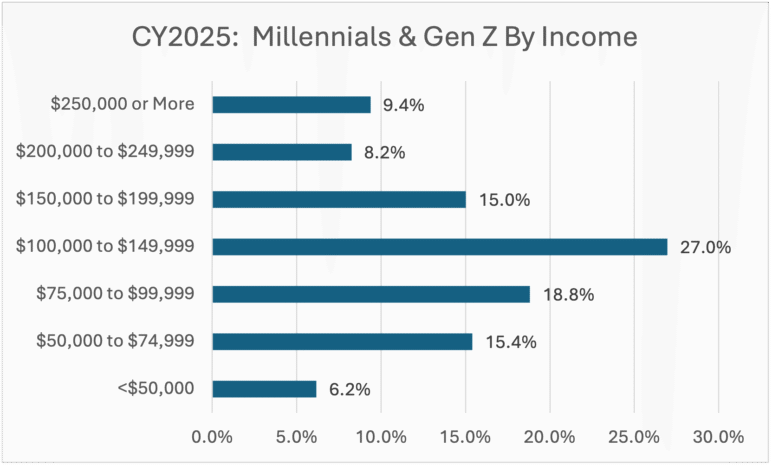
It is not surprising to see smaller average gift sizes for one-time and sustainer gifts for our new Millennial and Gen Z donors. These generations have yet to reach their top earning potential and are likely in the thick of student loans, mortgages and childcare expenses.
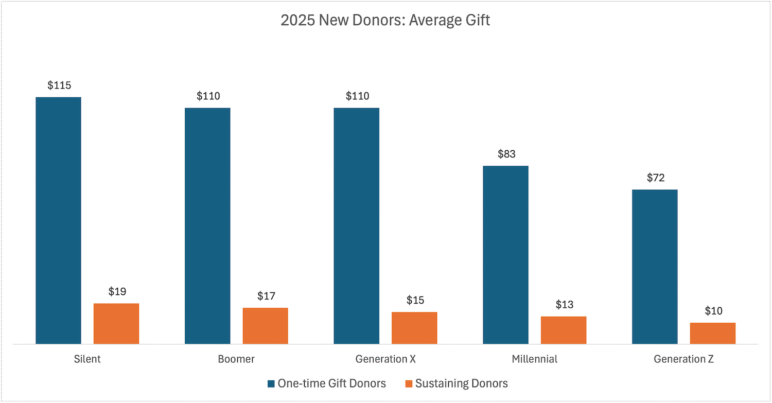
Note that one-time gifts from Gen X are in line with their Boomer siblings. Gen X donors are now between 45 and 60, with many in or heading toward their prime giving years. How does this inform your interactions with this generation?
And those Millennials are on the move. Two-thirds of our new Millennial donors have been in their current residence for less than three years. Are they recent transplants to your area? New home buyers? All things to consider for potential events and current giving potential.
The revolution may be televised, but the reactionary giving is online
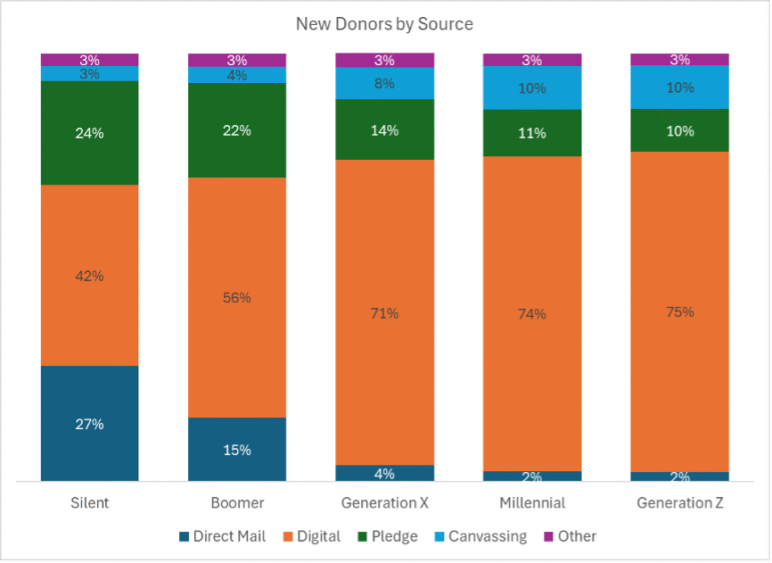
Much of the increase in new donors in 2025 is likely attributable to the loss of federal funding. Like other crisis giving in the last decade, online giving saw the sharpest increase. The share of new donors acquired online doubled in 2025.
For Gen X, Millennials and Gen Z, more than 70% of all new gifts in 2025 were made online. If we include gifts made online during a pledge drive, it approaches 80%. Also important: Pay close attention to the small share of younger donors giving at all during pledge drives in 2025.
A deeper dive into Passport viewing data for the TV and Joint licensees in our study shows a marked increase in activations and viewing among these younger cohorts. However, the difference between the rates of activation and streaming is wider. Both data points stress the importance of programming choice that includes the interests and tastes of younger viewers.
Monthly giving even more popular with younger donors
Donors younger than 61 are much more likely to make sustainer gifts, with over 55% of Millennials and Gen Zs making sustainer gifts in 2025.
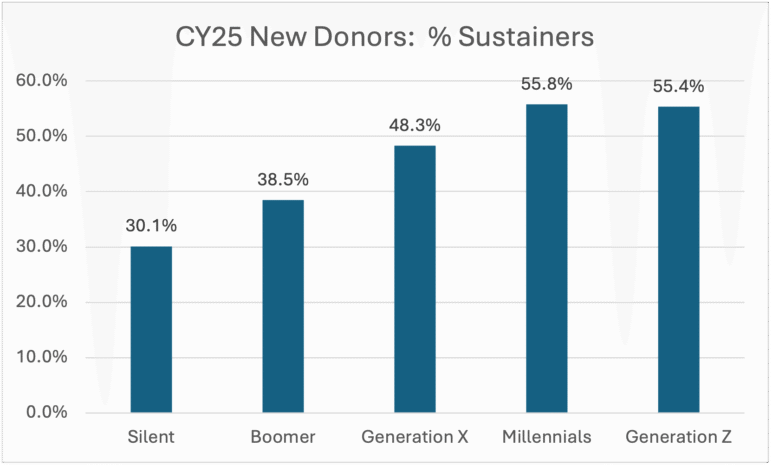
That means we should be able to retain these donors for years to come, especially if we focus now on engagement. Quality engagement starts with knowing who your donors are. (For more on retaining reactionary donors, see our blog post from June 30.)
How’s your TikTok game?
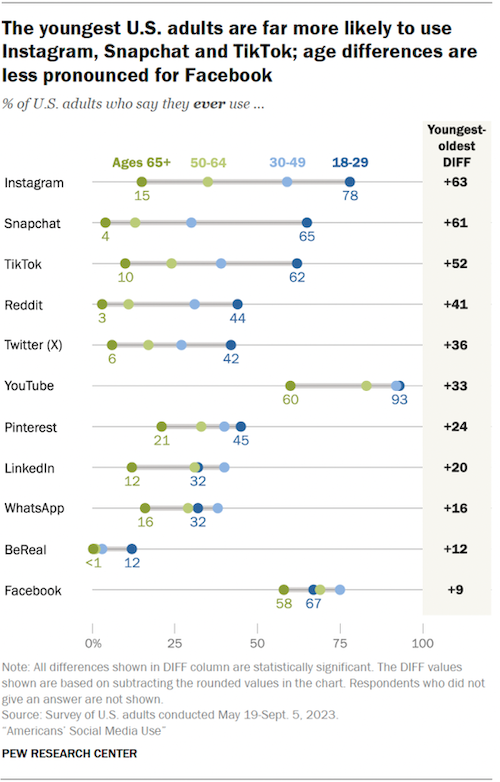
If you’ve ever seen a human being of any age anywhere, you don’t need me to tell you the importance of social media in 2025. Mastering social media is key to being front and center with your current and potential donors, especially your new, younger, highly connected donors of 2025.
See this chart from the Pew Research Center to get a sense of the most popular social media apps for younger people and consider how many videos your organization has posted today.
Much has been written about the new era in which public media suddenly finds itself. We think this analysis sheds light and hope on what the future may look like as this new generation takes on the mantle of supporting noncommercial local journalism and content. We’re excited to welcome them by meeting them where they are and getting to know them better.
Deb Ashmore joined CDP as Analytics Strategist in September 2023. With more than 25 years of experience in the nonprofit sector and public media fundraising, she is passionate about working to help clients understand their fundraising data to inform strategies for long-term file health and growth. Her previous public media experience includes 10 years as director of individual giving for WXPN in Philadelphia.
Jim O’Shaughnessy has spent the last 15 years in fundraising analyzing trends and creating products and services aimed at providing insight via data analytics and reporting. Jim co-developed the Blackbaud Index of Charitable Giving and the Target Analytics Campaign Optimizer. He has been with CDP since its inception while working as a senior developer under Chuck Longfield at Blackbaud. Jim holds an undergraduate degree in business from Boston College and a master’s of science degree in computer information systems from Bentley University.



One can reasonably assume that if a gift comes in during the days of a pledge drive, that the drive itself was at least some part of the reason WHY the gift was made at that time. I know full well the drive can be, and undoubtedly often is, the final little nudge that is at the end of a long chain of reminders…some subtle, some less so…to listeners that they should donate. But nevertheless, it’s not wrong to say “this donation happened now because the pledge drive is happening now.”
That chart would seem to blow that assumption away for anyone GenX or younger. Over three-quarters of all donations are coming in online. My question is: WHEN? Or more precisely: can we use WHEN the gift arrives to divine, in whole or in part, WHY the gift was made?
That fact that the gift came in online is, by itself, virtually meaningless. Of course it came in online. For anyone GenX or younger, things you buy outside of a brick-n-morter store? You buy them online. You don’t *call* in a purchase, much less a donation. However, the exact mechanism (and the chain of events leading up to it) by which the donation was made online does matter a great deal. E.g. if a donation was made on a station’s website, but it got to the website via a trackable link in an email newsletter? That tells a great deal about “when”, and even more about “why”. Best of all, it opens the door to A/B testing. That’s all highly relevant information!
My friend and colleague Ann Alquist taught me, years ago, that no matter how much everyone professes to “hate the pledge drive?” Public radio will keep doing drives until they stop being the most efficient and most effective (I’m using those terms very specifically) way of getting listeners to become donors, and way of getting donors to give on a schedule.
I think the last five years have shown that’s becoming increasingly less the case. Therefore it matters a lot to determine what the replacement primary vector will be for the pledge drive, and how quickly/slowly we should be phasing pledge drives off of the airwaves.