

‘Reveal’ finds new footing with faster, timely reporting
Reveal
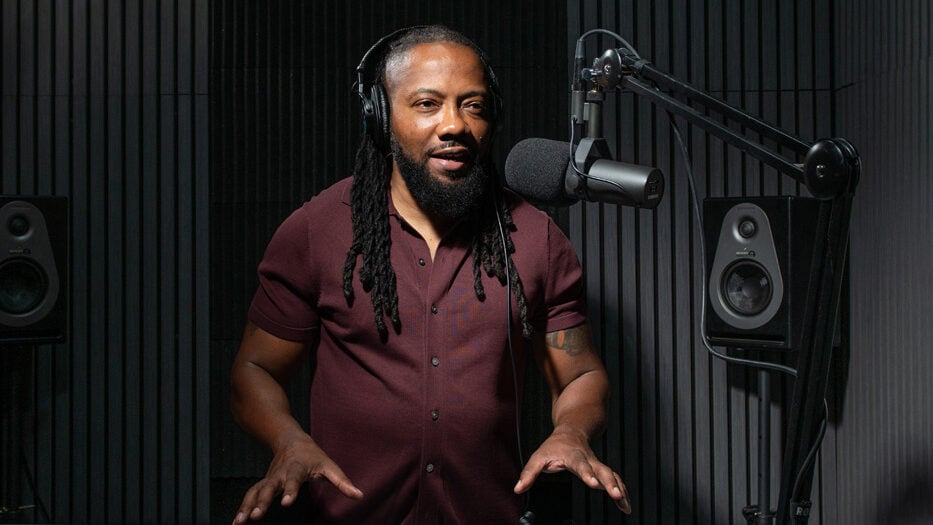
Al Letson hosts "Reveal" and "More to the Story," the companion podcast that debuted last year.
Three years ago, Reveal faced an existential crisis.
The award-winning weekly investigative radio show and podcast had consistently increased listenership year after year since its 2015 launch. But financial troubles, leadership turmoil and multiple rounds of layoffs at Reveal’s parent company, the Center for Investigative Reporting, left producers unsure whether the show would survive.
“It was a survival-based period of our lives,” said EP Brett Myers.
Then a lifeline came. In 2024, a merger with Mother Jones expanded the show’s reporting resources, supporting a greater emphasis on meeting the moment and the introduction of a new weekly podcast. Reveal is now seeing audiences grow across both its broadcast show and podcast feed.

“We’re doing better now,” Myers said. “We’re growing again, and that’s really exciting.”
With its refinements and new elements, Myers said, Reveal is helping public radio listeners better understand world events. “We’re really finding our footing as a place to go and understand what’s happening now — not the sort of latest headline news — the context behind the now,” he said.
Eric Teel, program director of WFAE in Charlotte, said the program performs exceptionally well on the station’s schedule, attracting and retaining listeners since shifting to Sunday afternoons three years ago. The show’s investigations and commitment to uncovering “the truth for the American public” are valuable to audiences, Teel said, which its performance reflects.
“It’s doing very well, relatively,” Teel said. “I love it. I put a lot of stock in listenability to our programs.”
‘A ton of stress’
The Center for Investigative Reporting had endured financial strain starting in 2018, but the situation became more dire starting in 2022. Tax filings show that CIR experienced a net loss of nearly $2 million from 2022–23.

The challenges stemmed in part from the difficulty of supporting investigative journalism. “We get most of our money from foundations, but when you’re doing investigative journalism, a lot of times the big corporations are going to be your targets, so you’re not really getting a whole lot of donations from those places,” said Al Letson, host of Reveal and More to the Story, its companion podcast that launched last year.
Meanwhile, CIR was enduring repeated CEO turnover and the departure of key figures. In August 2022, CEO Kaizar Campwala resigned just seven months after taking the job. His departure came after CIR staff reportedly sent a letter of no confidence to the board citing doubts about his leadership abilities. The organization had cut 18 positions under his management.
CIR’s board appointed former executive director Robert Rosenthal as CEO to replace Campwala. But the layoffs had “decimated” the organization’s workforce and almost eliminated Reveal’s editing and production department, driving some staff to leave in search of “more stability,” Myers said.
“There was a ton of stress,” he said. “From month to month, we didn’t know if we would be here the next month.”
The Foundation for National Progress, which publishes Mother Jones, completed its merger with CIR in February 2024, integrating the organization’s newsrooms. The merger and Rosenthal’s leadership saved Reveal, Myers said.
“Were it not for him, and were it not for Mother Jones, which has been incredible, we wouldn’t exist today,” he said.
‘Moving where the news is’
The merger with Mother Jones also presented a solution to challenges posed by the shifting media landscape of the late 2010s and early 2020s. The intensifying news cycle threatened to dilute the impact of Reveal’s investigations, Myers said.
“It meant that when we would be done with the story that we spent a year on, the world was wherever the world was,” he said. “It was hard to meet the moment when all of our stories were deep dives.”
Reveal hit the ground running after the Mother Jones merger was finalized, Myers said, with the 2024 election underway. The merger expanded the show’s access to reporting resources, which “strengthens our sourcing, sharpens our angles and improves our news sense,” he said.
This gave the show more bandwidth to be “as timely and relevant as possible,” Myers said. With the news cycle moving “faster than at any point” in Myers’ career, Reveal’s team put greater emphasis on meeting the moment week to week while staying true to the show’s “deep investigative roots,” he said.
That has involved a streamlined editorial process, quicker decision-making and “being ready to turn around episodes on a much tighter timeline,” which could mean reporting full shows within one to two weeks, Myers said. These “rapid-turn” episodes give audiences “the context they need to understand major news events,” he said.
“What’s different now is the regularity with which we’re hitting the news,” Myers said. “… We have to be relevant to our audience, and we have to provide value to them and to the stations that air us.”
Though the team had always produced rapid-turn episodes, the modern news landscape demands more. Three of the first dozen Reveal episodes produced this year followed tighter production schedules, Myers said. Topics have included the immigration raids in Minnesota, the United States’ capture of Venezuelan President Nicolás Maduro and the war in Iran.
The emphasis on timeliness also led to the creation of More to the Story, an interview-based podcast that updates Wednesdays in Reveal’s podcast feed. The show features Letson in one-on-one conversations with various guests, a format that he said presents another opportunity to address developments in the news week to week.
“With More to the Story, it can be quicker, it can move faster,” Letson said. “If something is in the news, we can talk about it quickly. What we’re doing now is that we’re just moving where the news is.”
In addition to emphasizing relevancy, Myers said the team has tweaked Reveal’s tone. He said that the often “depressing” nature of the topics covered resulted in many episodes being “too heavy.”
Balancing tone within episodes by injecting “more lightness” makes for easier listening each week, Myers said. The team also began a series of “inconsequential investigations” in October, featuring in-depth dives into staff members’ personal questions and mysteries.
“Our hearts are as big as anyone’s, and I think that we’re really good at delivering on the heart,” Myers said. “These are slightly dehumanizing times, so it’s really important to do human-centered reporting.”
Furthermore, Myers said, the team has begun introducing more episodes broken into segments. Those shows covering multiple topics offer variety and help the show be “more listenable,” he said.
“It also asks a lot of the listener to sit with one thing for that long, so intensely,” Myers said. “It’s good for stations too, because broadcast listeners are in and out … and they’re only hearing part of it. You need to give them really good on-ramps back into a story.”
‘Context behind the now’
Metrics show that the changes to Reveal are resonating with listeners, Myers said. The show’s cume audience grew 15% to 845,000 from fall 2024 to spring 2025, according to Nielsen data. Downloads on its podcast feed have grown by 70% since the debut of More to the Story.
“What it says is, we got it right,” Myers said. “We’re delivering something of value.”

WFAE’s Teel said that the station’s 2 p.m. Sunday slot is typically “not a phenomenal time for massive audiences” but that Reveal has performed well there. The show was Sunday’s second most–listened-to program last July, behind only Weekend Edition. Reveal is also retaining audience better than many shows in the station’s Sunday lineup despite dips in overall listenership last summer and fall, Teel said.
“The biggest comment I hear about Reveal is the appreciation of the depth of reporting,” he said.
KALW in San Francisco airs the program Mondays at 5 p.m. Executive Director James Kass said the show is among the station’s most popular news and talk programs.
“It has an interesting approach … which is something we really like,” Kass said. “We want to give our audiences opportunities to really dive deep into issues. As a station, we do not break news. We cover the impact that news has, and I think Reveal does a great job at that.”
Answering the call
Moving forward, Myers said he expects to introduce more collaborations between Reveal and More to the Story. An episode of Reveal last month that originated as a More to the Story episode featured Letson in conversation with Black journalists about the erasure of Black history and the Trump administration’s attacks on DEI initiatives.
“The interviews … felt perfectly at home as an episode of Reveal — one that was original for our listeners and prominently featured Al leading conversations in a way that only he can,” Myers said.
Letson said he sees an opportunity to engage in more on-the-ground reporting with More to the Story. He said the show will evolve with the rapidly shifting media landscape.
“We live in such a fast-moving world that the great thing about More to the Story is that it can answer those calls,” Letson said. “Wherever that takes us is where I want to go.”
Myers said it’s likely that More to the Story will expand into its own podcast feed and potentially into broadcast, which would “offer a lot of new growth.”
“People are going to be able to find it. It’s going to help with search,” Myers said. “That show could eventually find a broadcast audience. Half-hour weekly shows are tricky on a broadcast clock … but we’re hearing from some stations that there’s interest in us offering that as a broadcast product.”
For now, Letson said the team is committed to “not only telling the right story, but that we’re telling it accurately.”
“In a world full of lies, AI and all sorts of crazy stuff, the truth is getting harder and harder to find, and I think that we are one of those places where you can find it.”