
How KQED tapped classroom media to bring youth voices to drive time
Martin do Nascimento / KQED
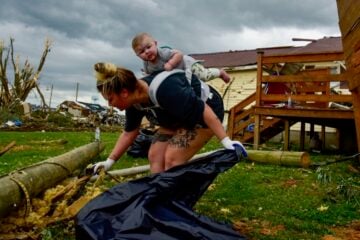
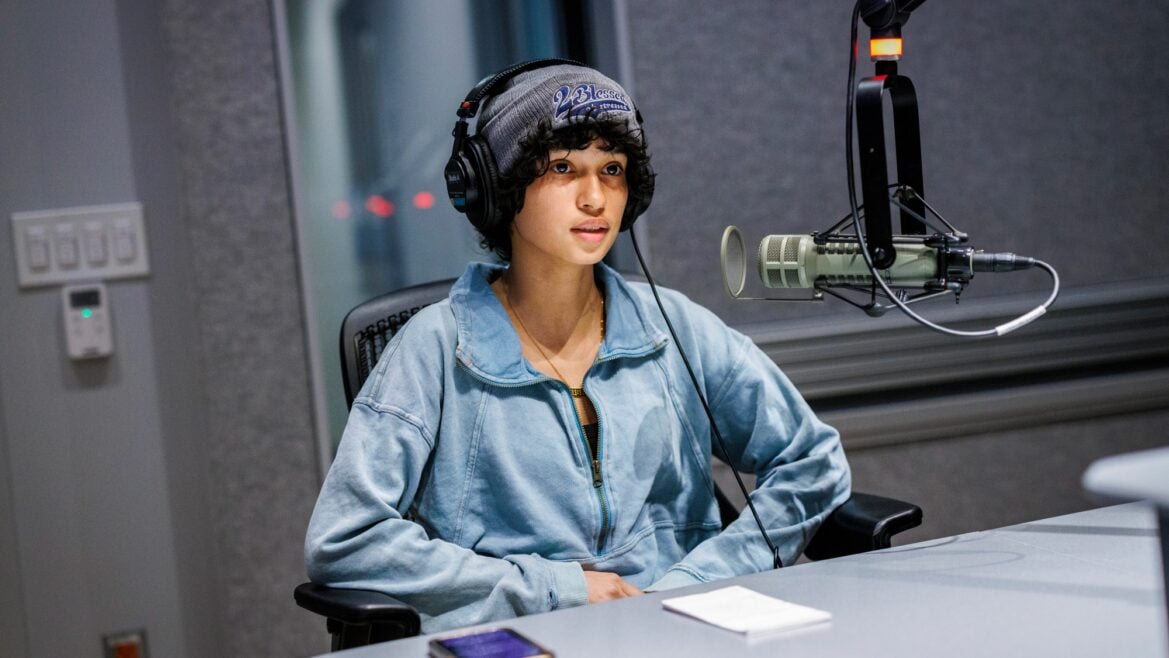
Eumari King Perez, a student whose “Podcasting Democracy” submission was featured on-air, sits for an interview at KQED in June.
When budgets are tight, building a youth production system can be difficult. Yet these programs for students are a practical way to bring authentic new voices to public media airwaves.
One solution for keeping this path open is to partner with classrooms where students are already creating media. KQED’s education and radio programming teams recently created a new workflow for adapting student-generated classroom audio into compelling, broadcast-quality segments for drive-time radio.
We developed this process to strengthen relationships with the next generation of listeners while providing compelling content for KQED’s legacy audiences. Our intention was to create the public radio content that our audiences know and love — contextualized conversations that reflect different perspectives and are relevant to daily life.
We learned how to leverage KQED’s existing relationships to create something new and authentic, even with limited resources.
Education work as audience engagement
Public media education teams have historically focused on services like early learning outreach, curriculum development and educator training.
This is valuable, community-facing work, but too often it’s separated from internal conversations about editorial or audience-development strategies. Education and broadcast teams operate on parallel tracks, occasionally intersecting but rarely converging with any institutional intention.
But education work can help public media build relationships with young people who represent audiences of the future. Through the experience of seeing and hearing themselves in our programming, younger viewers and listeners connect to our core audiences.
At KQED, we’ve learned to adapt popular new media formats while maintaining our role as trusted curators for our listeners. Researchers at Sesame Workshop’s Joan Ganz Cooney Center reported in 2023 on how stations collaborate with young people. The study, “Gen Z in the room: Making public media by and with youth for the future,” called on the public media system to develop more thoughtful strategies: “Without the equivalent infrastructure and production dollars for tween and teen station work, youth-produced and youth-involved media have become valued as a way of amplifying a more diverse array of voices from the community.”
Represent student voices with authenticity
Our education and radio programming teams started early in the year with a provocative question: What happens when education departments become content originators, not just vehicles for community engagement?
We quickly recognized that the right question was: what formats can we use that share students’ perspectives with the widest possible audience during drive time, the largest platform of our radio service?
Team leaders started talking by brainstorming approaches for featuring student voices in our broadcasts. Everyone agreed with a core principle of representing student voices in ways that went beyond novelty.
The first stage in the process was determining how to source student commentaries that could be adapted for broadcast.
We started with what we had. KQED Education has long served teachers and students through self-paced courses and hands-on workshops, visits to classrooms and field trips hosted at the station. Our Youth Media Challenge, a project that supports classroom media creation, invites middle- and high-school students to share their media on our youth-only publishing platform, the Youth Media Challenge Showcase.
Launched in 2016 and open to students nationwide, these projects have been adopted by public media stations across the system, including GBH in Boston; WEDU in Tampa, Fla.; and PBS Wisconsin.
This spring, we prepared to release a new curriculum, Podcasting Democracy: Understanding the Constitution to Inspire Change, that combines core social studies content and audio storytelling. Students learn how constitutional principles have been shaped by Americans throughout history and then create persuasive audio commentaries about an issue affecting their community. The objective is to support students in developing their own civic voice.
Students are encouraged to submit their finished podcasts to the Youth Media Challenge Showcase. About 175 Podcasting Democracy pieces submitted to the pre-release pilot have been published on the platform to date.
KQED Education staff selected 20 that had strong narrative structure and clear storytelling. These pieces explored community issues in ways that were broadly relatable or offered a genuinely unique perspective. Then, the team reached out to classroom teachers to secure the necessary media releases.
Connecting youth and drive-time listeners
With the 250th anniversary of the Declaration of Independence upon us, Podcasting Democracy offered an opportunity to try a new model. Rather than quoting a teenager in a radio news piece or featuring a young person on TV, we could work with the audio essays that were already being created in classrooms. If we could pair strong student media with a relevant news peg (in this case, a semiquincentennial) to fit into All Things Considered, we would have an ideal entry point for connecting youth and general audiences.
Education and radio staff then reviewed the selected student submissions to identify pieces that fit best with the theme of young people sharing their visions for what the country’s next 250 years could look like.
Our next question was how to script the pieces together to punctuate for casual listeners how young people — our communities’ future mayors, representatives and civic leaders — see our neighborhoods of the future. Scripting went through several revisions to create a tone that was right for radio and match the news delivery style our radio audience expected.
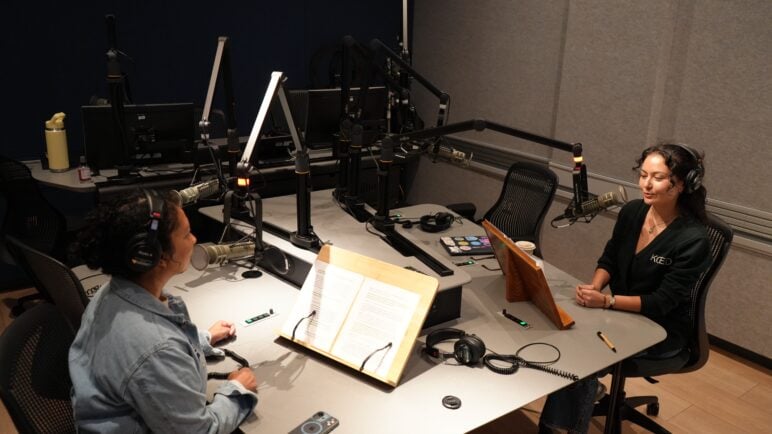
The team used a two-way format to contextualize the students’ voices, and their voices remained central to the storytelling. Equally important was ensuring that the core public radio listener heard why these students’ perspectives are relevant to them, and how they connect to the news cycles we’re all watching.
This idea of scripting that focuses first on the audience experience of hearing student voices was pivotal. Previously, there would have been resistance to cutting youth-submitted pieces into a shorter format.
Almetria Vaba and Jessica Fagen collaborated with Rachel Roberson on script development, which took about 10 days to complete, and then they recorded the segment for broadcast. They introduced and contextualized the student clips around the newsworthiness of the country’s semiquincentennial.
What We Made
KQED prioritized the segment for ATC to make sure as many listeners as possible heard the piece. The full segment runs at a brisk pace and wraps at just over eight minutes.
The four student pieces featured in the broadcast were stunning: Reflections on food insecurity in a difficult economy and how farmers markets fill a need in some California communities; a description of how mountaintop removal has changed a Kentucky community; a Colorado student’s humorous take on sleep lost during Daylight Savings Time; and a Montana student’s examination of voting in the state. Within the segment, listeners heard how young people connect their own experiences to a larger national conversation. And young people from the Bay Area and across the country added forward-looking reflections to a conversation that is shaped primarily by adult voices and historical narratives.
The California Report Magazine, KQED’s statewide weekly news program, also featured Podcasting Democracy. Host Sasha Khokha interviewed student creator Eumari King Perez and Rachel Roberson, one of the curriculum writers for Podcasting Democracy. The interview explores the educational goals behind the project, Eumari’s experience participating, and early pilot results that showed the curriculum increased students’ understanding of the Constitution and democratic institutions. This segment also featured excerpts from several student submissions.
What we learned
Through this project, the teams developed a sustainable workflow for youth storytelling and engagement that other public media organizations could realistically adapt. Moving forward at KQED, we are focusing on:
- Making a plan to feature youth voices more often on the air, based on bandwidth and available content, with conversations early and regular check-ins with staff. A quarterly cadence is an aspiration.
- Building alignment across teams about what content we want to feature and connecting it to relevant events in our community.
- Utilizing KQED’s Youth Media Showcase as a station resource. Built from student participation from school districts around the nation, the showcase is a platform where media creation is integrated with learning.
- Addressing technical considerations like permissions, scripting and production early in the process.
Education outreach work and broadcast storytelling don’t need to exist in separate silos. Stations that treat their education infrastructure as a source of relevant local content will find that the storytellers they’ve been looking for have been there all along.
The larger lesson from this project is that many public media stations may already have untapped content in classrooms across their communities. As educators increasingly incorporate media creation into core instruction, stations have new opportunities to connect youth voice, civic learning and broadcast storytelling without having to build and maintain entirely separate production systems.
Across the country, students are creating content ready for your airwaves in arts, media and entertainment multimedia classes; in journalism classes using PBS News Student Reporting Labs prompts; and projects developed through programs like National History Day.
The KQED Youth Media Challenge Showcase, featuring content from classrooms across the country, is a robust resource stations can tap into too. It’s accessible and can be filtered by state, city and district.
With Podcasting Democracy, we learned how classroom media projects can be adapted into meaningful public media content, creating new pathways to reflect the voices and experiences of young people.
Almetria Vaba leads KQED’s collaborations with education agencies, public media stations and other nonprofit organizations.
Ernesto Aguilar oversees radio broadcast content and innovation initiatives in KQED’s content division. He previously served as executive director of the National Federation of Community Broadcasters.
Rachel Roberson is an educator and content developer who specializes in media literacy and media project-based learning.
Jessica Fagen is a literacy educator who specializes in using the study of media arts, film language and the written word to inspire creativity and critical thinking.