
PBS CEO Paula Kerger at Annual Meeting: ‘The system we are building together will be stronger’
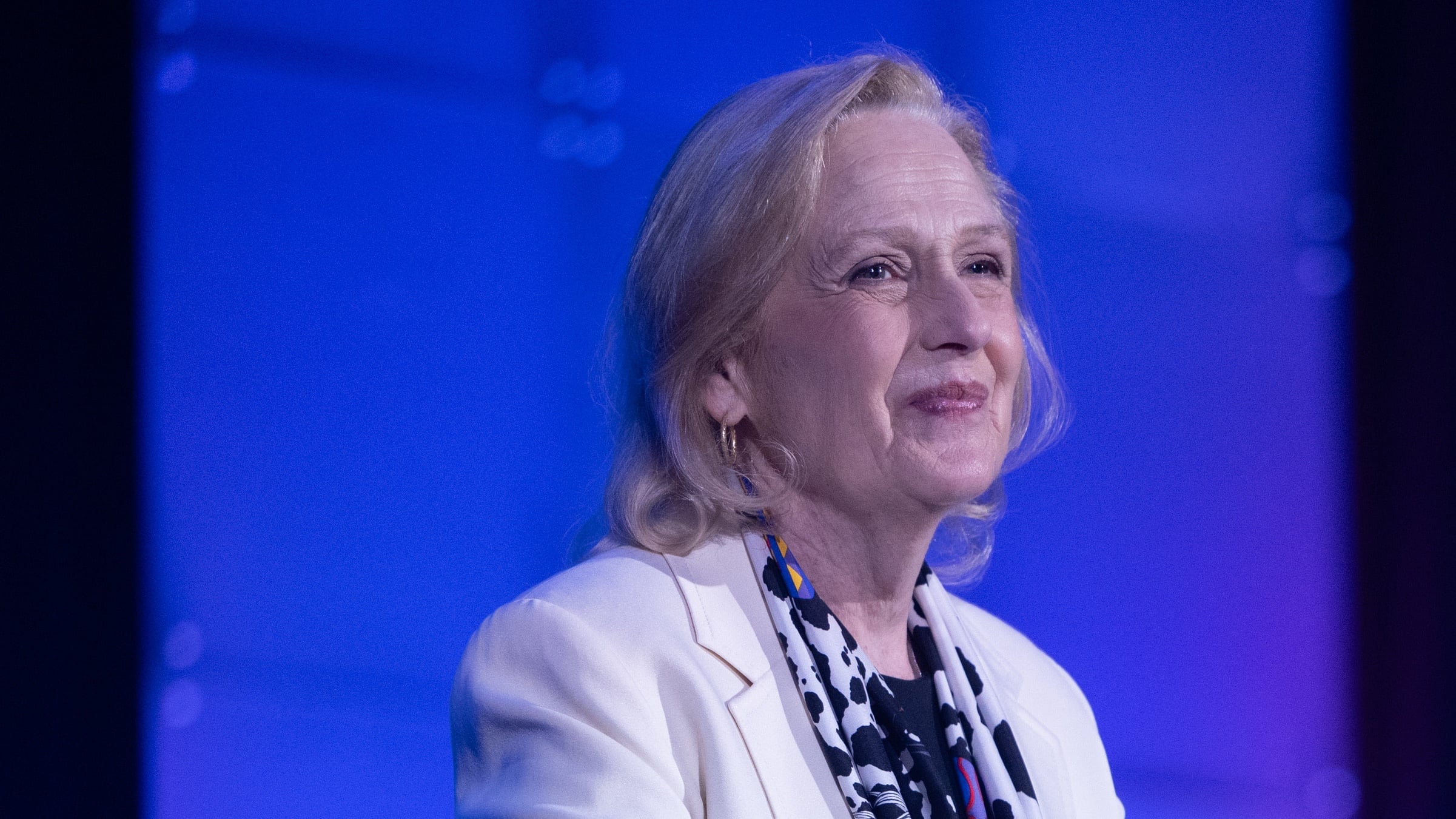
Courtesy PBS
PBS CEO Paula Kerger speaks at the 2026 PBS Annual Meeting in Austin, Texas.
In a keynote address delivered Wednesday at the 2026 PBS Annual Meeting in Austin, Texas, PBS CEO Paula Kerger acknowledged public media’s challenges following the rescission of federal funding while highlighting the system’s recent successes. This transcript has been edited for style and clarity.
It is so good to be together. Especially after the year we have had. They thought they had taken us out. But we’re still here! We’re still here!
This past year has been the hardest year any of us has experienced in public media. They took away our funding. CPB closed its doors after nearly 60 years. And stations have been faced with impossible choices.
When Newt Gingrich tried to defund us in the 1990s, his plan was a glide path to zero over three years. We had three months. Three months.
But we’re still here! And we are more determined than we have ever been.
As I have said many times before, I have not given up on federal funding. The pendulum swung hard against us, but pendulums have a tendency to swing back.
But I know we are not going to sit around and wait for that to happen. More than anything, this past year has clarified for me just what’s at stake when we think about the future of public media — and why our work matters now more than ever before.
We are on the cusp of a great transformation. It’s been uncomfortable and difficult. But it is forcing us to really wrestle with important questions.
What we are building is a public media system that is more connected to communities, more present on the platforms where people actually spend their time, and more financially resilient than anything we have had before.
That transformation will not come from Washington. It will not come from a single benefactor. It will be powered by individuals. By visionaries. By the thousands of people who work in public media coming together to meet the needs of their communities.
It will be powered by you.
Our system has always been full of visionaries. People who saw what did not yet exist and built it.
In 1948, a woman named Frieda Hennock became the first female commissioner of the FCC. At a time when every broadcaster in the country was fighting for commercial licenses, she said the broadcast spectrum is a public resource, and part of it should be reserved for education.
Without Frieda Hennock, there would be no public television. And in 1953, she was invited to inaugurate the very first educational television station in America: KUHT, right here in Texas.
A decade later, President Lyndon Johnson looked at the BBC and said: Our country should have something like that. Not a government network. A public one. He signed the Public Broadcasting Act in 1967, and a system was born.
Then came the people who made our system extraordinary. People like Joan Ganz Cooney, who believed television could teach children to read. People like Fred Rogers, who understood that the most radical thing you could do on television was treat a child with respect. People like Bill Moyers, who believed the American people deserved journalism of depth and substance, and spent his career proving them right.
And people like Jim Karayn.
By early 1973, the Nixon administration had nearly succeeded in strangling public television. Nixon vetoed a funding bill that had passed the Senate 82 to 1. His appointees at CPB purged nearly every public affairs program. The system was on its heels.
Jim ran NPACT, our Washington, D.C., public affairs center. He saw an opportunity. He visited PBS President Hartford Gunn every single day for 12 weeks to convince him to broadcast the Senate Watergate hearings. A station poll passed by only 52%.
After 12 weeks of lobbying, Hartford Gunn finally relented and made the decision to air the hearings gavel to gavel, in prime time. No editing. No commentary. Just the hearings, in full, so the American people could draw their own conclusions.
By the sixth broadcast, 70,000 letters had poured in. Viewers sent money. Stations that had never raised significant funds saw thousands of dollars arrive overnight. The coverage launched the MacNeil/Lehrer NewsHour. It secured long-term funding for the first time. But more than that, it proved that public media could do what no one else would: use media to educate, engage and inspire. Not just entertain.
These visionaries are not only in our past.
A few years ago, conventional wisdom said that young audiences had shorter attention spans. That they would never sit through an hourlong documentary. Certainly not on YouTube.
Raney Aronson-Rath did not believe it. She invested in building Frontline’s YouTube channel. Not just clips. Not summaries. Full-length investigative documentaries. Streaming around the clock.
Today, Frontline has more than 3.2 million YouTube subscribers. Their documentaries regularly surpass a million views. Some have been streamed more than 42 million times. That is investigative journalism, reaching a massive audience on a platform that everyone said was only for short-form content.
Raney proved them wrong. Not by chasing trends. Not by dumbing down the work. But by trusting the audience. By believing that people, including young people, are intelligent enough to sit with a difficult story if you tell it well.
Our values did not become outdated. They became the differentiator. In an era when trust itself is the scarcest commodity in media, we are the ones who have it. And a generation of Americans is responding.
Jim Karayn was extraordinary. Raney is extraordinary. But here is what I have learned in 20 years of leading this organization.
One visionary can start something. It takes a whole system to sustain it.
The real story of public media has never been about any one leader. It is about what happens when thousands of people who work in public media come together to meet the needs of their communities.
Over this last year, I have been touched by the number of people who have thanked me personally for what PBS has done. But I want to be clear about something. I am just one person. It is everyone working together that has brought us to this point.
And the proof is everywhere.
In Texas, all 10 PBS stations came together through Texas PBS. They built a statewide model for shared content, collaborative journalism and joint fundraising. In August, they gathered in Amarillo — leaders from Austin, Houston, Dallas, San Antonio, Corpus Christi, Lubbock, El Paso, College Station and Midland around one table. They launched the “Made in Texas” series: local documentaries produced across the state, airing monthly.
Ten stations acting as one. That is collective action.
We see this in the community as well. One of the biggest lessons of this entire year is this: We do not need to convince people that PBS matters. We just need to tell them what the situation is. They are the ones who step up.
And they have stepped up in a big way.
When the federal funding was cut, the American people came forward. Not with polite applause. But with their wallets. With their voices. With their time.
More than 1 million new donors joined public media last year. Revenue from individual giving rose more than 40% across our system.
And here is what moves me most. Nearly half of those new donors did not just write a single check. They signed up to give every month. They chose to stay.
The Public Media Bridge Fund has raised more than $70 million dollars to support stations.
And last month, the PBS Foundation met its campaign goal, completing the largest fundraising campaign in public media history. This milestone is a testament to the power of our mission and the generosity of individuals who believe in what we do.
I will be honest with you. After the drama of the vote to cut our funding, I expected this surge to fade. That is what happens after a natural disaster. The flood waters recede. The cameras move on. People turn to the next thing.
That did not happen. Contributions have continued to grow. People have stood up. And they are still standing.
When I was in Arkansas a few months ago, people drove hours to tell the state commission how much PBS programming means to them and their families.
One older man’s comments have stayed with me ever since. His name was Al Adams, and he spoke movingly about what PBS meant to him as a former educator, a person of faith and a grandfather. But what he said last made me stop in my tracks.
He said: “As a longtime donor, I’m certainly willing to up my contribution” to keep PBS in Arkansas. “If I get to travel less in my waning years, I think it’s a sacrifice well worth making.”
Think about that — he’s willing to sacrifice his retirement dreams in order to ensure that his children and grandchildren, and people all across the state, can continue to have access to PBS.
People ask me: “Isn’t there some billionaire who can solve your problem?” My answer is always the same. I don’t think that’s a great idea. What has made us strong is not one person with deep pockets. It is millions of people, people like Al Adams, each doing a little bit, because they believe in this work. Because they believe in our mission.
This is not our weakness. This is our superpower.
We draw our strength directly from the American people. We are varied. We are diverse. And that is what makes our stations strong and vital.
Every station in this system is independent. Locally owned. Locally governed. You formed PBS to do the things at scale that you could not do alone. And that means the future does not depend on one person, one decision, one election. It depends on all of us.
Every station. Every community. Every person in this room.
PBS exists to support you. The apps. Passport. The platform deals. The content investments that can only be made at scale. Over the next two days, you’ll hear in detail what we have in store for you in the next year.
That is our job.
Your job is to serve your communities. And you are doing it brilliantly.
Last November, we premiered The American Revolution from Ken Burns, Sarah Botstein and David Schmidt. Ten years in the making. Filmed in 85 locations. A story told from every perspective: the generals and the foot soldiers, the enslaved and the free, the loyalists and the revolutionaries.
Eighteen million people watched the premiere broadcast week. For the first time in our history, PBS broke into the top ten of Nielsen’s weekly streaming ratings. Viewers have watched more than 4 billion minutes of this film.
Four billion minutes.
But here is what makes me most proud: This was not just a television event. It was a community event. Across all 50 states, stations and community partners turned this film into something much larger than television.
Seventy stations received grants to host local events. More than 400 events are planned through the rest of this year: screenings with panel discussions, youth programs, civic forums, author talks, interactive exhibits with historical reenactors. More than 50 national partner organizations signed on, from the National Constitution Center to Colonial Williamsburg to Mount Vernon to iCivics.
And our stations made it their own.
East Tennessee PBS partnered with the Women’s Suffrage Museum to host a screening exploring how the ideals of the Revolution sparked early conversations about liberty and equality for women.
In Chattanooga, [Tenn.,] WTCI partnered with the Cherokee Film Commission and the Museum of the Cherokee People to center Native voices in the story.
In Louisiana, the interest from teachers has been so strong that Louisiana Public Broadcasting is adding summer sessions it had not planned.
And right here in Texas, Panhandle PBS hosted teacher events in partnership with the regional Education Service Center and the Texas Panhandle War Memorial, exceeding every attendance goal they set.
This is the model. Content created at national scale, activated at the local level, every station making it their own.
Today I’m extremely pleased to announce that we have secured a 10-year deal with Ken to extend the rights to his full catalog for all of our platforms. This is especially important in this moment that Ken has placed his bets on our future. And we’ll be the home for Ken’s future projects as well.
Ken is working on Emancipation and Exodus, an examination of the end of slavery, Reconstruction and the Great Migration, co-directed with Sarah Burns, David McMahon and Erikia Dilday. Ken and his longtime colleagues Sarah Botstein and Lynn Novick are also in production on a film about President Lyndon Johnson and his Great Society.
And we’re going to keep elevating American Revolution. This summer, we’re going to have a marathon broadcast event and make the entire film available for free on our streaming platforms leading up to July 4.
This is not just any film in any year. As we mark the 250th anniversary of our nation, the questions the founders wrestled with are the questions we are wrestling with right now. What do we owe each other? What does self-governance require? How do you build something lasting out of something improbable?
The promise of our democracy, the very future of our country, only works if every generation is prepared to carry it forward, especially the next generation
And that is why our work for children is not just important. It is a moral imperative.
I cannot tell you how many parents I have met this year who are terrified by what their children are experiencing and consuming. They feel a loss of control. Their kids can find anything on YouTube. And the things they are finding are not designed to help them learn, grow or become thoughtful members of their communities. In fact, a lot of it is designed by AI, with the sole purpose of capturing kids’ attention and monetizing it.
At the same time, more than half the children in this country are not in formal preschool. For so many of those children, we are their classroom. We are the first place they learn their letters, the first place they learn to count, the first place they learn how to take a deep breath when they are angry, or how to say I’m sorry, or how to treat another person with kindness.
We teach kids that their feelings matter, that other people’s feelings matter, that they are part of a community. These are not just school-readiness skills. These are the essential skills that citizens need. That is the foundation of a functioning democracy.
You know, in the late 1960s, half the kids in this country had no access to formal preschool. The children’s television landscape was a lot like YouTube today: filled with content that did not align with children’s best interests.
So Joan Ganz Cooney asked a radical question: What if television could teach?
And do you know what happened when Sesame Street went on the air? Parents across the country wanted it for their children so badly that they organized to create new stations.
That is who we are. We do not wait for someone else to solve the problem. We build the solution.
The loss of Ready to Learn funding was devastating. It was a knockout punch. But we cobbled the resources together to finish Phoebe & Jay and made sure it got to air. Why? Because this work cannot wait. The children who need us right now will not be three years old again if and when federal funding comes back.
And we’re not stopping now — we have so much more in the pipeline to serve kids.
The founders of this country believed that every person deserves the opportunity to lead their fullest life. That starts with children. It starts with making sure that every child in America, no matter where they live, no matter what their family can afford, has a chance to learn, to grow and to become the citizen this country needs them to be.
And that brings me back to why all of this matters. Not just for our system. For our country.
When our nation was created, the founders built it around an improbable idea. Not just self-governance. Not just liberty.
The pursuit of happiness.
Think about what that means. No other country had ever put that at the center of its purpose. The idea that every person should have the opportunity to pursue their fullest life. To learn. To grow. To participate in the life of their community and their nation.
That same principle is the core of what we do at PBS: providing ideas and inspiration so that people can lead their fullest lives. In essence, the pursuit of happiness.
That is what our kids’ programming is about: the belief that every child should reach their potential. And what our programming is about: the idea that informed citizens are the foundation of a free society.
And this is what every station is about: A public square. A place where people from all walks of life can come together, where they can learn from each other, where they can find common ground.
In a media landscape built on division and algorithms, we are still here, serving everyone.
We represent this country at its best. Uplifting all voices. Believing that all children should reach their potential. Being a public square at a time when one is harder and harder to find.
By fighting for a stronger public media, we are fighting for the future of our country.
I want to close with something personal.
Over the past year, I have traveled all over this country. I have sat in rooms like the one in Arkansas, where 100 people showed up to fight for their station. I met a TSA agent in Fargo, North Dakota, who stopped me to say thank you. I have read letters from kids who donated their birthday money because they wanted to help.
And I have been humbled. Truly humbled.
Because in those moments, person after person has come forward. And each one tells me why PBS matters to them. Not in the abstract, but in their lives, in their children’s lives, in their community.
I joined PBS because I believe the work and the mission are important. I have always believed that. But sitting in those rooms, hearing those voices, I realized it is so much bigger than what I understood.
Because there is no one else standing between those communities and the loss of something that’s irreplaceable. There is no one else who is going to do this work. No other institution. No other company. No algorithm. No billionaire.
Just us. The people in this room. The people at your stations. And the millions of Americans who believe in what we do.
That is democracy in action. Not the version you see on cable news, or from talking heads. What we do is the real thing. People coming forward. People standing up. People saying: This matters, and I am willing to fight for it. I will fight for it.
[Pause.]
In 1948, Frieda Hennock stood alone against an entire industry and said: The airwaves belong to the people. In 1969, mothers went door to door to build stations so their children could watch Sesame Street. In 1973, Jim Karayn was told that putting Watergate in prime time was professional suicide.
They took risks. They built something from nothing. And they changed this country.
That same energy is alive in here today. I can feel it.
The system we are building together will be stronger than the one we inherited. More connected to communities. More present where people need us. More creative. More resilient. More bold.
And it will be built by the people in this room, with the support of the American people.
What an extraordinary privilege. What a profound responsibility. And what a beautiful thing to fight for.
I have never been more proud to stand with you. And I have never been more confident in where we are going.
Together, we will continue to fulfill our mission: to educate, engage, and inspire the American people.
Thank you.



Thank you Paula! Thank you for your leadership and for the model you offer to us all. The Watergate Hearings provide a terrific example. We received numerous threats and staff spent nights guarding transmitters. Fortunately, those were quite nights. But each day was progressively louder as our phones rang and Alabamians called in from every region to thank us for the broadcast.
Incredible presentation. Indeed the will and the caring for public broadcasting is everlasting.
Paula beautifully reminds us of where we get our strength and our values. As my long-ago boss at Detroit PBS Bob Larson used to say, “If we serve, we will survive.”
Way beyond survival, though, we will thrive because, as Paula says, “We do not need to convince people that PBS matters. We just need to tell them what the situation is. They are the ones who step up.”
Bless PBS, its member stations, its staff, volunteers, viewers, and most importantly, its members.