
The remarkable nonlinear journey of public TV researcher David LeRoy
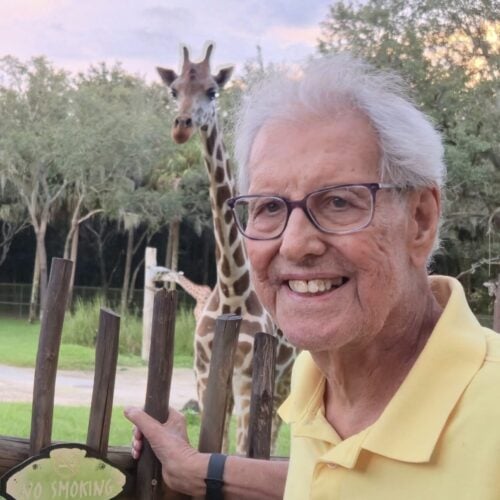
LeRoy
This remembrance is adapted from a tribute published by TRAC Media Services. It has been edited for style and length.
Though David was an avid reader of obituaries in his later years, he never wanted one. In keeping with that wish, here are some details about David’s life you might not know but would enjoy learning.
Twenty-two years ago, David LeRoy went to New Smyrna Beach, Fla., from the Arizona desert so he could die next to the ocean. It took more than two decades, but he finally reached his goal, passing at 6:15 a.m. on July 6 at the age of almost 91.
He had previously announced he didn’t want to die on the Fourth of July (too noisy) or Bastille Day (too militant), so he didn’t. Those of us who knew David found that totally in character.
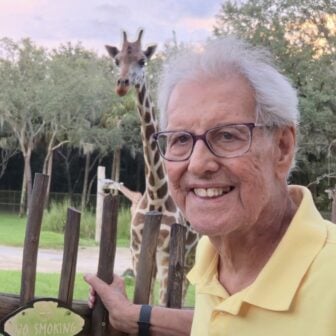
David is survived by Judy, his wife of 68 years. If you knew David, chances are you also knew Judy, his co-conspirator and co-founder of TRAC Media. You may also know his daughter Simone, who, following her father’s footsteps, has been doing public TV research since she was seven years old and David paid her a quarter to critique Sesame Street. Another daughter, Lisa, sensibly entered another field.
David loved public TV — especially local public TV — and numbers. He pursued both so obsessively a psychologist might offer an Asperger’s diagnosis. David pursued those interests for an entire lifetime. And he took a lot of people along with him, cajoling, nagging, demanding, whining until they performed the functions that enabled him to pursue his goals.
People who knew him from different venues and times have different adjectives to describe David. He’s been labelled “brilliant,” “mean,” “kind,” “acerbic,” “passionate,” “one-sided,” “boring,” “exciting,” “chaotic,” “focused,” “intelligent” and “totally lacking in common sense.” All are probably true. David had a divergent brain.
Where most people gather facts and bring them together for a conclusion or perspective, David took the conclusion and ripped it apart to find the elements that comprised it. And then he took those elements and examined them further to arrive at some unlikely, amazing place that was either brilliantly insightful or totally confusing.
David disliked schedules and disdained order — his office, his car and his brain were disorderly and chaotic. And that was true all his life. It made grade school a challenge and high school so much of a challenge he never finished, an embarrassment for his parents and younger siblings, Helen, Mike, Joe and Peggy. His distaste for school stemmed from factors beyond schedule and order loathing.
For one thing, he had ADHD at a time when those letters were just a series of vowels and consonants rather than a diagnosed condition. He was also dyslexic in an era when stumbling through oral reading in class meant you were just plain stupid. Though letters hopped around on the page and never formed much of a pattern, an intense urge to know things urged David to master reading on his own terms, in his own way.
Yes, he learned to read, but you can’t read all the time, and David’s choices for the between times weren’t particularly wise. After an older friend “borrowed” a neighbor’s car and gave David a driving lesson in a cornfield in northern Wisconsin, the local police got involved. Both boys spent six months in a local institution for juvenile miscreants optimistically labeled the “Reformatory.” But it was really a place that spent less time reforming than teaching new antisocial behaviors.
David was thankfully impervious to those influences, probably because he worked in the laundry. Between loads, he could read anything he could get his hands on. When he returned home after being “reformed,” he needed something to do. He was 17 and didn’t get on particularly well with his family, so he did the most obvious thing in the post–World War II America of the early 1950s. He joined the Army.
Oddly enough, it was the perfect solution. Being able to read was a skill that, it turned out, was in short supply. At the age of 18, he became a weapons instructor, teaching 40-year-old Army lifers how to take apart assorted weapons. Why? Because he could read the manuals and they couldn’t. Then, in Guam, he was put in charge of supplies and became the swashbuckling equivalent of Radar from Mash, trading sheets for Jeep parts with other units in the area.
David, despite his dislike of schedule, accepted Army life. He found parts of it boring, so when someone told him he could get two days a week off-duty if he signed up for something called a GED, he did. At the end of three years of, in David’s words, “mostly goofing off,” a young lieutenant told him that, since he had a GED, when he got out of the Army he could go to college for free on something called “the GI Bill,” a leftover from WWII. It sounded a lot better than getting a job.
David registered for college at the University of Wisconsin Extension Center in Green Bay, Wis., affectionately known by those who attended as “Cardboard Tech” for its shabby, cheap post-war construction and its odorous location behind a small, foul-smelling river carrying paper mill effluent out of the city.
David’s lack of formal education was bound to catch up with him, and it slammed him hard in freshman English. You’d think that years of reading would have taught David something about spelling, punctuation and syntax, but it apparently hadn’t. After two failing attempts at writing essays, the instructor told him that, without help, there was no way he’d pass the course.
Having learned resourcefulness in the Army, David applied his skills. Where would he find the best candidates? The Extension Center had a small, one-room library and a staff of five student librarians who took shifts through the days and evenings. Librarians work with books, so they must have writing skills, right? David turned to the library for writing assistance. Having some standards, David cased the place for several days to determine which of the librarians was best looking.
After deciding on the librarian, he learned her work schedule, casually approached the library desk and told her that he “needed to have a paper typed” for freshman English, and that he’d pay for it. She agreed before seeing his manuscript for the “Meaning of Names in Charles Dickens’ ‘Nicholas Nickelby.’” Had she seen the jumbled mess of non-punctuated incomplete sentences, bad grammar and misspellings, she’d never have agreed. David’s life, and her life, would have been very different.
The librarian not only got him through freshman English, she edited every paper David wrote through five years of college, four years of graduate school and 60 years of research — all while researching and writing college, grad school and professional papers of her own. At one point in his life, David described Judith as a “Swiss Army Knife” because she met his needs, whatever they were, whenever they happened.
He probably never realized that for her, his primary asset — besides his weird, divergent thinking pattern and insatiable curiosity about things that interested him — was the fact he was never boring. Never.
Discovering his niche
So how did TRAC Media Services come about? David’s major professor in grad school was Larry Lichty, who had recently gotten his own PhD in mass communications. Larry had an interest in public broadcasting, primarily radio, and David discovered an interesting niche alongside it in public TV.
After finishing his PhD, David, Judy and their two children moved to Tallahassee, Fla., where Florida State University was starting a Mass Comm department. David’s choice was heavily influenced by climate — he traced the Mason-Dixon line on a wall map in his children’s bedroom and, for a year, told them they were going to be moving below it. David hated the frigid Wisconsin winters after his Army sojourn in Guam.
In Tallahassee, David published numerous research papers and rose through the academic ranks with Judy’s help. (She was writing her own PhD dissertation at the time.) Jack Lyle, director of research at CPB, noticed the research and offered David a sabbatical year as his assistant director. That was 1976, the Bicentennial Year, and Washington, D.C., was an exciting place to be. As part of his job, David provided grants for a couple of public broadcasting research endeavors.
At that time, audience research was shunned by many PTV station managers, who considered the mission of public broadcasting to be just that — mission — not attracting viewers and listeners to their media.
When the sabbatical was over, David accepted a position at the University of Houston. His interest in media research had intensified, and — better yet — he met Stan Peterson, a rep who had been in Nielsen’s programming department and knew possibilities for research that Nielsen wasn’t even promoting. A.C. Nielsen was owned by a man who appreciated public broadcasting so much that he offered PTV audience research at a price deeply discounted from commercial stations. That, to David, seemed an inviting proposition.
David and Judy signed a contract with Stan for Nielsen Sweep books in five markets and tried to figure out how best to condense the material into reports for local PTV stations. They bought an early Apple Macintosh, took out a bank loan to buy a Paper Tiger printer and a Selectric typewriter knock-off, and David wrote a computer program that generated the first data comparisons.
Data input into that program was laborious. Judy read numbers to David from the Nielsen paper Sweep Books, and he punched them into the Apple computer. Then David did the reading, and Judy punched the computer keys. They hated Wednesdays because the Nielsen books listed most of the programs as “various,” which meant absolutely nothing. Eventually, after much discussion, evaluation and argument, they had a product.

They rented a small ballroom in a Chicago hotel and invited a bunch of public TV programmers who they considered potential clients for the service. In those days, when finding and scheduling programs was a crucial station function, programmers were local station VIPs. Most expected to eventually elevate to general manager positions. David often reminisced about the latitude and power programmers had “in the days before PBS co-opted their jobs.”
Twenty-two programmers attended, and by the end of the presentation and discussion, nearly a dozen of them signed on — those who were intrigued by the data and not, in the words of one of them, “offended by David’s unusual presentation style, acerbic wit and contrarian nature.” For a nominal fee, after each of the four Nielsen sweeps, they would receive audience data, a personalized report evaluating their performance, and suggestions for enhancing it. Hot dog!
The early years of TRAC required diligence and stamina. David and Judy often worked 16- and 17-hour days analyzing data and writing reports in their home study. When that became insupportable, TRAC moved, expanded, and hired an office manager, bookkeeper, data analysts and, finally, fellow researchers.
Research reports for CPB, regional associations, producers and even PBS flowed. Member research beckoned. David and Judy were invited to speak at PTV meetings here and abroad — the foreign PTV broadcasters kept inviting them back because, they said, they found the team not only intelligent and informed but also very entertaining as they argued enthusiastically about public broadcasting research.
Much of TRAC’s initial appeal and success can be credited to David’s insistence that the primary product of TRAC research was intelligence, not data or numbers. What did the numbers mean? What should you do about them? Stan Peterson, still the company’s Nielsen rep, provided increasingly enticing data … ethnic viewing reports, zip code analyses, flow studies. When the Nielsen programs couldn’t provide something, Stan devised other ways to extract it, and David made it useful.
David felt research should inform decisions and he wasn’t above (or below) telling folks exactly what those decisions should be. David was forthright to a fault. Judy said David’s brain was like a gumball machine. Ask David a question and out rolled a thought, an idea, an opinion with no internal censor whatsoever to temper it.
And so it went for more than 35 years. Life changed, PTV changed. In his later years, David, perhaps uncharacteristically, said he’d had great pleasure working in a media that developed better instincts and spurred human evolution. That’s a mouthful for a guy who observed, correctly so, that he had very few social graces. David was a fault-finder, and he found that public TV, an institution engaged heavily in “scab picking,” made him feel right at home.
Most of David’s friends were somehow related to public TV or mass communications. Since everyone knew he didn’t suffer fools lightly, being his friend was something of an honor. That didn’t spare you from harassment though — often it was just the reverse. But David’s friends, once made, persisted for decades and he was, in his own way, very loyal to them. Not an emotive, hugging, warm handshake type person, he assumed that friends worth having could deal with tough love. And they did.
Yes, David had lots of opinions, and he wasn’t shy about them. In public broadcasting, he ranted about the lack of local station autonomy — David was always a local station champion. He wanted local stations to be cognizant of audience as well as mission. His favorite saying was that no souls are saved in an empty church. Though big ratings weren’t his expectation, he was frustrated by an “overconcern” with primetime and vociferously insisted that genres with small audiences can find their viewers in other dayparts than primetime.
And David loved local shows. He’d watch them for hours. He’d hear about a station’s local show and harass the poor programmer until he sent it. A particular pet peeve was when “the bureaucrats” (naming no names) did ROI studies to prove that local shows were a waste of station resources. David’s caustic tongue (he had one) and critical mind (he had that, too) went into attack mode. David, heart and soul, believed local shows were a crucial part of a station’s purpose.
When national, state and local governments pull back funding, what does the station rely on? Its community, the viewers within it and the accumulated value of the station to its community. And what’s a more obvious example of community service than programming directed to it? Local shows don’t have to be costly, slick or gorgeously filmed. Viewers have long said that it’s more important for the content to be authentic than slick — genuine, not fabricated.
Public TV was central to David’s existence. His biggest fear in his latter days was that stations wouldn’t recognize their own worth and wouldn’t capitalize on the value that years of community service had accumulated. His last work was an archive project in which he gathered interviews from PTV professionals who had worked to make their stations great community institutions. David didn’t want their efforts forgotten. He felt that a celebratory archive at every station would be an asset to haul out every time funding got threatened and the station’s future looked bleak.
David, in many ways, was an acquired taste. While not a sugar-coater, his love and appreciation for public TV was obvious to those who heard his presentations or who talked with him. And it could be contagious. The many messages after his death from programmers whom he inspired during his years in public TV suggest they felt that David was crucial to their careers and to their continued desire to work in public TV.
Despite his reputation as a glass-half-empty soul, David felt that PTV and local stations will endure “because there are people around who understand its importance.” If public TV disappeared tomorrow, someone would reinvent something like it in the future. “If a cynic like me sees and appreciates the value of local public TV stations, you know there’s got to be hope for them in the future.”
That’s our David … . For those who feel so moved, David asked that donations “In Memory of David LeRoy” be made to your local public television station.