
Maryland governor vetoes advertising set-aside legislation that could benefit pubcasters
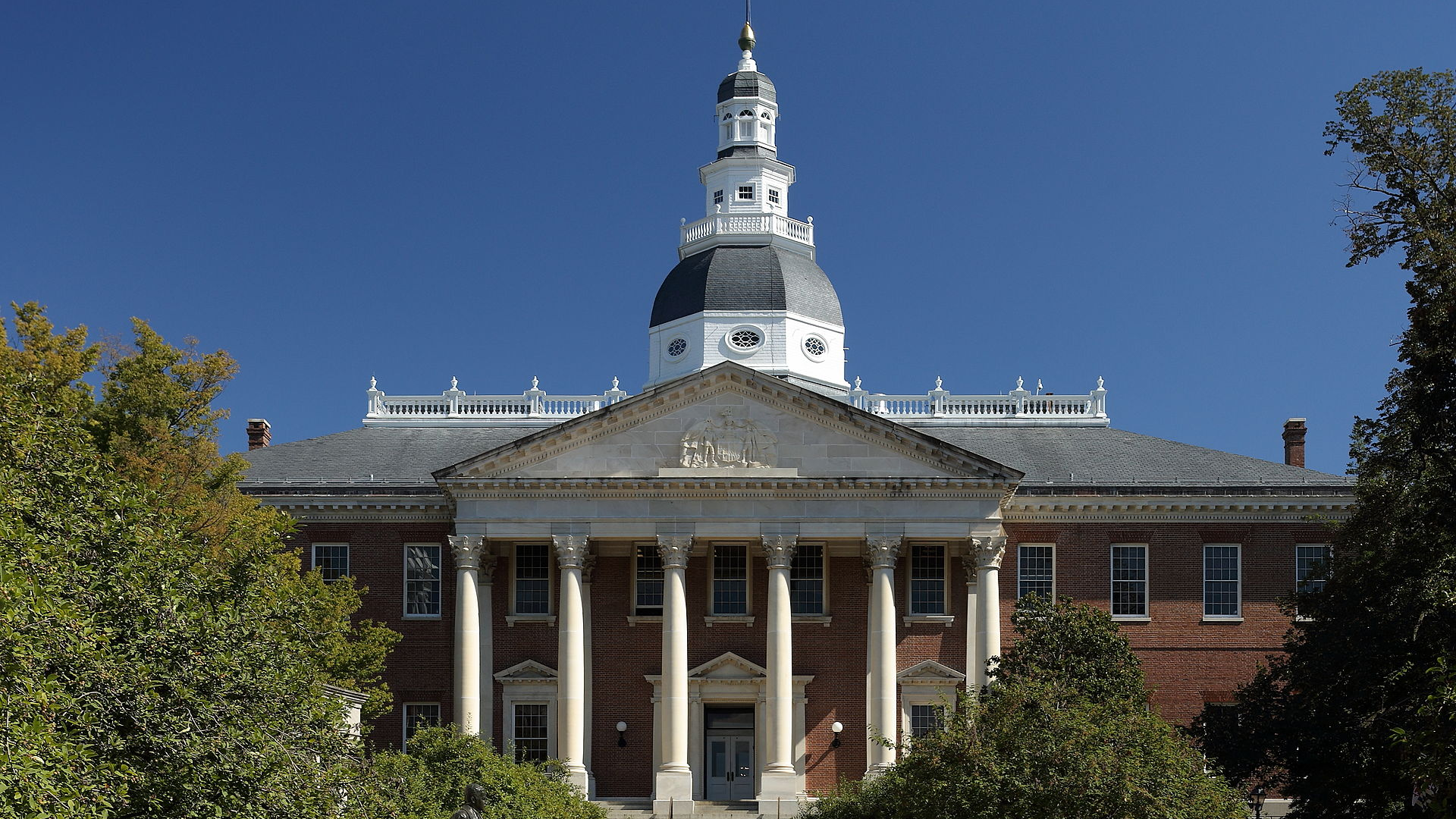
Martin Falbisoner / Wikimedia Commons
The Maryland State House in Annapolis, the state’s capital.
Following a veto by Maryland Gov. Wes Moore, advocates for local news organizations are determined to revive a bill that would direct government agencies to allocate half of their advertising dollars to the state’s public broadcasting, commercial and nonprofit news organizations.
The bill passed unanimously in the Maryland Senate and by a vote of 129-7 after the House’s third reading when both chambers voted April 13.
In a letter to Maryland Senate President Bill Ferguson, Moore cited concerns that the legislation could impair “the state’s ability to communicate effectively with Maryland residents.”
Rebecca Snyder, executive director of the Maryland-Delaware-DC Press Association, led coalition work in the state to pass the bill. She said Gov. Moore’s decision was “misguided” and reflects a lack of faith from the administration in Maryland’s local news ecosystem.

“We hear so often about … how we need to support local media and how the news infrastructure and ecosystem is really important, and this was a bipartisan, straightforward bill that would have made an incredible difference to Maryland’s local news organizations,” she said. “It really felt like a turn towards big tech to say, ‘Oh, no, state agencies want to place as much as they possibly can in large national platforms,’ programmatic advertising that doesn’t give back to Maryland.”
While Moore’s decision to veto was disappointing, the coalition remains committed to working with the administration to keep the bill alive, said Lori Henson, manager of government advertising policy for the nonprofit local news advocate Rebuild Local News.
“There was obviously a real understanding on the legislature’s part that this was an important policy that would be beneficial to the state’s local news outlets,” she said. “We want to work with Governor Moore’s administration to try to find a way forward now.”
What happened?
In his letter explaining his veto, Moore noted an increasing prevalence of subscription paywalls across local news organizations that have transitioned to primarily electronic delivery as “the availability of print media declines.” He said this clashes with the state’s goal to reach “the broadest possible audience” with its advertising.
Henson said that contrary to Moore’s argument, local news outlets can reach communities that might be harder to target. She also pointed out that the bill would let state agencies choose which outlets to advertise with.

“In fact, the bill will require local news organizations to be more competitive … to compete for the state’s business,” she said. “They’re going to have to submit analytics that show their click-through rates and submit information that demonstrates who they’re reaching and how effective they are. The government actually gets better information under these kinds of policies.”
Many qualifying local outlets, such as public broadcasters, television channels and numerous digital outlets in the group, lack the paywalls that Moore says may block potential audiences, Snyder said.
“If a state agency did not want to be on a paywalled site, there’s no requirement for them to be on a paywalled site. There are plenty of options,” she said. “When you look at the diversity of the news organizations that are represented in this legislation. It befuddles me that a concern about a paywall is the thing that would make him veto the bill.”
Moore also raised concerns that the legislation would benefit publications owned by multistate or national media conglomerates, whose “editorial priorities, staffing and financial decisions may reflect goals that are far from the communities they serve.” He wrote that the state’s support for local journalism should be limited to “outlets rooted in and accountable to Maryland communities.”
Although the bill doesn’t require Maryland-based ownership for qualifying outlets, Snyder said the bill’s language, such as requirements to cover Maryland news and to have at least one full-time–equivalent Maryland-based employee, nevertheless bolsters access to local coverage.
“You can have ownership across state lines and still employ a ton of people in Maryland,” Snyder said. “Those dollars are coming back in Maryland, and the focus is on the coverage rather than the ownership because we want to foster the ecosystem of Maryland news. … I don’t know how many people Google or Facebook employs here in Maryland. That money’s not staying in Maryland.”
Another concern Moore brought up in his letter was that the bill would create “financial risk for the State.” He argued that allocating state agency advertising funds to local organizations “without regard to their proven standards of accuracy, accountability, and return on investment” would make use of public funds in ways that “cannot be adequately justified to Maryland taxpayers.”
Henson said the idea that the state redirecting existing funds and investing in local news organizations would be a risk to Maryland taxpayers “doesn’t make sense,” as the legislation is “simply a ‘buy local’ bill.”
“The state already does this for veteran-owned businesses, women-owned businesses, minority-owned businesses,” Henson said. “It’s simply prioritizing local news, which is a reinvestment of taxpayer dollars in their own communities.”
She added that the state already allocates an “unknown amount of money” to big tech companies, data which the coalition has not been able to obtain.
“If the concern was, ‘We don’t want to send money out of state, we don’t want to take a financial risk of sending it to places that aren’t going to use it,’ that doesn’t seem to be an issue that’s been brought up with any other kind of media outlet,” Henson said.
Next steps
The coalition is assessing options to find a path forward for the bill, as “failure is not an option,” Snyder said. The team is first looking to meet with Gov. Moore’s office and agency stakeholders to “see if there is an option on how we should move forward,” she said.
“We believe in local news. We think that it is important for the state to take full advantage of the capabilities of its local news ecosystem,” Snyder said. “There’s a variety of paths forward, and we’re exploring all the options. We have a track record of working in collaboration with everyone, and we want to do that with the governor’s office.”
Depending on the outcome of discussions with Moore’s office, a veto override “could be on the table,” wrote Maryland State Del. Linda Foley in an email to Current. A three-fifths vote in both chambers would be required during the next regular or special legislative session to enact a veto override. The assembly is currently not in session but is expected to reconvene for a special session following the state’s primary elections June 23.
For now, the coalition is determined to work with the administration, Snyder said.
“State agencies don’t need this legislation to do the right thing and to prioritize local media in their ad spends. They could do that right now. The governor could issue an executive order to say this is a priority of the administration. … We’ve seen him do that,” Snyder said. “That’s why we want to work closely with the governor’s office to help him live his values and help him learn to live his values, because that’s honestly what I think this is all about.”
It becomes more difficult each day for local news organizations to stay afloat, Henson said. She hopes the bill can move forward to ensure that news outlets continue to serve their communities.
“Every day that passes is a day that they’re struggling to meet the coverage needs of Maryland. Time is not on our side here,” Henson said. “Communities need news and information that is as high-quality and as rooted in their communities as local news is. And so the sooner we can get them a little support, the better.”