
OPB, KMHD content staff union reaches first contract with management
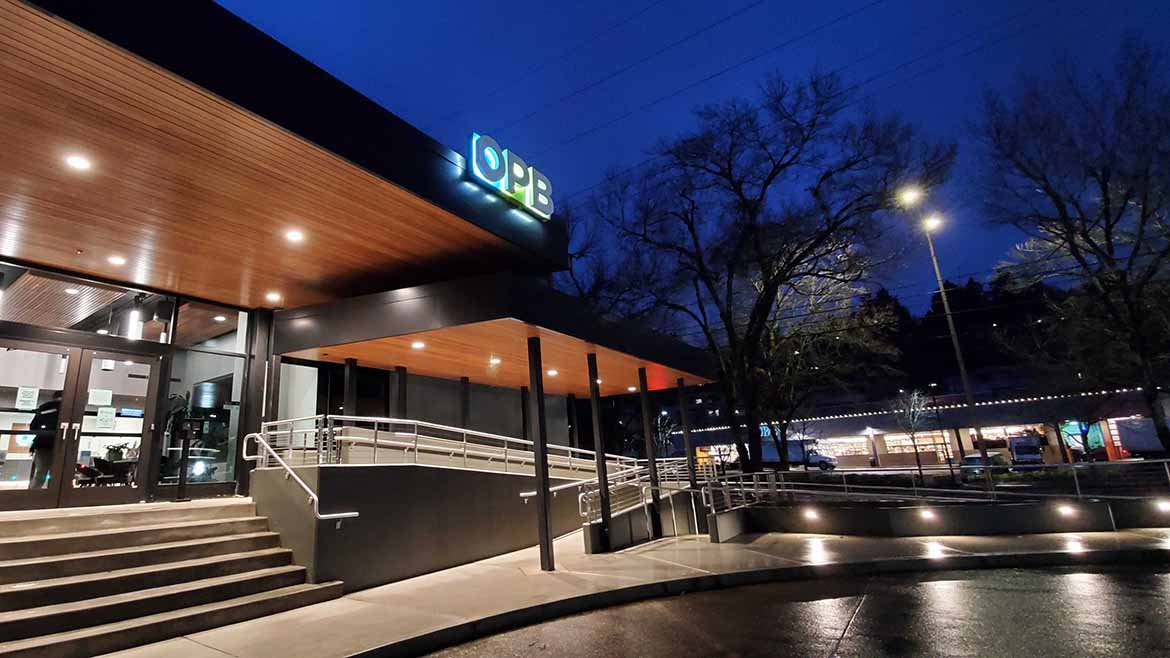
Devin Dousay / OPB
OPB's headquarters in Portland.
The union representing content staff at Oregon Public Broadcasting and its jazz station KMHD in Portland has agreed to its first contract following nearly two years of negotiations with management, securing provisions that include annual pay increases and a raise in salary minimums.
The three-year contract took effect April 27. It includes increasing the minimum salary for union-represented employees from around $53,000 to $65,000, with unit members who earned less retroactively receiving increases for the period beginning July 1, 2025.
Furthermore, content staff are guaranteed annual salary increases of at least 3% over the course of the three-year contract, a transition from merit-based salary increases. The contract also includes protections pertaining to layoffs, severance, grievance procedures and the use of AI likenesses of employees.
The unit comprises more than 90 members represented by the Screen Actors Guild – American Federation of Television and Radio Artists, making OPB the largest public media organization on the West Coast with SAG-AFTRA representation. It includes hosts, reporters, on-air staff and audio, digital and video producers, eight of whom are KMHD employees.
The contract was adopted following ratification by the unit of unionized staff, the local SAG-AFTRA chapter and the National Labor Relations Board.

“I’m very, very happy with what we were able to do,” said Lillian Karabaic, host of OPB’s Weekend Edition broadcasts and a member of the unit’s negotiating committee. “We have some members who saw really significant raises come out of this contract, especially people … that were making the lowest levels within the unit.”
In a statement, OPB CEO Rachel Smolkin said negotiations were “grounded in mutual respect and a shared commitment to our employees and our organization,” adding that she believes “the agreement represents important progress.”
“Despite the ongoing, annual loss of $5 million in federal funding, through the support of our members and sponsors, we are demonstrating our equity values by applying a living wage standard for all employees at OPB and KMHD,” Smolkin said in the statement.
Numerous OPB engineering, operations, IT, administration and member services staff are already unionized, represented by the Service Employees International Union Local 503. They are currently in the fourth year of their contract, which expires at the end of June.
Aiming for the ‘largest impact’
Negotiations between content staff and OPB began after station management voluntarily agreed to recognize the SAG-AFTRA unit in early 2024. Talks spanned more than 20 months and 35 bargaining sessions, Karabaic said.

The unit aimed for its first contract to create the “largest impact for the largest number of people,” said Crystal Ligori, OPB’s All Things Considered host and a member of the negotiating committee. That included both raising minimum salaries to a living wage for the unit’s lowest-paid members and easing healthcare costs for families of anyone at the organization, she said.
In addition to raising minimum salaries to $65,000, the contract commits OPB to covering a larger portion of family and spouse health insurance, Ligori said. The organization will also provide cellphones for all employees, which is useful for limiting sources’ personal access to employees, Ligori said.
These provisions were “really crucial for us to do,” she said, adding that “like a rising tide lifts all ships,” the union pushed for changes “not just within the unit but for the organization as a whole.”
Moreover, Ligori said the unit pushed to include provisions in the contract that ensure employees receive hazard pay when required to work in the field under unsafe conditions and compensation when using languages in their reporting other than English or assisting with translations.
The unit also secured minimum pay for employees who come into the station for short shifts and adjusted the status of fill-in hosts, who were previously considered temporary employees, to part-time employees and unit members, guaranteeing they get paid at the higher minimum rates of their positions.
The contract also creates guardrails around the use of AI, which Ligori said will protect unit members’ jobs. It primarily restricts OPB from utilizing an AI-created likeness of any unit member’s voice or appearance.
Other provisions included language regarding severance and layoffs, which Karabaic said the organization previously lacked guidelines for. The provisions commit OPB to a paid notice, in addition to further compensation depending on years of service. It also includes a “right of recall” to reintroduce an employee into the unit should a comparable position open within a year of layoffs, Ligori said.
Karabaic said the unit included these provisions in response to the widespread industry layoffs that have followed the rescission of federal funding for public broadcasting. They guarantee that employees know “how they’re going to be treated if they do have to separate from their station,” she said.
“That was just such a huge thing, because I saw very different outcomes for folks at nonunion stations versus union stations with all of the layoffs with federal funding being cut last year,” Karabaic said.
Though negotiations were occasionally tense, Ligori said that OPB was committed to the bargaining process and did not try to “stonewall in any way.”
Karabaic said negotiations were bound by a mutual objective to “get it right” and create a contract that “would be able to represent the most people but also would be enforceable.”
“We didn’t want to create something that would be hard to enforce on a day-to-day basis,” Karabaic said. “We wanted to make sure that it was comprehensive but also reasonable and practical and supported all of our creators.”
A collective push
For Karabaic, a key factor in getting the agreement across the finish line was solidarity, both from the community and within the station. She said public media and Oregon-based unions issued statements and reshared posts expressing solidarity with the unit and that high-ranking staff members advocated for their peers who earned less.
“We’ve had a lot of our personalities, who people know and love, stand up and say, ‘I make a good living, but I want that to be true for all of my coworkers as well,’” Karabaic said. “We never would have been able to get this done … if we didn’t have all of the force of all of the unit standing behind us.”
Ligori said that in future negotiations, the union will look to secure provisions affecting smaller segments of the unit. In the meantime, she said, she hopes other unionization efforts across public media can learn from the unit’s success.
“OPB and the union really came together to do what is best for their employees, both within the unit and outside of the unit,” said Ligori. “I really hope that this is an example for both other unions and also other stations, managers and owners.”