

BTPM unveils dual-format NPR-classical lineup alongside new commercial station
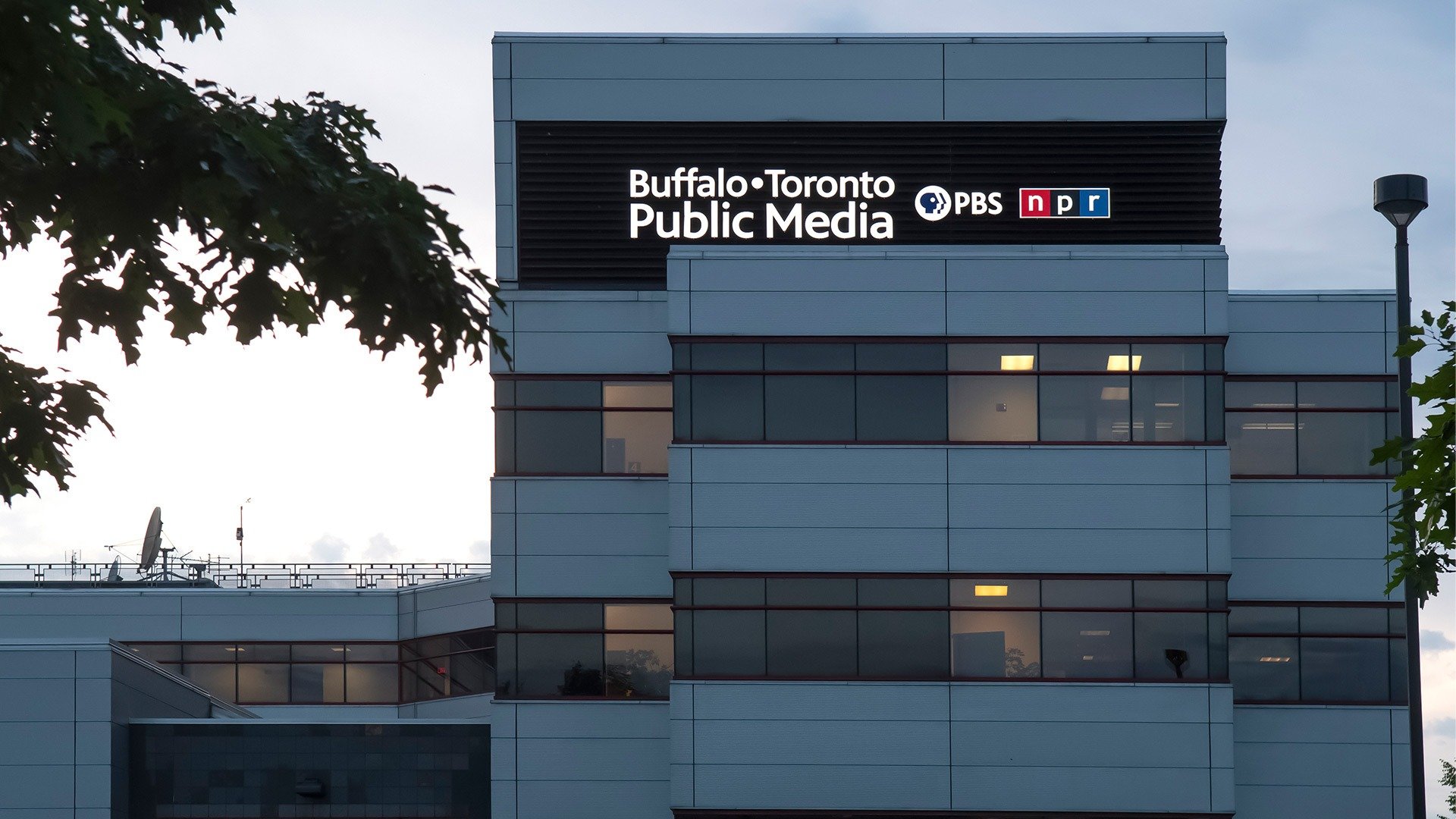
BTPM’s headquarters in Buffalo, N.Y.
Buffalo Toronto Public Media will launch a broad-based news format in the coming months on a signal it converted to commercial status while turning its NPR station into a dual news-classical format.
With the changes, which BTPM announced Friday, classical programming will move from the broadcaster’s 94.5 FM to 88.7 FM, now the NPR news station. The commercial news station will be financed by both advertisements and member support, according to CEO Tom Calderone.
The shift follows BTPM’s decision to convert WNED-FM, the 94.5 signal, to commercial status last month in response to the loss of CPB funding. Calderone said the organization’s decision to wait until at least May to implement the changes gives it time to “be surgical” in the execution.
There are “still lots of moving parts, but so far the reaction internally and externally has been very positive,” Calderone said. “It’s now our job to direct people to where they can find their favorite shows.”
Another pivot
Calderone said the FCC approved BTPM’s application to modify WNED’s status within a week of its submission Jan. 30, sooner than expected. The station had expected a decision in May or June, he said.
“We were so appreciative of that speed on the FCC side, that we’re able to then say, ‘Okay, let’s go into high gear and figure out what we’re doing with this,’” Calderone said.
The organization initially planned to retain WNED’s classical format and introduce advertisements upon switching it to commercial status. But after consulting with the station’s classical hosts and engaging audiences through emails, phone calls and public forums, Calderone said, BTPM leadership pivoted to moving classical to WBFO 88.7, the current NPR station.

Audiences “understood the rescission, they understand why we had to do this, but there was this thing bugging them a little bit about having commercials next to Mozart and Bach,” Calderone said. “We always respect our audience, so that’s why we made the switch.”
With the audience feedback in mind, the organization decided the best way forward would be to make 94.5 primarily news and information-based, a format Calderone said would better suit commercial advertisements.
When BTPM approached distributors of national programming about the new business model, Calderone said, NPR determined that it would not allow its shows to air on the commercial station. “I just don’t think NPR is in that place right now that they’re thinking this way,” he said.
So BTPM decided it would consolidate NPR tentpoles like Morning Edition and All Things Considered with classical programming on 88.7 while moving the news station’s original programming, such as What’s Next?, Friday Night Lights, Skin in the Game and Group Chat, to 94.5 FM.
Meanwhile, American Public Media gave BTPM permission to air its shows on the commercial station, and the station is negotiating with other distributors, Calderone said. BTPM NPR currently broadcasts Radiolab and The New Yorker Radio Hour, which are distributed by WNYC.
The updated format on 94.5 will feature programming that now airs on 88.7, including news, public affairs, high-school sports and evening simulcasts of The Bridge, BTPM’s alternative music stream. Station reporters are pitching ideas, and commercial podcasters have also reached out, Calderone said.
A new model
BTPM has always had it “in the back of our minds” to create a wide-ranging format, but the clock restrictions that come with being an NPR affiliate didn’t give it the bandwidth, Calderone said. He added that the new station’s model reflects over a year’s worth of conversations he’s had with people in the industry about ideas like airing NPR programming on commercial radio but that he understands NPR’s reluctance to allow it.
“I think the assumption is everyone’s talking about it, but there are just some people that haven’t talked about this stuff yet,” Calderone said. “They obviously have a lot on their plate, and this is just … not a priority in their agenda.”
As for the 88.7 signal, Calderone sees big opportunities for the NPR-classical-hybrid format.
“Now that classical has Morning Edition and All Things Considered, we’re excited that there might be more sampling of our classical music station, which is one of the few in this country that is still locally programmed and locally hosted,” Calderone said. “This will give them, hopefully, a little bit of a steroid into their morning and afternoons with the great NPR programming.”
Starting a new dual-format station may buck long-running trends among public radio stations, but Calderone said it mirrors modern-day listening habits.
“I wish that we were living in a day where someone has the radio on nine hours a day,” he said. “That’s just not reality anymore.”
He added that the dual format is “no different from the way people consume podcasts. You might listen to a true crime podcast and then switch over to a comedy podcast and then to a pop culture podcast. That’s how you consume content now.”
BTPM will still offer a full-time classical format on an HD2 simulcast on 88.7, an online stream and an FM station in Jamestown.
Diverse appeal
Calderone said one of the benefits of the new format on 94.5 is the opportunity to reach several different demographics.
While the station is committed to abstaining from “screaming car ads” and infomercials, he said the freedom from FCC restrictions on descriptive language and calls to action will open up more robust opportunities for existing underwriters and interested advertisers. The advertisements will appeal to various facets of the station’s projected diverse audience base.
“There are already a few examples of people who [have said], ‘I would love to be on with you guys. I just want to tell the world that I have great coffee, and I just can’t say that on your station,’” Calderone said. “The fact that that’s going to be able to happen now is going to open up the portfolio of pitches to a whole new level.”
BTPM also plans to continue holding fund drives on 94.5. In the meantime, Calderone said, the next objective is to ensure that BTPM’s current audience understands the upcoming changes.
“Once we get our sea legs with 94.5, with a lot of the shows that people are used to hearing like Marketplace and all that, I think then we’ll go out for a larger cume,” he said.
BTPM doesn’t yet know how much revenue the changes will bring, Calderone said, adding that they’re part of a series of efforts to adapt to life after CPB.
“This is just one of the many ideas around how to bring revenue into this building to close this $2.2 million gap every year,” he said.
Correction: An earlier version of this article incorrectly referred to The Bridge as a show. It is a stream.





Didn’t pubradio programmers prove beyond any shadow of a doubt over the past 25+ years that dual-format NPR News/Classical is a certain pathway to underperformance. The organizations in larger, medium and medium-small markets who have stuck to this approach (you know who you are!) tend to be the least-listened-to stations in the system by just about any metric you care to apply — P1 / loyalty, listening occasions and duration, share, etc. They are often also the most financially fragile.
In this second quarter of the 21st century, could it be any clearer that listeners are content to make their own “variety?” Ever-increasing audience fragmentation is as certain as the sun coming up tomorrow. The only guarantee that comes with straddling format lanes is that you’ll be run over.
I don’t think you’re wrong, Duncan, but this is clearly a special case. Whether anyone wants to admit it or not, what BTPM is doing is seeing whether or not they can survive, if not succeed, without the NPR newsmagazines (ME & ATC) in a post-CPB world. The point is that the new commercial 94.5FM will become the flagship station, and the existing dual-format 88.7 will be the afterthought where they keep the newsmagazines…probably at a steep negotiated discount.
The X factor here, of course, is Canada. While in general, NPR and PBS programming tends to be VERY popular in Canadian cities…but neither 88.7 nor 94.5 really reach Toronto all that well. Allegedly the radio listenership is pretty minimal, even though WNED-TV is quite popular.
I get the distinct sense that NPR is not in a discounting mood these days with medium and larger market operators. Nor should they be. Despite the recent findings from Edison about the shift in listening from linear broadcast, ME and ATC remain powerful magnets. If a station is not seeing net revenue from those programs which subsidize most everything else we air or create, they are doing something wrong.
Small/rural, mixed-format, community stations notwithstanding, the “my market is different” rationale for dual format NPR News-Classical — favored by GMs who do not understand how people use radio or are cowed by their boards or licensees — holds even less water now than in the 90s when the research community challenged us to up our public service game. Returning to faulty practices just digs the funding hole deeper.
I may not have been entirely clear: I don’t think there’s a lot of “my market is different” thinking going on in BTPM. I think they’re putting all of their efforts and focus on creating a new, commercial, news/talk format for Buffalo that’s independent of the public radio ecosystem. Their concern is that NPR is dying, and they’re so concerned about it that they’re trying to see if they can make something else work to replace it.
Putting the dual-format on 88.7 is a sop, really. It’s so the local populace won’t scream in anger about “taking away our Morning Edition” or “taking away our classical music.” That’s not the only reason, but it’s a big one. Quite possibly the largest one.
Now obvious I’m not going to say that BTPM doesn’t care if 88.7 succeeds or fails *at all*, because that’s obviously untrue. I’m sure they’d love it if it still makes money. Heck, I think they’d be OK with it “only losing a little money.” And I’m equally sure that if 88.7 starts bleeding red ink, that’s a problem.
But, in general, how well 88.7 succeeds or fails will play second fiddle to **how well 94.5 succeeds or fails.** The point of this whole experiment is to make 94.5 succeed, likely at all costs. They want to know that if the current NPR-centric incarnation of “public radio” ends up dying…which I think is a VERY valid concern…that there’s a future for BTPM along a completely different path.
So again: I don’t think you’re wrong at all! Dual-formats are a loser of a strategy FOR THAT STATION. But that station (88.7) is not the station BTPM is primarily worried about anymore. That’s why I say it’s a special case: BTPM has the luxury of two full-market FM signals to do this kind of experiment with.