
Stations try to keep Learning Neighborhoods alive after Ready to Learn cuts
Idaho Public Television
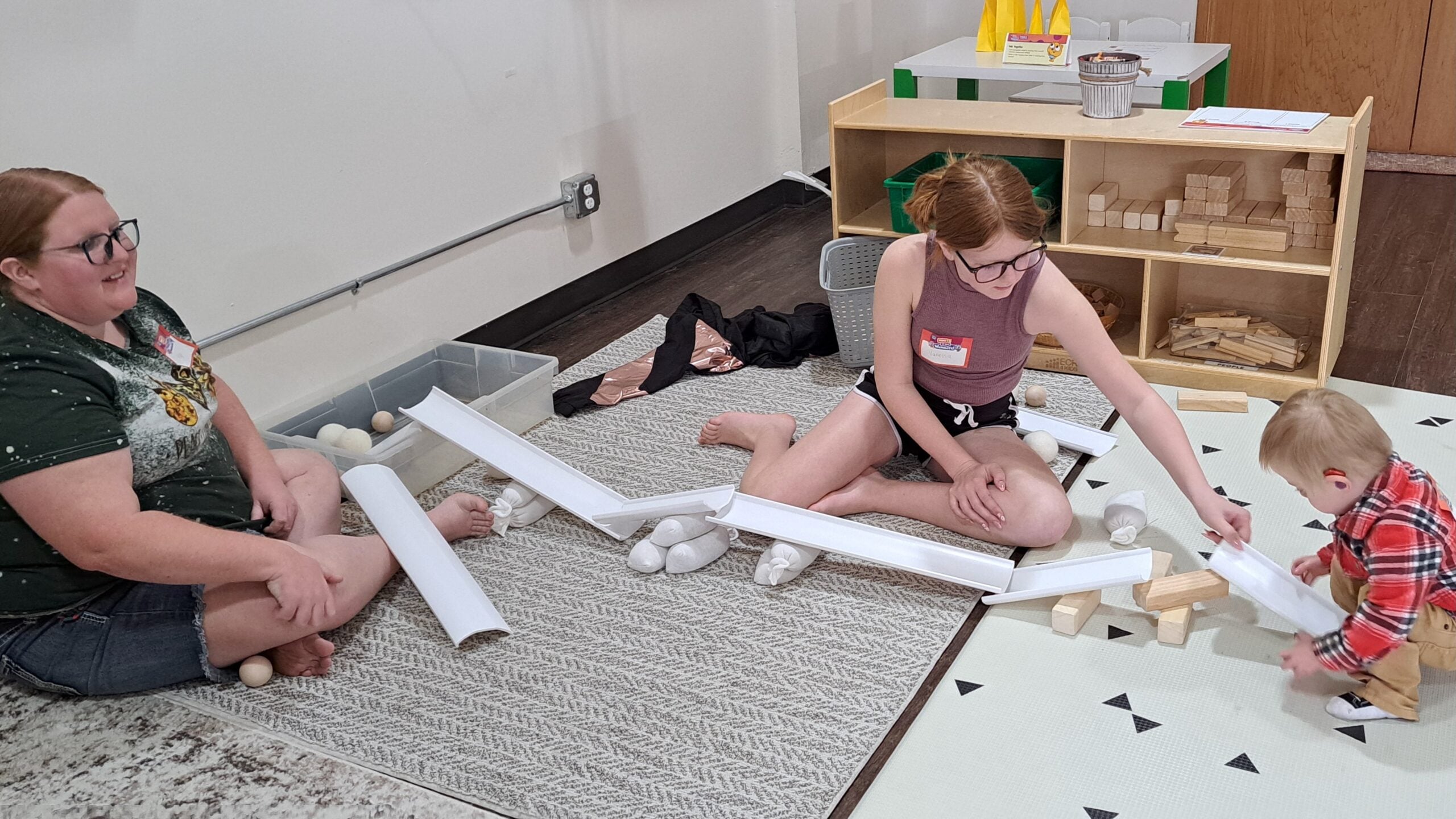
A family participates in a problem-solving exercise at a Ready to Learn workshop at The Garden children's center in Potlatch, Idaho.
Lenea Pierzchanowski has spent the last three years getting to know a small community in rural Idaho. A city of around 800 residents, Potlatch sits in the middle of what Pierzchanowski calls a child-care desert.
Pierzchanowski, an education specialist for Idaho Public Television in Boise, has visited Potlatch farmers’ markets, homeschooling co-ops and child-care centers to provide fun and educational activities for kids and families.
“It was supposed to be a one-time deal, and then they just kept asking me back,” Pierzchanowski said. “So the kids got excited.”
Pierzchanowski was creating a Learning Neighborhood in Potlatch with funds from a Ready to Learn grant from the U.S. Department of Education, which also supported the creation of her position. Learning Neighborhoods are collaborative projects between public media stations and community partners, designed to use public media content for new programming at local schools, libraries and child-care centers.
Learning Neighborhoods launched in the fiscal year 2020 RTL grant cycle with the awarding of $105 million to CPB and PBS. The winning proposal outlined a community engagement model that aimed to establish 40 Learning Neighborhoods over the course of the five-year grant. In 2024, PBS announced that 41 member stations had launched Learning Neighborhoods.
That work was thrown into limbo last year when the Department of Education abruptly terminated the 2020–25 RTL funding. The termination resulted in a loss of $23 million for RTL projects, according to PBS, which furloughed 25% of its PBS Kids staff following the funding cut.
The RTL termination, followed by the rescission of federal funding for public media, left stations with fewer options to sustain Learning Neighborhoods. Pierzchanowski was forced to end her work in Potlatch, and IPTV canceled events planned for the rest of the year.
“I had worked really hard to build trust and transparency and relationships,” Pierzchanowski said. “I feel that a lot of the communities felt like that trust was broken.”
In the wake of the grant’s termination, IPTV’s education team faced resource gaps. Director of Education Kari Wardle said the station was able to keep Pierzchanowski’s position but had to scramble to do so.
Wardle said the education team had planned to develop other Learning Neighborhoods in similarly unresourced communities and to find an outside funder to sustain the program. Since the team thought it had two years to secure that funding before the RTL grant ended, it was left empty-handed.
“We would love to do Learning Neighborhoods in other communities,” Wardle said. “It’s just been that funding source that we’ve not been able to tap into yet.”
New York projects stall
Some stations have been able to sustain Learning Neighborhoods with outside support. KERA in Dallas announced in November that it would expand its Learning Neighborhoods into Fort Worth. KERA President Nico Leone said the station has been doing local fundraising to support its early childhood education programming.
WQED in Pittsburgh has continued its Learning Neighborhood programming with external funding, according to CEO Jason Jedlinski.
“Local employers and community supporters have stepped up to help us bridge part of the gap here in western Pennsylvania,” Jedlinski said. “But the loss of this support will be felt nationally in the educational media available to young children.”

But not all Learning Neighborhoods are able to continue. The WNET Group in New York City canceled its planned events last year after the termination of RTL funding. It had spent the five years of its grant staging more than 170 events in Brooklyn’s Brownsville neighborhood.
“We really focused on family engagements, so a lot of family workshops, a lot of kids and parents working together,” said Norah Jones, lead content producer with the WNET Group’s kids’ media and education department. “And that was really popular in the community.”
Sandra Sheppard, director and EP of WNET’s education department, said it’s hard to imagine finding other funding amid the challenges caused by the loss of federal support.
“It’s a void in the community,” Sheppard said. “The institutional relationships [are] very strong there, but there are no Ready to Learn resources to continue the programmatic efforts.”
Sheppard said the WNET Group will look for ways to continue building the “very strong partnerships” it made with community organizations, some of which will sustain projects developed as part of the Learning Neighborhood. United for Brownsville, a nonprofit that serves the community’s Black and brown children and families, will continue operating an early-intervention program for at-risk youth that it created in partnership with WNET.
A possible future?
Prospects for new Learning Neighborhoods and other RTL projects appeared to be looking up when the Department of Education and the Department of Health and Human Services announced May 8 that they would accept applications for $31 million in RTL funding for FY26. The agencies plan to award one to three grants, with an application deadline of July 8.
But RTL’s future darkened yet again when the House Appropriations Committee passed a Labor, Health and Human Services, and Education spending bill June 9 that did not include RTL funding for FY27. In a report accompanying the bill, the committee said it “has chosen to prioritize funding for local school districts to improve student outcomes in the core curriculum of writing, reading comprehension, and math.”
IPTV’s Wardle said that with CPB no longer around to serve as an intermediary for the RTL grants, she didn’t know whether her station could expect to receive funding for its Learning Neighborhood. But she said Idaho PTV would like to continue the work and has been asked to join a group of stations that are applying, she said.
Wardle said that as her team seeks additional funding, the demonstrated impact of its programming in Potlatch will be useful.
“Now we have proof of performance,” Wardle said. “We have people that will speak to how wonderful it is.”