
Lawmakers eye funding stream for NJ PBS, local news
Famartin / Wikimedia Commons
This article was first published by the New Jersey Monitor and is republished here under a Creative Commons license.
New Jersey lawmakers are poised to tap unused film tax credits to shore up the state’s local and public media.
The Senate Economic Growth Committee discussed legislation Monday that would allow the New Jersey Public Broadcasting Authority to auction off millions in tax credits each year to generate funding to back hyperlocal news outlets and the state’s faltering public media organization.
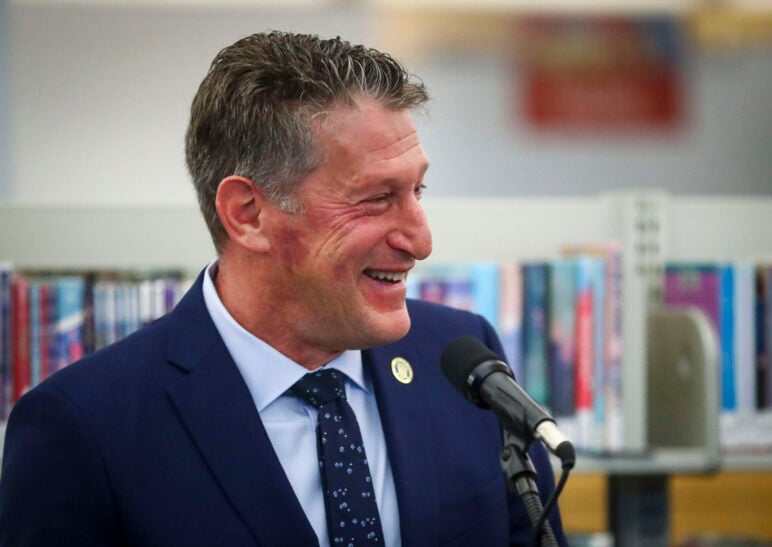
“Public media is going through a transformation of what it looks like in this new ecosystem, and New Jersey struggles to have a Jersey-specific focus from north to central to south to the shore and every single piece,” said Sen. Andrew Zwicker (D-Middlesex).
Though the present version of the bill calls for $20 million to be annually pulled from the $400 million in yearly film tax credits New Jersey authorized through 2049, Zwicker said that amount would be reduced to $15 million. Zwicker also said a $15 million appropriation from the state’s general fund will be removed from the bill to detach funding for local and public media from the state’s annual budget process.
Bolstering New Jersey–focused media is important as residents increasingly turn to social media feeds for news, said Sen. Nilsa Cruz-Perez (D-Camden), the panel’s chair.
“It’s scary that people think social media, Facebook and all the other outlets, are the ones who are giving you information,” she said. “Sometimes that information is not true. It’s been put in there without any research whatsoever.”
Recent budget cycles have not been kind to public media.
In the 2024 fiscal year, state funding for the New Jersey Civic Information Consortium, a nonprofit created to fund and encourage local journalism, totaled $4 million. It fell to $3 million the following year, then to $2.5 million in the current fiscal year. Gov. Mikie Sherrill’s first budget proposal would zero out that line item.
As written, Zwicker’s bill would direct at least $5 million annually to the consortium, but it’s unclear how those details may change before the bill sees a committee vote.
The consortium has provided some funding to the New Jersey Monitor.
The governor proposed cutting a separate $1 million line item supporting NJ PBS and NJ Spotlight News, its news arm, to $250,000. That reduction added to deeper federal cuts that prompted WNET, the corporate parent of NJ PBS since 2011, to shed public broadcasting.
State officials last week announced Montclair State University had been awarded a contract to run New Jersey’s four public television stations for up to 15 years as part of an agreement that includes weeknight newscasts and other public affairs programming.
The bill’s supporters said reliable funding would enable local government news coverage that has largely disappeared in New Jersey compared to the decades of yore.
“We’ve witnessed firsthand the rapid decline of local journalism. Major publications have either ceased publication or have closed. The consequences are stark: New Jersey now ranks 49th out of 50 states in terms of journalists per capita, leaving our residents without reliable local news essential to a functioning democracy,” said Lisa Sahulka, the consortium’s executive director.
Dedicated funding would allow the consortium to expand, Sahulka said.
Since being signed into law in 2018, the consortium has issued more than $12 million in grants, which are funded by individual and corporate donations alongside state assistance.
“People like my parents need good, strong journalism, good civil information now more than ever,” said Jerome Montes, a member of the consortium’s board. “This is very much a worthwhile investment. It’s worth it both for the strength of our democracy and the individual decisions that millions of residents make with regards to their pocketbooks and with regards to what goes on in their townships every day.”
Some of the bill’s provisions are still under negotiation, Zwicker said, and the legislation was not ready for a committee vote Monday. He hoped to advance it before the Legislature breaks for its customary summer recess, which generally starts July 1 after the state budget is signed.
“We’ve got a few more details to work out. I hope to get this bill in front of the committee for a full vote in the very near future, but the most important thing here is that we’re working together to create a vibrant, thorough, New Jersey–centric broadcast and media ecosystem,” Zwicker said.