
PBS chief calls for Arkansas public TV commission to ‘take a pause’ on leaving national network
Tess Vrbin / Arkansas Advocate
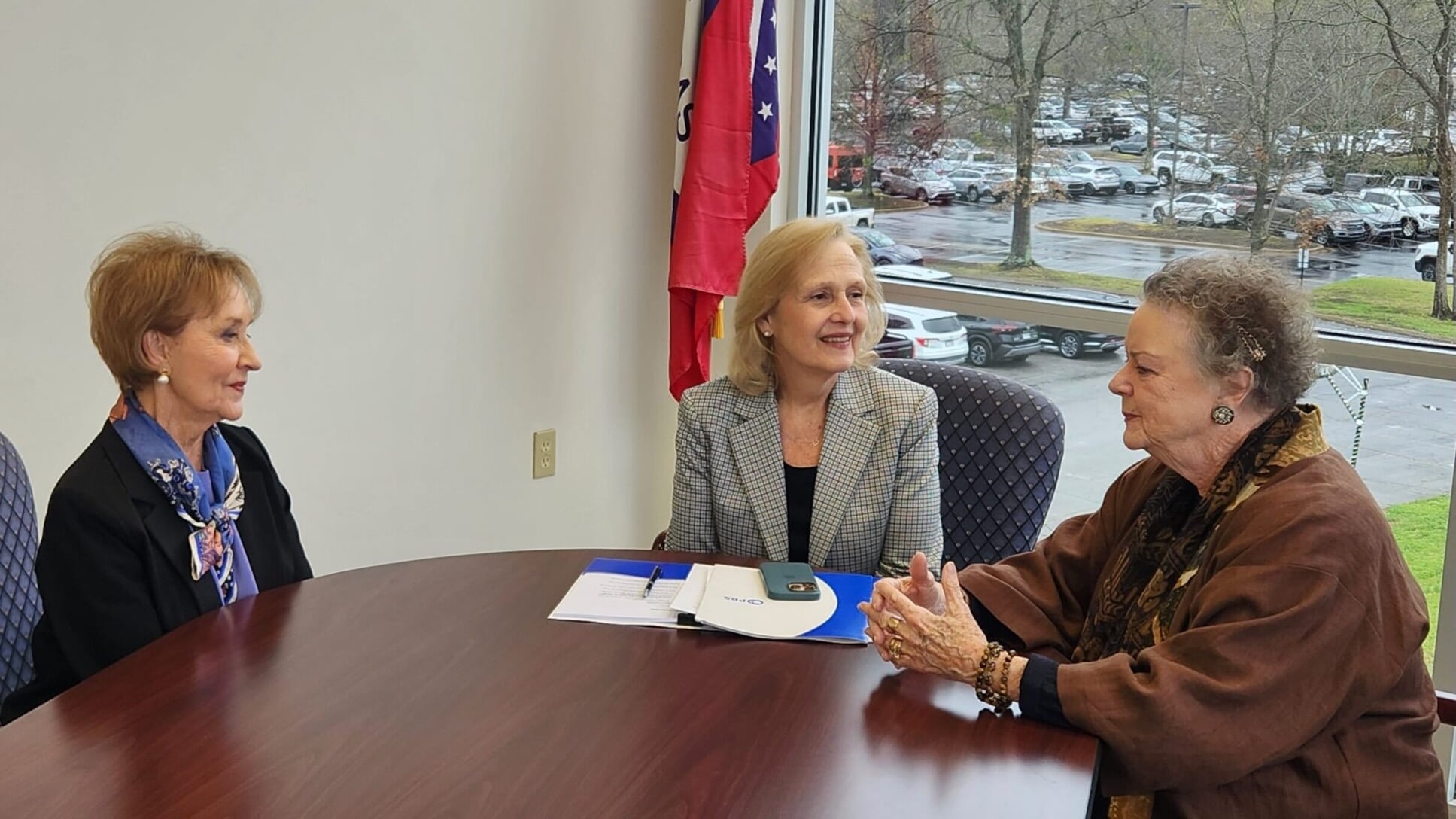
Former Arkansas First Lady Gay White, widow of Gov. Frank White; PBS CEO Paula Kerger; and former Arkansas First Lady Barbara Pryor, widow of Gov. David Pryor, chat Wednesday during Kerger’s visit to Little Rock. The women spoke in advance of their plan to appear before the Arkansas PBS Commission Thursday to urge commissioners not to cut ties with the national PBS network.
This article was first published by the Arkansas Advocate and is republished here under a Creative Commons license.
The Arkansas PBS Commission might see unusually high attendance at its quarterly meeting Thursday. That audience will include PBS CEO Paula Kerger.
Kerger said Wednesday she hopes the crowd signals to the board of Arkansas TV, formerly known as Arkansas PBS, that it should take a pause on its decision to cut ties with the national public television network.
The commission’s vote last year came as a shock to PBS headquarters and to Arkansans who have relied on PBS shows like Clifford the Big Red Dog and Ken Burns’ documentaries.
Arkansas TV CEO Carlton Wing has repeatedly said that continuing to pay PBS dues would be financially unsustainable. The Corporation for Public Broadcasting announced its closure last year due to a loss of federal funding, but Arkansas is the only state whose PBS station responded by splitting from the network. The separation is expected to be complete by July 1.
Many viewers and donors decided to stop financially supporting Arkansas TV, according to emails to and from the agency obtained via a public records request. Two former Arkansas first ladies, Barbara Pryor and Gay White, chair the new Friends of Arkansas PBS advocacy group.
Pryor and White plan to join Kerger at the commission’s 10 a.m. meeting Thursday at Arkansas TV’s Conway headquarters. In an interview with the Arkansas Advocate, Kerger talked about the state’s decision to split from PBS and efforts to get the commission to rethink its decision. This interview has been edited for clarity and length.
Arkansas Advocate: What message do you think it sends if tomorrow the commission sees a crowd they haven’t seen before, a crowd of people all there for the same reason?
Kerger: They should be talking to the public. [For] a move this significant, the public should at least be part of the conversation. What I’m going to suggest to the commission is that they take a pause, get the public’s input and look very hard at the suppositions they made in constructing why they feel they have to leave PBS.
This is a brand-new team. They’ve got a general manager that has only been in the role for a few months. How do you understand how this all works if you’ve only been in the job [that long]? So they just need to give themselves a little breathing room to look carefully at what their options could be. I listened to the [commission’s] last hearing, and there was a lot of information in it that was just not accurate.
Arkansas Advocate: What was the biggest or most striking inaccuracy?
Kerger: They said that they had to vote immediately, or otherwise they would be stuck with PBS for a full year [starting July 1]. It’s not true. We have a policy that if a station does in fact decide to leave PBS, they need to give us 180 days’ notice. It’s just on a rolling basis.
It would have been great if Carlton [Wing] had actually called us before the decision to disaffiliate. I have been in this job for 20 years — Friday will be my 20th anniversary. I have never been in a circumstance where someone has made a decision this big and never even talked to us.
Arkansas Advocate: There’s been a downturn in financial contributions to the station since the vote to disaffiliate. If Arkansas TV has less money, how is it going to fund its plan to produce in-house content that fills the gaps left behind by PBS shows?
Kerger: It doesn’t make sense. They’re going to have to build their own app. They won’t have the carriage on YouTube TV and Hulu and all these other places where people are going for our content. I just want the commission to know we will work with them in whatever way they need to help them understand and quantify everything that they’re going to have to figure out how to replace.
Arkansas Advocate: How encouraging is it that Friends of Arkansas PBS exists, that it has two former first ladies behind it, and that people seem motivated to show up at tomorrow’s commission meeting?
Kerger: I think it’s profound that two former first ladies of two different parties are reminding everyone of the importance of PBS, particularly our services for kids, and particularly right now in this state, as everyone [in government] is focused on education.
After the [CPB] defunding, contributions really began to flow into the station. I would have leaned into that and tried to make sure the community understands that the station will only exist if the people support it.
This state has a significant number of kids that are not enrolled in formal pre-K. We are that for them, and a lot of those kids watch us over the air. Big pockets of Arkansas are not well-covered by broadband. Saying, “Well, you can stream it, or you can do this or that” — that’s cutting out all those kids. We want to make sure that the first time they walk into a school, they have a certain understanding of basic concepts in math and literacy and problem-solving skills. All of this is the stuff that we build.