

How YouTuber Johns Hopkins brings stories of Baltimore history to WYPR
Baltimore Heritage
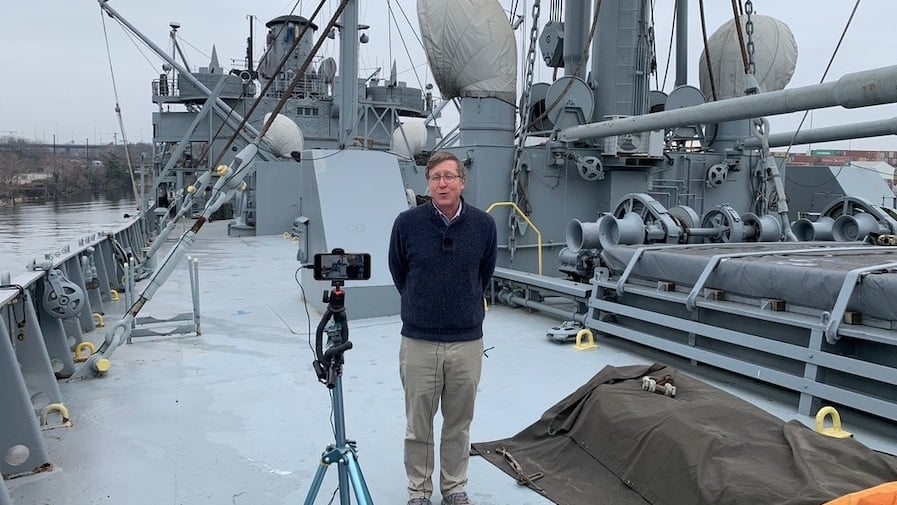
Hopkins on board the S.S. John W. Brown, an operational World War II–era Liberty ship that is berthed in Baltimore Harbor.
Johns Hopkins, host and creator of a YouTube series about the history of Baltimore, can’t help but laugh at the fact that the show’s title, “Baltimore Heritage’s Five-Minute Histories,” is a complete and utter lie.
Out of nearly 400 videos produced since 2020, “exactly zero of them are five minutes,” Hopkins says. “They’re all over five minutes.”
Hopkins, whose name reflects a distant family connection to the philanthropist who established Baltimore’s renowned university and hospital, began producing the YouTube videos during the coronavirus pandemic. Posted on the channel of Baltimore Heritage, the historic preservation nonprofit that he directs, the videos explore the rich and complex history of Charm City.
Now Hopkins is working with Baltimore’s WYPR to adapt stories from the YouTube show into a podcast and feature segment, Five Minutes of Baltimore History. With a running time of exactly four minutes, the title for the WYPR series is another misnomer.
The stories air during local breaks in NPR’s All Things Considered, so there’s no wiggle room to go longer or shorter. Hopkins admits that hitting the exact length has been the hardest part of adapting his histories for audio.
“That has required a lot of discipline for me in a way that I had not been used to,” Hopkins says. “Every word has to be useful because we don’t have that much time.” After recording sessions at WYPR, he leaves the studio feeling frazzled by the mental workout of distilling his stories.
But there is a payoff for all that effort. Since Five Minutes Of Baltimore History debuted last fall, Hopkins has begun to feel like a minor celebrity around town. When he starts a conversation or introduces himself, people often recognize him and start talking about a story they’ve heard on WYPR, he says: “It’s happened a lot.”
The conversations invariably veer into memories or personal connections to the story. “It’s been really neat to be a part of a big community discussion,” he says.
The WYPR features launched in November with a story about Formstone — a type of stucco that was applied to exteriors of Baltimore row houses after World War II. Since then, Hopkins has delivered comprehensively detailed stories about architectural heritage or notable historical figures, such as Little Willie Adams, a prominent businessman who got his start by running an illegal lottery, and a description of Billie Holiday’s life as a child growing up in a historic neighborhood. Hopkins narrates the entire four minutes of each segment, giving listeners tips for what to look for if they want to go out and explore.
YouTube launch
It’s all the more surprising that Hopkins isn’t a Baltimore native. He grew up in St. Louis, studied history at Yale and moved to Baltimore in 1999.
Johns Hopkins, the Baltimore philanthropist whose bequest established Johns Hopkins University and Johns Hopkins Hospital, is “a very distant relative,” explains his descendant Johns Hopkins, executive director of Baltimore Heritage since 2003. “A great, great, great, uncle to the eighth degree.”
Baltimore Heritage is dedicated to historic and architectural preservation. It offers popular walking and bike tours of historic buildings and sites to build awareness of the city’s rich history.
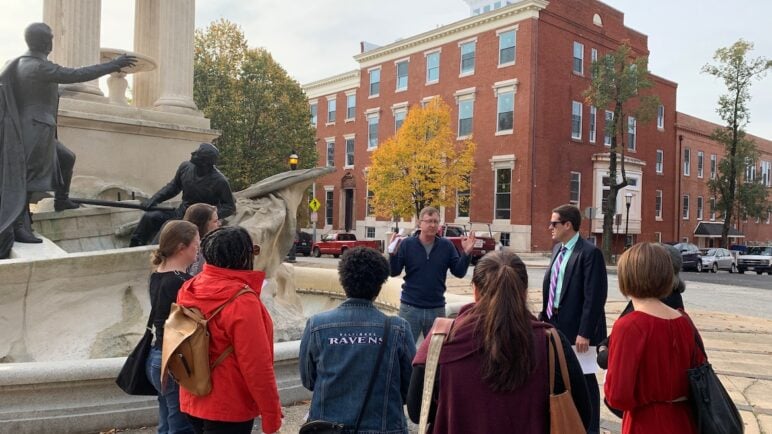
When the coronavirus pandemic brought Baltimore tourism to a halt in March 2020, Hopkins decided to record video histories in his living room, with his son running the camera. “Baltimore Heritage’s Five-Minute Histories” launched on YouTube with the story of the historic building where, beginning in 1912, the Hendler Creamery Company pioneered manufacturing and packaging processes for ice cream.The first video clocked a running time of 6:12.
“I thought maybe we’d get four or five neighbors who would watch,” Hopkins recalls. “But we got 200 people within the first hour.”
Encouraged by the response, Hopkins continued recording daily episodes from home over the next three months. Each video got at least 1,800 views, but some attracted as many as 11,000.
When lockdown restrictions eased, Hopkins began recording videos outside, starting with Graffiti Alley, an intersection of alleys within an arts district where graffiti artists can practice their craft. Baltimore Heritage’s YouTube channel now has a collection of nearly 400 “Five-Minute Histories” and nearly 18,000 subscribers.
Craig Swagler, WYPR president and GM since 2023, has been watching the video series all along. “I realized that there was a narrative there that could really translate into a bigger audience,” he says.
To Swagler, the videos align with WYPR’s mission to elevate the community while being honest about its messy and complex past. Plus, Hopkins brings knowledge, innate warmth and contagious enthusiasm to his stories. Swagler decided to explore how to adapt them for radio.
Content partnerships with Baltimore Heritage and other organizations that share public media’s values can help WYPR function as an “amplifier and town square” for the community, Swagler says. “We want to show our listeners, supporters, and community that we serve everyone with our broadcasting.”
Lisa Morgan, the WYPR producer who oversees Five Minutes of Baltimore History, says the show has the same lineage as “Pass The Mic” — an award-winning segment that invited Baltimore activists, artists and organizers to discuss topics on their minds.
‘Everyone can relate’
As a WYPR donor and listener, Hopkins was eager to adapt the series for radio. With so many stories from the YouTube show to draw on, Hopkins and Morgan had to think creatively about how to tailor stories for listeners, not viewers, Morgan says.
Hopkins “has a quirky voice,” Morgan says. “It’s not an authoritative voice.” He also has a knack for bringing playfulness to his stories. Even though a lot of Baltimore’s history is dark, he finds humanity in each story. “That’s something that everyone can relate to.”
With 2026 marking the 250th anniversary of the signing of the Declaration of Independence, Hopkins plans to dive into many more stories over the next few months. To demonstrate how cyclical history can be, he also wants to produce timely segments that respond to news events.
Meanwhile, Morgan is looking to bring Hopkins into WYPR’s live events. “I think John would be great at that,” she says. “Inviting people to places where no one else gets to go makes them very excited, especially if it’s a historic building. ”
Hopkins doesn’t see why other cities can’t replicate his Five Minutes formula to explore their local histories. “This could be done in Philadelphia, New York or Houston,” he says. Showcasing history is a way to help people fall in love with a city. “Or even helping them fall back in love with it.”