
Nine PBS campaign aims to raise $30M for renovation and community-centered collaborations

Courtesy Nine PBS
A rendering of the exterior of Nine PBS' renovated headquarters.
Nine PBS in St. Louis has raised $19.3 million for its capital campaign supporting renovation of its headquarters and an impact fund focused on its early education and community initiatives.
The campaign, which launched in January 2024, has a goal to raise $30 million, according to CEO Amy Shaw. About $20 million will help finance the renovation, though the building costs — and campaign goal — could increase based on final cost estimates. The remaining $10 million will go into its impact fund, which is investing in community engagement, media collaborations and Nine PBS’ preschool education program.
Nine PBS announced Nov. 3 more than $17 million in lead gifts from the Berges Family Foundation, the William T. Kemper Foundation and the Steward Family Foundation. The family of Jack Taylor, founder of the car rental company Enterprise, also provided lead gifts, including a donation from his granddaughter, Carolyn Kindle, who is president of the Enterprise Mobility Foundation.
A more collaborative workplace
The renovation is designed to allow the staff to work together more effectively, Shaw explained. Nine PBS’ workforce of 76 full- and part-time employees has grown by at least 40% since the late 1990s, when the building became its HQ.
The building lacks conference room space to accommodate Nine PBS’ regular internal and external meetings, Shaw said. And the layout is problematic, with workspaces spread across different floors and separated by walls.
“Our staff are really cut off from each other. We are a highly collaborative team, and the physical infrastructure of the building does not create that kind of environment,” she added.
Nine PBS has a flexible policy that allows for hybrid work outside of the office. “That works for us, but it’s also even more important that when people are together, they have the right kind of spaces that impact purposeful work,” Shaw said.
The renovation will also improve integration of the building and the adjacent Public Media Commons, an outdoor media environment and gathering place built more than a decade ago.
Design plans call for accordion doors that would open the headquarters’ lobby to the Commons. And restrooms in that part of the building will be moved to be more accessible during outdoor events, Shaw said.
“Those two spaces, while they are right next to each other, they actually feel quite separate,” Shaw said. “We’re going to actually be able to put those two things together.”
Plans call for staff to move into a temporary space in early fall 2026, Shaw said. The renovation is estimated to take about a year.
Impact fund
The impact fund is targeted at three priorities: bringing the community together, building a media collective and expanding early education efforts into new communities.
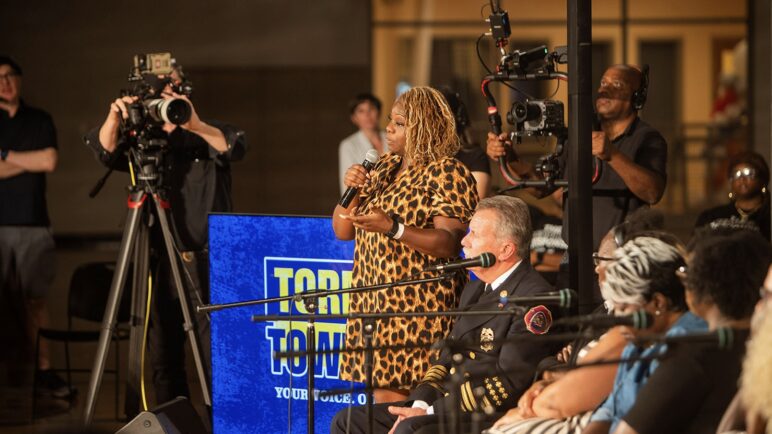
Some of the money has already been deployed, Shaw said. After a tornado destroyed neighborhoods across a 23-mile path of Greater St. Louis, Nine PBS ramped up production of content related to its impact and recovery efforts. The package included videos for social media and digital publication and segments for its weekly magazine program, Living St. Louis. In August, the station produced a televised tornado town hall with community leaders. Senior Producer Carol Daniel moderated the conversation.
Nine PBS has been convening community-based nonprofit organizations for 18 years around specific issues such as education or the Affordable Care Act, Shaw said. Now the practice is much more consistent, she said.
Early this year, Nine PBS started hosting “structured convenings” with nonprofits, said Chief Communications Officer Leah Freeman in an email. The meetings help Nine PBS serve as “the connective tissue between organizations and community efforts across St. Louis,” she added.
With support from the impact fund, Nine PBS will be able to host the meetings more frequently and include more nonprofits, Freeman said. Nonprofit leaders who have attended expressed a strong desire to expand the group.
“Bringing the community together isn’t just us that’s gathering information and story ideas and information that we can use in our content,” Shaw said. “It’s also connecting the dots on organizations who have assets that can be beneficial to the other organizations.”
Nine PBS also aims to build a media collective through partnerships with other news organizations and freelance journalists. Through collaborations, partners will be able to tell bigger stories and give audiences a fuller picture of the topics they explore, according to Shaw. It is too early to announce the news partners, she said.
“It’s not [audiences] getting a story here and there,” Shaw said. “They’re not getting a raindrop in a bunch of different buckets. We’re actually filling one bucket with a lot of raindrops around some of the more pivotal factors and issues in our St. Louis region.”
The approach is to “really go back and take different aspects of that story and then publish them all collectively so that more people get access to this information,” Shaw said.
For its preschool education program, Nine PBS will extend its reach to new communities, including rural areas.
The station already partners with nonprofits and works with school districts, families and caregivers to support literacy and social-emotional learning using educational resources from PBS Kids and other public media entities, Shaw said. For the expansion, Nine PBS will devote more resources and staff to reach more children.
“It’s really growing the volume and the scale of the work,” she added.
In Missouri, kindergarten is not mandatory, and children aren’t required to attend school until they are 7 years old, Shaw noted.
“We know from 0 to age 7, a lot of lost learning is a challenge,” Shaw said. “We also know that a lot of learning can take place.”
‘We’re growing our work’
Nine PBS announced the campaign’s lead gifts Nov. 3 in part to counter misperceptions that the rescission of CPB’s federal funding meant that local public media stations were going away, Shaw said.
“We wanted to make sure that people knew that we were still here,” Shaw said.
Nine PBS didn’t need to do an emergency fundraising appeal following the rescission, she added.
“We have positioned ourselves financially in a way that we’re growing our work, we’re fulfilling our public service mandate to our community, and we are continuing to be very clear that our community’s ongoing financial support is essential to ensuring we do the work that’s being asked of us,” Shaw said.
Correction: Nine PBS has not launched the public phase of its campaign, as reported in an earlier version of the story. The station plans to launch the public phase in 2026.