
Governor’s plan to save NJ PBS moves toward finish line
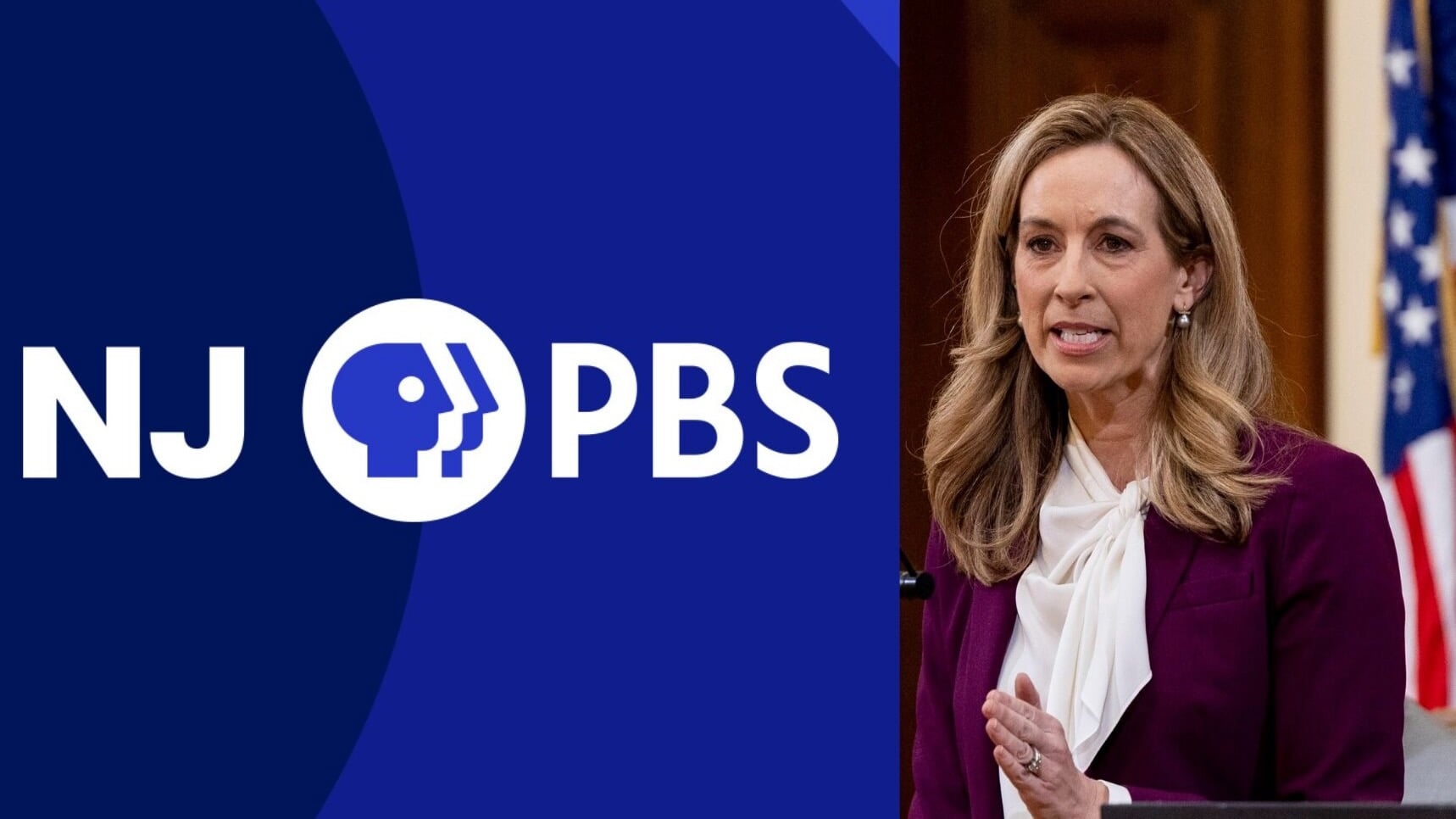
Sherrill photo: Anne-Marie Caruso / New Jersey Monitor
This article was first published by the New Jersey Monitor and is republished here under a Creative Commons license.
Two weeks since Gov. Mikie Sherrill’s administration picked Montclair State University to take over operations of New Jersey’s public television network, skeptics have increasingly grumbled about her choice.
They warn that tasking a state institution with managing public media risks political interference and violates a 2010 state law that requires a nonprofit (or similar entity) to run the state’s broadcasting system. They also fear public broadcasting will take a back seat to the school’s main mission of higher education, and that university officials — whose plan calls for little to no state funding — overpromised on what they can deliver.
The clock is ticking down to the state’s June 22 deadline to seal the deal, and legislators have convened a public hearing for Monday to mull the matter.
Phil Alongi is CEO of New Jersey Independent Public Media, the nonprofit that had competed with Montclair for New Jersey’s public media license. He’ll be in Trenton Monday to voice his concerns and urge lawmakers to hit the brakes.
“There’s not a single commercial broadcaster that covers the entire state of New Jersey. That means that whoever gets this public media license has an outsized responsibility to get this right. That has to be robust. It can’t be saying, ‘We’re only going to have three reporters.’ There are fewer reporters in Montclair’s plan than there are press secretaries in the Sherrill administration,” Alongi said. “For me, that seems like a nonstarter.”
The hubbub comes after a rocky year for NJ PBS. The network announced in September it would close this month after federal and state funding cuts last summer drove the station to gut staff and contract negotiations broke down between the state, which owns the license, and WNET, the New York-based public TV station that has operated NJ PBS since 2011.
The state put station operations out for public bid in February and got four proposals, according to the state Treasury.
Alongi’s nonprofit and Montclair offered the meatiest bids, and both had a long list of local community organizations, media executives, and universities on board.
State officials announced earlier this month they’d awarded the bid to Montclair.
Treasury spokeswoman Danielle Currie told the New Jersey Monitor that Montclair’s bid had “significant strengths, including readiness to operate, existing broadcast facilities and operations, experienced industry staff, and a longstanding presence in public media.”
Still, it was clear the proposal’s price won over many of the decision-makers.
Montclair offered three broadcasting “scenarios,” one of which would require no state funding. Under two other scenarios, Montclair would seek $250,000 in state funding — the state’s current appropriation — or $1 million. The other bidders projected they’d seek millions annually in state funds.
Currie said Montclair’s bid offers “the strongest value to New Jersey residents,” while the state called the plan in an announcement “fiscally responsible,” noting that it “leverages existing university assets to create an operational budget that recognizes the current fiscal environment for public media.”
Keith Strudler, dean of Montclair’s College of Communication and Media, said that drafting a plan that does not rely on state support and uses existing university infrastructure was key to their bid’s success.
“This is a financial issue, first and foremost,” Strudler said. “We obviously hope that the federal government at some point will restore funding to public media. But we also know that if we don’t want to be in a place where, three years from now, if there is a state financial crisis and the X number of millions of dollars that had been appropriated are not available, that we’re back where we were to start with.”
For journalism to survive, it has to do so “without bloated budgets,” Strudler added.
“The goal was not simply to build the cheapest bid you could. The goal was to build one that’s going to be sustainable,” he said. “We will all acknowledge that more dollars can equal more employees. That doesn’t inherently make a bid better.”
One critic, Brenda Flanagan, a longtime NJ PBS journalist who retired in January, fears New Jersey residents will get short-changed by a broadcast plan she regards as “bare bones.”
Montclair plans to hire 21 staffers the first year, only three of whom would be reporters, with up to 20 students supporting station operations in a “teaching hospital” model. The bid by Alongi’s group, in comparison, includes 53 staff, 10 of whom would be reporters.
Alongi noted that Montclair’s bid is cheaper, “but you get what you pay for.”
“It costs less because they’re going to deliver less. So it really is just a fundamental decision on what we think New Jersey deserves,” he said.
Alongi also has questioned whether it’s legally permissible for a state university to operate public media in New Jersey under the 2010 Transfer Act, which lawmakers passed to get public broadcasting out of state control. Public media must be “truly independent from state government,” former Gov. Chris Christie said then.
Currie said Treasury officials determined Montclair’s management is authorized under the Transfer Act.
While such concerns were enough to persuade state lawmakers to schedule Monday’s hearing, it’s unclear whether legislators will reject Montclair’s bid.
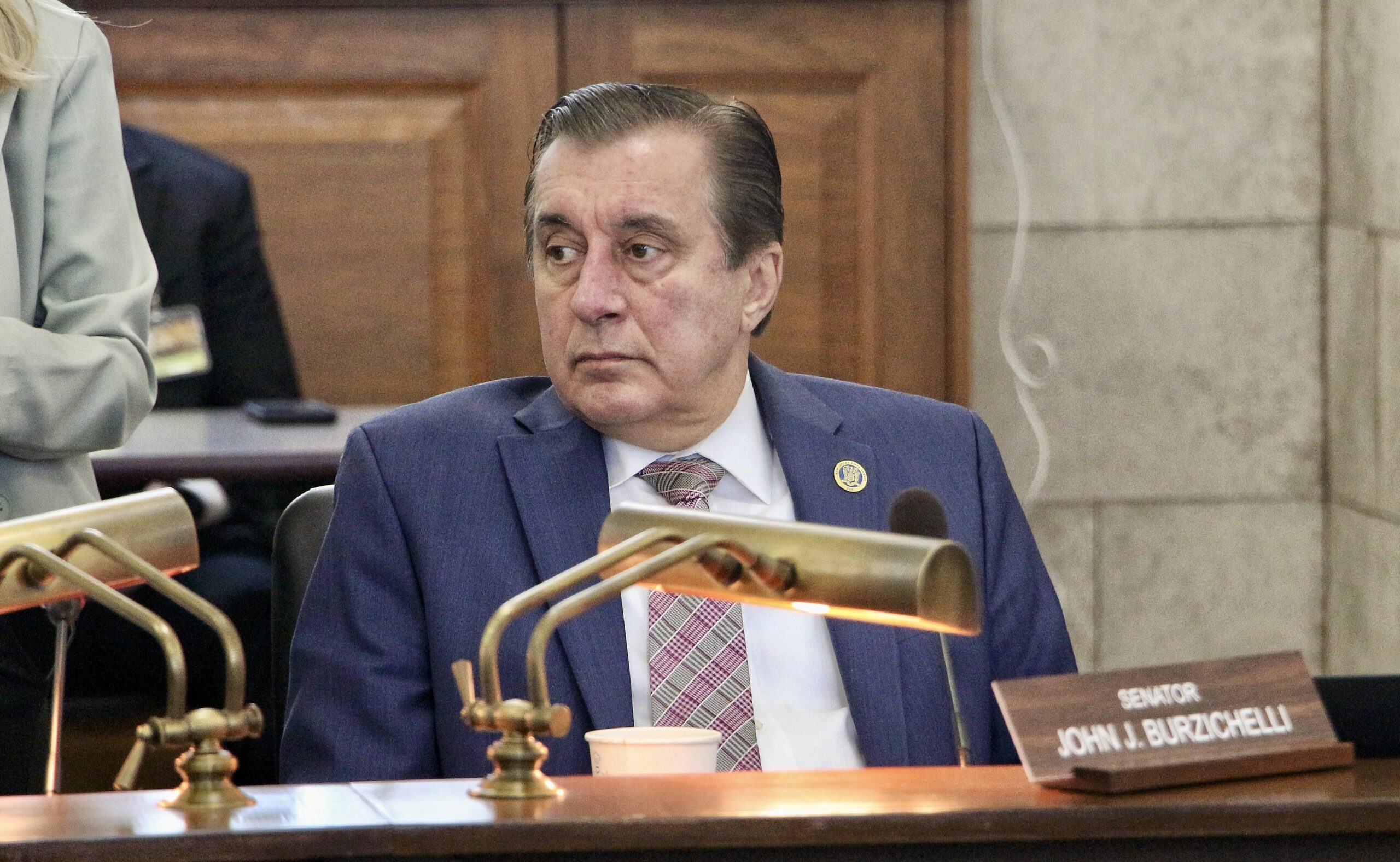
Both chambers would need to do so by majority vote by June 22. But Sen. John Burzichelli (D-Gloucester), who’s been an outspoken public media supporter, doubts that will happen given how busy legislators can be in June. They must approve a state budget by June 30 and typically scramble to pass unfinished business before recessing for the summer.
“There’s going to be some form of public broadcasting in New Jersey, in some way, in some structure,” Burzichelli said. “Is it going to be perfect? It may take a little time for it to reinvent itself, and that’s OK. Just so it has a heartbeat, and it’s working, and information is getting out.”
If Montclair’s winning bid stands, the university will take over NJ PBS’ operations on July 1. Their contract would be for five years, with two five-year contract extensions. WNET would help Montclair transition under a three-month contract extension that expires Oct. 1.
That imminent handover alarms Flanagan, who penned a letter of protest to state officials Thursday asking them to rescind their approval and hold a public hearing.
“This contract constitutes a five-to-15-year commitment. So, I think it’s worth a little extra time to get it right,” she wrote. “Because New Jersey residents need and deserve professional, balanced and robust public broadcasting that’s relentlessly focused on the Garden State.”
With Montclair at the controls, she said, NJ PBS would become a state-run network operated by state employees, endangering journalistic independence.
“That presents potential interference, and even if it’s not overt, there’s always the appearance of potential influence,” Flanagan told the New Jersey Monitor.
It also raises thorny questions, like whether journalists’ notebooks would be considered public records subject to disclosure if those journalists are state employees, critics say.

Sen. Andrew Zwicker (D-Middlesex) shares some of Flanagan’s concerns. He said he has asked legislative staff to draft a bill he aims to introduce soon that would prohibit political meddling at public broadcasting stations managed by state universities and give employees legal recourse for such. Lawmakers in Illinois recently passed similar protections, which now await Gov. JB Pritzker’s approval.
“I want to make sure that safeguards are in place that go beyond what Montclair has said they will do in terms of codes of ethics,” Zwicker said.
Perhaps anticipating pushback, Montclair noted in its bid that more than half of NPR’s 1,000 member stations and nearly 50 public television stations are licensed to a college or university.
Kelly McBride, senior vice president of the Poynter Institute and chair of its Newmark Ethics Center, said that model can work well, pointing to Wisconsin as a place that’s doing it right. It can also backfire, she added.
“Universities get a lot of political pressure, and the danger is that political pressure will spill over into the content decisions that a public media organization will make,” McBride said.
Public media managed by public universities can also make for messy finances, as one public broadcasting station in Florida has found. After Pensacola State University opted to part ways with North Florida PBS station WSRE, the station sued in December, accusing the school of trying to take funds it raised from viewers to support programming.
Beyond that, McBride said, running a public broadcasting station requires expertise, making it critically important for any public media license holder to carefully weigh who they trust to oversee operations.
“Honestly, the biggest problem when a license is transferring is that the new owner or the new manager just doesn’t know what they’re doing. It’s really complicated to run a broadcast organization,” McBride said.
That makes hiring critically important, especially for positions like general manager, she added. Montclair hasn’t yet hired for most positions, including general manager.
Strudler conceded to the complexity of broadcasting, joking that he’s learned so much about broadcasting in recent weeks that “I want another degree.”
But he said he’s confident Montclair will get it right, and he invited critics to join their cause.
“The goal here is the success of public media,” Strudler said. “So we want anyone who wants to help and be involved to help and be involved. We’ll find places for all kinds of partnerships. We think that we can help set a model for how public media can evolve nationally.”