
How Mister Rogers tackled Cold War fears and why it still resonates
Internet Archive
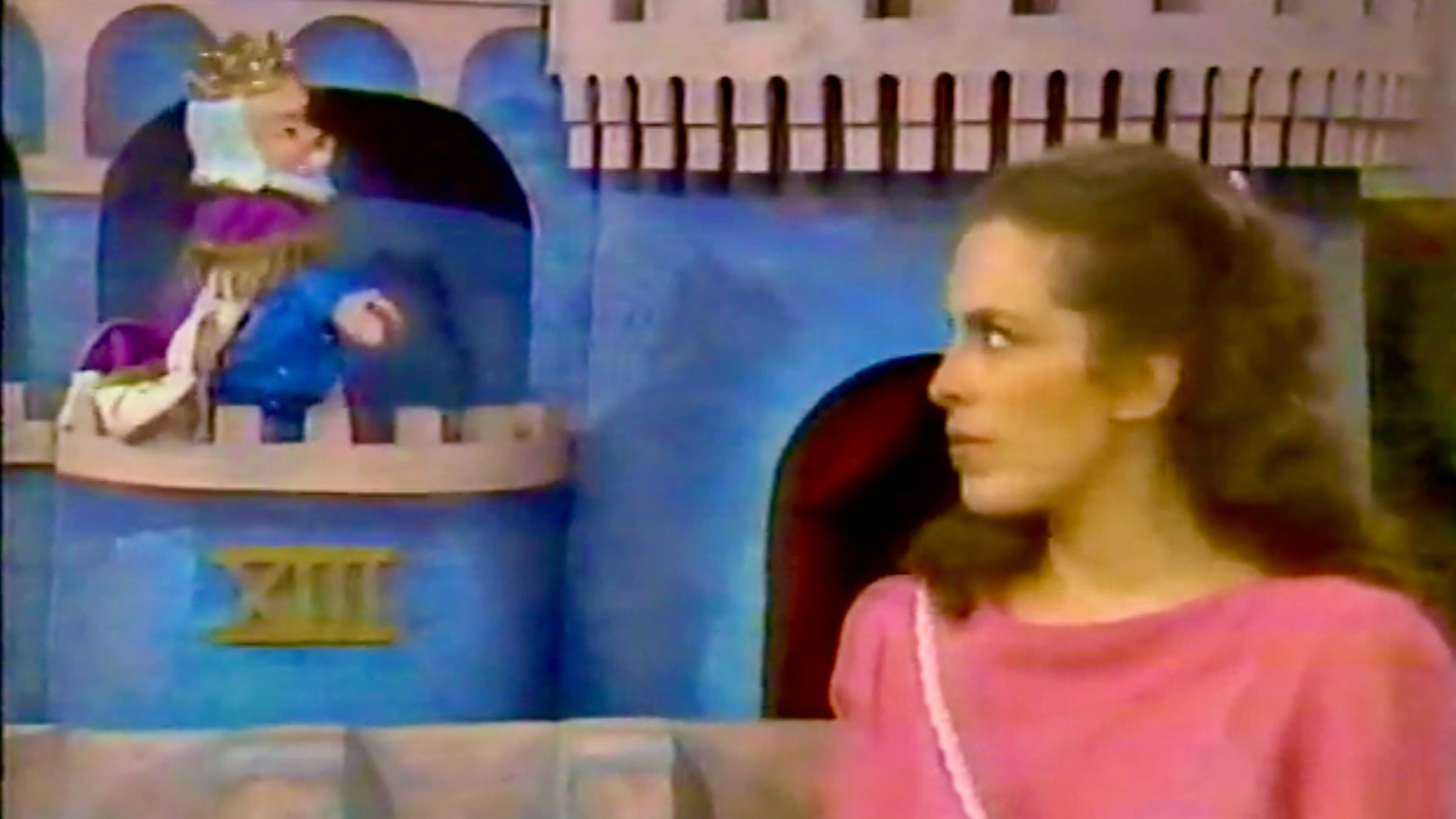
Lady Aberlin (played by Betty Aberlin) glares at King Friday as he justifies his preparations for war in the third episode of the "Conflict" series.
Mister Rogers’ Neighborhood often tackled complex social and emotional issues. One series of episodes that aired in 1983 stands out — and for more than two decades, they were nearly impossible to see.
The weeklong series “Conflict” examined the horrors of war and the dangers of geopolitical paranoia. King Friday, ruler of the Neighborhood of Make-Believe, becomes suspicious that beaver Cornflake S. Pecially is manufacturing weapon parts for the neighboring town of Southwood, a city with a history of violent conflict.
An arms race ensues. Out of fear and mistrust, and with no concrete evidence, King Friday braces for the worst. He orders residents to take up arms, build fallout shelters and wear gas masks. As the neighborhood militarizes, Lady Elaine and Lady Aberlin make a peacekeeping mission to Southwood to investigate the true nature of Cornflake’s activities.
They discover the parts are for bridges, not bombs. Peace is restored, but only after the fantastical neighborhood is transformed by suspicion.
Even with a happy ending, “Conflict” is eerie and disturbingly relevant. As Michael Long wrote in his 2015 book Peaceful Neighbor: Discovering the Countercultural Mr. Rogers, ”There has been nothing like it in all of children’s programming.” Long told me that he still stands by that assessment.
‘A brilliant metaphor’
The episodes clearly convey Rogers’ main takeaway. As schoolteacher Harriet Cow says, “War isn’t nice.”
“It speaks to how radical Rogers was,” Long said. “He was a Christian pacifist, no doubt about it, and was very consistent on that point.”
The juxtaposition of the famously gentle TV show with apocalyptic dread may seem incongruous to present-day viewers. But as Long notes, it made sense given Rogers’ direct approach. “He is pushing us hard, but in a very soft way,” Long said.
Rogers’ concerns suited the early 1980s, an era menaced by the threat of global destruction. In an effort to prevent the proliferation of Communism and the spread of Soviet-Cuban influence, President Reagan aggressively militarized parts of Central America and the Caribbean. The invasion of Grenada occurred only months before “Conflict” aired.
The episodes also aired the same week as The Day After, a made-for-television movie that envisioned full-on war between the U.S. and the Soviet Union. More than 100 million people watched the film.
As Rogers told The Associated Press in an interview at the time, “Little did I know that we would be involved in world-wide conflict now. But that’s all the better because our shows give families an opportunity for communication. If children should hear the news of war, at least they have a handle here, to assist in family communications.”
Actor Betty Aberlin, who portrayed Lady Aberlin in the series, agrees. “I thought it a brilliant metaphor for the very young who were being subjected to scary images of war every night on the news,” she told me in a recent email. Aberlin said that she considers the episodes among her proudest achievements on the show.
Reception to the episodes was mixed, Aberlin said: ”The mail response was 50-50 hawk and dove.” The polarizing reaction was unsurprising given the era’s political tension. In his infamous “Evil Empire” speech, Reagan decried the growing nuclear disarmament movement and condemned those who “speak in soothing tones of brotherhood and peace.”
King Friday’s initial response to perceived threats echoes Reagan’s stance. “There’s no time for questions. This is a time for action,” the king confidently exclaims. Yet when proven wrong, he not only sees the error of his ways but laments the spending of neighborhood funds on a potential war instead of music classes in schools.
“The idea that money that could have been used for the arts, for services to uplift humankind and puppet neighborhoods, … was, because of a misunderstanding and reflexive fear … being used in a potentially destructive way, I thought [was] brilliant,” Aberlin wrote.
Not easy to find
Rogers ended the series of episodes by addressing the audience directly. “Rules are very, very important, not just for games but for all things — even big things like countries,” he said. “Countries have to have rules to protect people, too. And someday you’ll be helping to make the rules for your country. I trust that you’ll make the best kind you know how.”
Though their pacifist message remains relevant, the episodes were unavailable for viewing until recently. They last aired on PBS stations in 1996 and were removed from distribution. According to Fred Rogers Productions, Rogers made the decision, and the company continues to honor his choice.
The episodes never appeared on DVD sets or streaming platforms. They surfaced briefly on YouTube in 2017, then were taken down. A year later, a user of the Internet Archive uploaded the episodes to the platform (episodes 1521–1525 here). The quality may be grainy, but the message still gets across — and continues to resonate.
“When I see I bombings of schools and hospitals, I think absolutely he’s right,” Long said. “And if we could hear him tell us about war today, I think that would go a long, long way.”