
Alabama Public Television may drop PBS programming
Andrea Tinker / Alabama Reflector
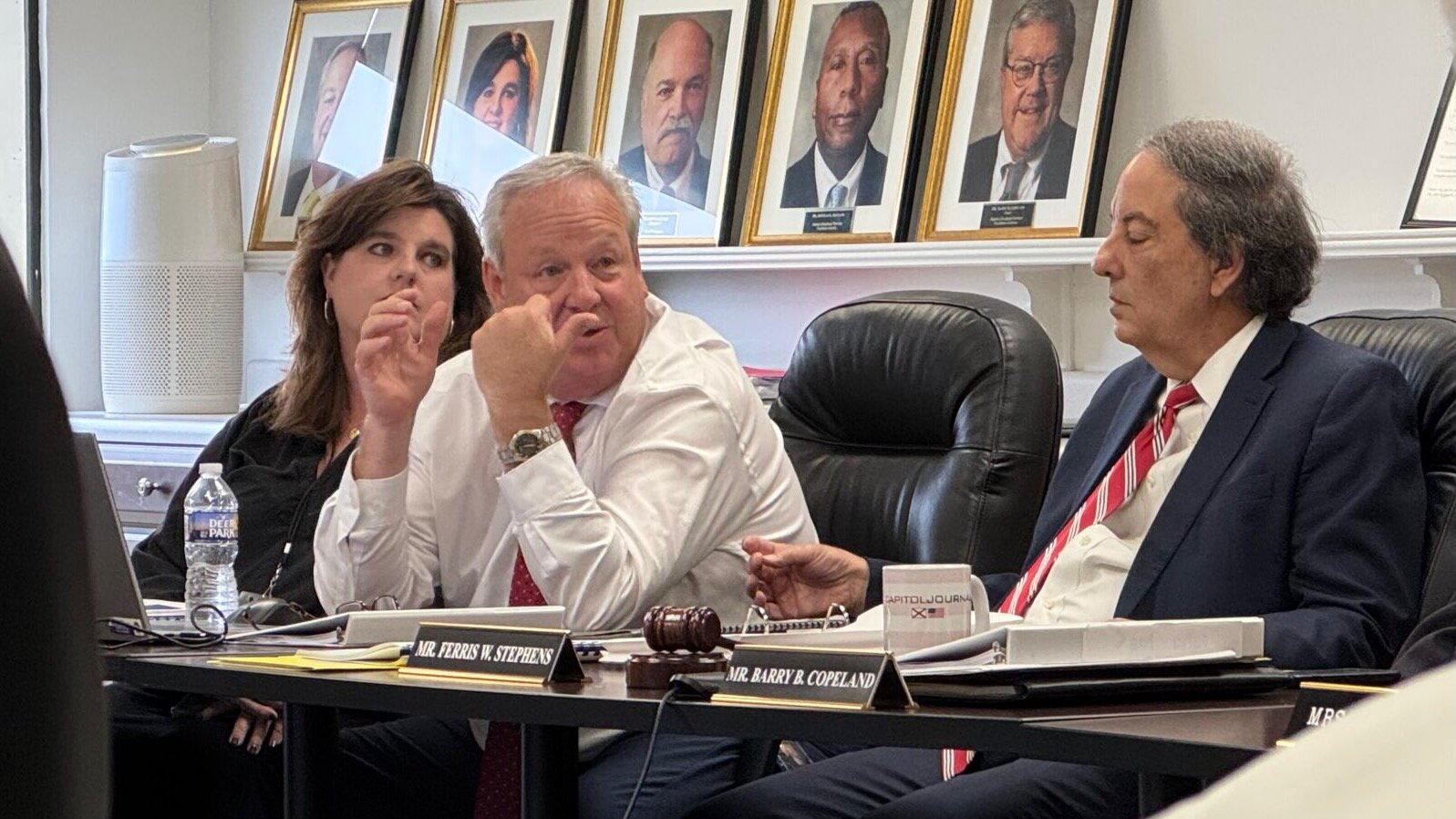
Wayne Reid, executive director of Alabama Public Television, speaks at an Alabama Educational Television Commission meeting Tuesday in Birmingham.
This article was previously published by Alabama Reflector and is republished here under a Creative Commons license. It has been revised for clarity.
BIRMINGHAM — The director of Alabama Public Television said Tuesday that the outlet could drop PBS programming in the future.
Wayne Reid, executive director of APT, said two commissioners on the Alabama Educational Television Commission, Les Barnett and Ferris Stephens, brought the idea of fully separating from PBS after the Trump administration this summer slashed funding to the Corporation for Public Broadcasting, which funded public broadcasting around the country.
Commissioners at the meeting were split over the proposal. Reid said the split may not happen because APT is still under contract with PBS and faces other obstacles.
“You’re going to have to redo our websites, redo our media library, because that’s all supported by PBS,” Reid told commissioners. “Now, the traffic system is really set up for PBS.”
CPB faced a $1.1 billion budget in July after Congress approved House Resolution 4. In 2024, APT reported that it received $2.8 million from CPB.
APT also responded to the budget reduction by cutting NPR programming for WLRH in Huntsville. While APT has local coverage, NPR and PBS provided national coverage to the network through programs like PBS News Hour.
Commissioner Bebe Williams said she thought cutting all PBS programming wasn’t the correct move for the network.
“When you cut off all the programming that we do, you’re cutting off so many programs I watch,” Williams said. “And the people that pay money for what they want … we’re going to have to have the membership in order to be able to afford things.”
Williams said the network should keep the children’s programming and Masterpiece, which has featured prestige dramas like Downton Abbey, Sherlock and Prime Suspect.
Board member Johnny Curry agreed that cutting all PBS programming would be detrimental to APT due to the amount of content the network gets from PBS.
“You have to be very careful about deciding whether to sever that relationship, because it’s my understanding that 90% of the programs that this network broadcasts come through and from PBS,” Curry said. “If you sever that relationship, and I’m not saying you should or shouldn’t, but if you sever it, you got to come up with 90% of your programming to replace, and that includes all of the educational programming the children watch during the day, which is the main mission of this institution,” Board Member Johnny Curry said.
Commissioner Pete Conroy spoke in support of keeping PBS programming.
“This morning in Hoover, there was a church school, and every single morning, these six- and seven-year-olds watch Daniel Tiger[’s Neighborhood] before the bell rings,” he said to the commission. “And that’s 300 moms that we’re going to have to talk to, because that would just be gone.”
Commissioners William Green Jr., who joined the meeting via Zoom, and Les Barnett said APT should move away from PBS programming altogether.
“PBS right now carries a negative connotation, and there’s no telling what they will do, how they will do it, and then if they make a statement or move a certain way, APT is going to be thrown in with them,” Green said.
Barnett said he’s not interested in funding PBS.
“Even if the federal Corporation for Public Broadcasting money came back in, I still don’t understand PBS,” he said. “… I don’t want to fund it. PBS has made themselves the enemy of what I stand with, and so I do not like them, and I don’t follow the philosophy of feeding the beast.”
Jack Williams, APT’s external affairs director, said state officials had not given him any indication that PBS programming should be dropped.
“The conversation is kind of focused around ‘How do we how do we help you guys, since you’ve lost federal funding,’ and we’re looking to do what we can this year, because in [20]27 there’s concern that the state may have to dip into the reserve funds for the first time since 2009 [or] 2010,” he said to the board.
Williams also mentioned to the commission that taking away PBS programming could impact school-aged children.
“There are [5,800] fewer children in public schools today than there were last year, and many of them were, as evidenced by Wayne’s slide, using the resources of the LearningMedia Center, and that will go away,” he said to commissioners.
PBS LearningMedia offers free educational materials for K-12 students and educators. Data presented at the meeting showed that PBS LearningMedia had over 50,000 quarterly users and over 322,000 quarterly streams.
Public comments about PBS programming being dropped can be sent to comments@apt.org. A vote to decide whether to maintain programming will happen Nov. 18.
This article has been updated with FY24 information about APT’s CPB funding. In addition, the Alabama Reflector updated the article to add the public comment email address and to clarify that commissioners brought the idea of separating from PBS to Reid, which was then brought to the board. This republished version has been updated accordingly.