

Building audience trust: APM + MPR beta testing AI tool for journalists
By Ellie Pierce
SPONSORED
In a recent school board meeting for the Anoka-Hennepin school district, a large district northwest of Minneapolis and Saint Paul, the topic of Ozempic was on the agenda.
Turns out, the district was wondering whether they ought to stop paying for employees’ use of the drug and similar GLP-1 medications. Premiums were set to go up somewhere between $500 and $700 more per month. One big reason: The cost of those medications.
No one from MPR News attended the meeting where this topic came up. In fact, no reporters attended the meeting at all. But an MPR News editor spotted the topic in a report from LocalLens, the AI tool acquired earlier this year by American Public Media (APM), which is part of the same parent company as MPR News.
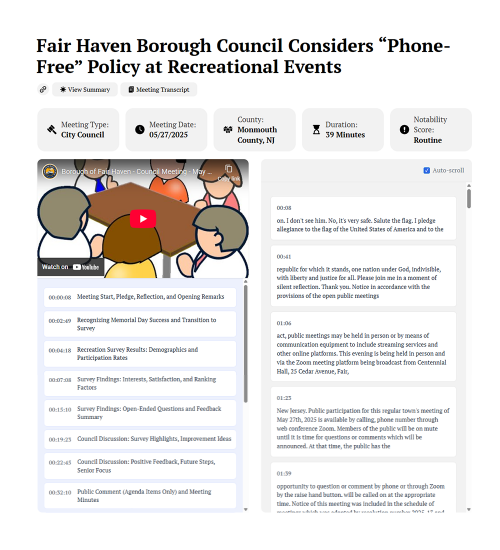
The newsroom had been using LocalLens in beta to gain access to searchable information from public meetings across the entire state of Minnesota.
Connecting to local communities
The GLP-1 news tip and a link to the relevant meeting recording was shared with a reporter, and then the journalist dug deeper into additional LocalLens reports. They soon discovered another instance in a different school district, across the state, resulting in an impactful story highlighting a trend newsroom leaders aren’t sure they would have found otherwise.
This anecdote isn’t a one-off.

“LocalLens has helped MPR News connect,” said Michael Olson, digital editor at MPR News. “We can track the activities of local governments in a significantly more substantive way, which has resulted in stronger, more compelling accountability journalism.”
It’s not that LocalLens does the reporting. Rather, the tool helps a statewide reporting staff have more access to hyperlocal issues and deliver local news that audiences are demanding.
As Olson described it, “We’re able to monitor local government meetings that are challenging to keep track of.”
“Right now, Minnesota Public Radio News is monitoring 250 different local governments through LocalLens,” Olson said. There was a time that kind of deep attention and coverage would take an army of reporters.
Now, the tool can be customized to provide notifications, summaries of meetings, as well as used to search, filter, and dig into specific topics. The tool also simplifies the process of finding exactly what time within a meeting recording a specific topic was discussed.
“We have easy access to more information that we might have missed before we had access to this tool,” Olson said. “It’s a really challenging environment for local journalism, news deserts are spreading, and there’s a lack of coverage of local issues. It can be expensive to do this kind of work on your own, but it’s critically important to these communities.”
Meeting the unmet audience need for local coverage
The 2024 Researching Unmet Needs (RUN) study—one of the largest audience studies ever conducted in public media—provides compelling evidence that trusted local news is what audiences both want and have a hard time finding. The national survey of 10,000 people found that when audiences seek out specific topics, things happening in their local community consistently rank the highest in terms of both interest and lack of availability. Data points in the study, Commissioned by Station Resource Group, Public Media Content Collective and Greater Public, indicate a great unmet need for information, events and content that connects people to their local communities.
This need comes at a critical time. Since 2005, nearly 3,500 newspapers have vanished in the United States, and news deserts reached a record high in 2025, with over 50 million Americans having limited access to local reporting.
Despite this, American’s trust local news. A 2024 Pew Research Center survey found that both Republicans and Democrats think local journalists are in touch with their local communities, with majorities agreeing that local news media “report news accurately,” “are transparent about their reporting,” and “cover the most important stories/issues.”
The gap between the trust people place in local news and their access to it represents a compelling and mission-aligned opportunity for public media organizations.
The business case: Quality coverage builds loyalty, loyalty sustains revenue
When RUN survey respondents were presented with a list of 17 news characteristics, the top two unmet needs they identified were “It’s something I can trust” and “It’s carefully researched.” LocalLens enables that first step in gathering local meeting information, giving reporters a place to identify stories and start digging in on important local issues.
“Public media organizations that deepen their local journalism capacity are positioning themselves for long-term sustainability,” said Chandra Kavati, President of APM.
“By meeting documented audience needs for trustworthy, carefully researched local coverage, they strengthen the community connections that drive membership, underwriting, and philanthropic support,” Kavati said. “Investment in hyperlocal coverage represents not just a prioritization of our shared public service mission, but a strategic business decision that builds the audience relationships essential for organizational sustainability.”
Getting to impact: Casting a wider net
A tool that helps reporters get at compelling and overlooked stories, find unique angles, and spend more time in their communities helps meet the needs of challenged newsrooms.
“We’d love to have to have 250 reporters, and obviously we’re covering some of these meetings already, but this is a way for us to cast a much larger net and stay on top of the issues and developments that matter to Minnesotans,” MPR News editor Olson said. “This type of coverage is the audience expectation, and no matter our constraints, we need to deliver on it.”
“Time is one of a reporter’s most valuable resources. Sitting through a multi-hour meeting can be essential for accountability, but it can also mean missing the opportunity to connect directly with community members about how those decisions affect their daily lives,” Olson said. “Our journalists want to be answering questions about impact. Understanding what something means for people’s lives requires more than just listening to officials talk about it.”
Try LocalLens in your newsroom
Want to get on the list to learn how your newsroom can try the beta of the AI tool LocalLens? Visit locallens.io

American Public Media (APM) is one of the nation’s largest producers and distributors of public radio programming, reaching audiences through stations across the United States. APM is committed to helping public media organizations better serve their communities. Find APM at americanpublicmedia.org or follow us on LinkedIn.