
Alabama Public Television governing board to survey state on PBS attitudes
Andrea Tinker / Alabama Reflector
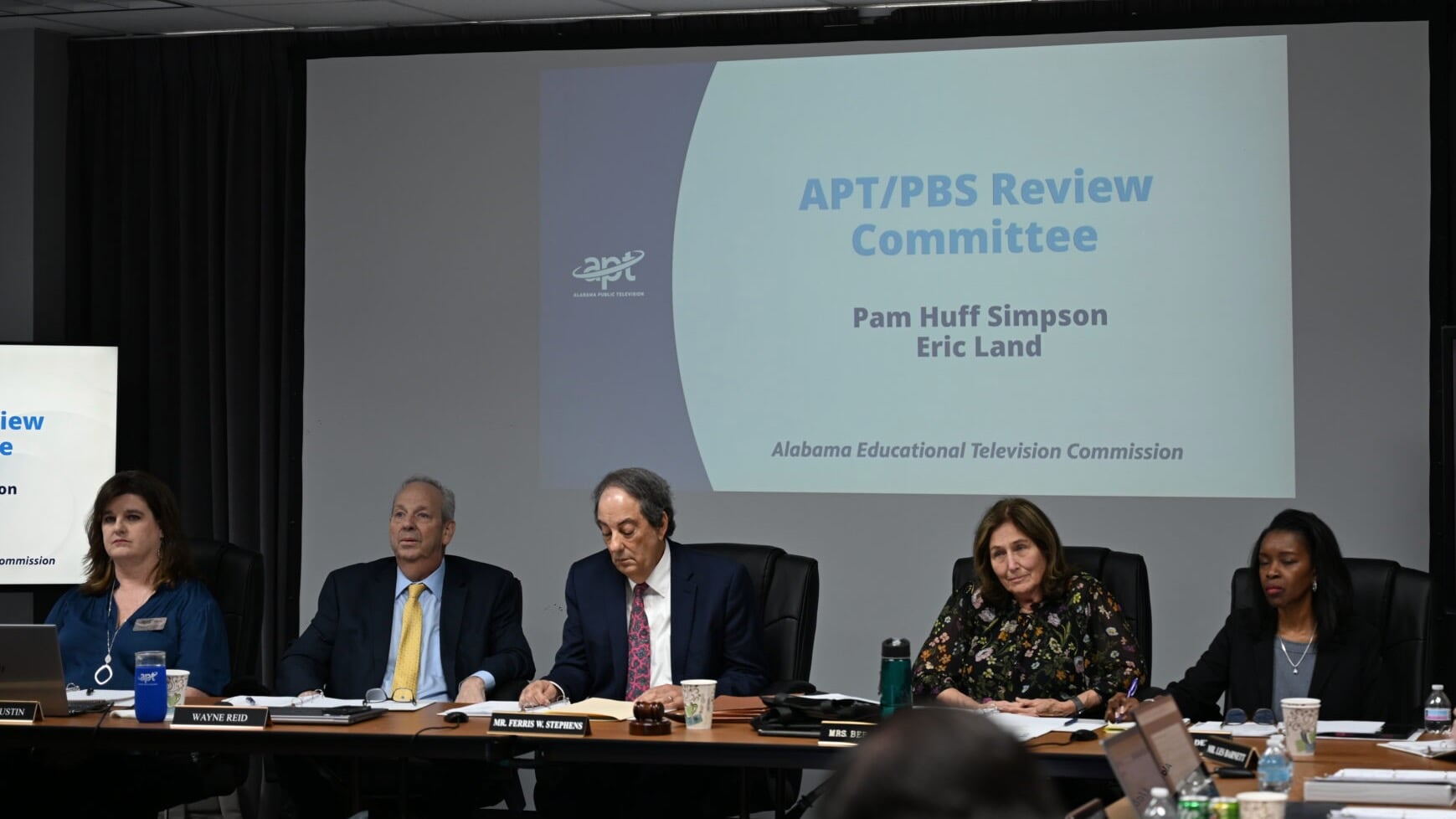
Members of the Alabama Educational Television Commission listen to speakers during the commission's quarterly meeting in Montgomery, Ala., on April 21. The commission voted to conduct a survey of Alabamians' attitudes toward PBS programming.
This article was first published by the Alabama Reflector and is republished here under a Creative Commons license.
The Alabama Educational Television Commission voted Tuesday to conduct a survey of public attitudes toward PBS programming, amid pushes from some commissioners to end APT’s affiliation with the network.
The vote came after a strong debate between commissioners over whether commissioning such a poll was appropriate or in line with a letter from Gov. Kay Ivey last year about determining whether to continue the partnership.
“One of the things we discussed after we already decided to continue with PBS is to further find out what people of Alabama want. And so what I have done is I have called — and in the letter it says a reputable poll — and so a reputable poll [company] that everyone has to do a survey of what Alabamians want in public television is McLaughlin,” said AETC Chair Ferris Stephens.
Stephens said he was following guidance from Gov. Kay Ivey. In a letter sent to the commission in November, the governor suggested conducting a public survey over “a sustained period of time” to determine public attitudes toward APT and its programming.
The survey would be conducted by McLaughlin & Associates, a national survey research and strategic services company that has serviced several Republican candidates, including President Donald Trump, former Attorney General Jeff Sessions, U.S. Rep. Robert Aderholt and former U.S. Sen. Luther Strange.
According to Stephens, the organization quoted him $47,500 to conduct the poll, which would survey 600 people.
Commissioner Pete Conroy argued that the survey goes against Ivey’s letter.
“I think it’s really important for you to understand the letter in the email from the governor that said we would only pursue a survey if indeed, we were going to disaffiliate, and we have not made that decision,” Conroy said. “And I would very much like to postpone any discussion about a contract for a survey, because you’ve already been talking behind the scenes about getting a survey that would support your predetermined outcomes. I don’t want to do that.”
In the letter, Ivey said the survey should gauge not only how Alabamians feel about disaffiliation but also consider what would happen should APT choose that path.
Eric Land, a member of the APT/PBS Reviewing committee, said after the meeting that Stephens’ choosing the company to do the survey felt like an overreach.
“I felt that the commission should have given the executive director the assignment to bid that job and look at a number of research companies, make that presentation to the commission and then have them vote on who they believe would make the most sense after some research is done,” he said.
Land also said he thinks McLaughlin’s political positioning could “shade” the results of the survey conducted and questioned why another research facility like the one at the University of Alabama wasn’t chosen.
Ivey’s letter was sent ahead of a meeting last year where the future of PBS’ programming at the station was uncertain. The commission later voted to continue programming until the end of its contract in June. Following the expiration, the commission will revisit the contract and discuss whether or not to maintain PBS programs.
Prior to the vote, Pam Huff Simpson, another member of the committee, spoke in favor of maintaining PBS programming, saying that completely disaffiliating from PBS wouldn’t be sustainable.
“Approximately 90% of APT’s current programming schedule is sourced from PBS,” she said to the commissioners. “The advisory committee came to the unanimous conclusion that disaffiliation with PBS would be a critical mistake. Instead, we recommend this long-term partnership, one in fact forged 57 years ago with PBS, be allowed to continue.”
A member of the public criticized the commission’s vote to allow the survey.
“You’ve taken an action today that calls into question your commitment to PBS,” Elaine Witt said. “If you would use the University of Alabama polling outfit, which is very legitimate, or if you would let this committee that you brought in of broadcasting professionals who have been in the business, they’re the ones who hire the marketing term, not your politically appointed chair, who not only wants to bring in a political polling firm, but he wants to review the questions. That is unprofessional.”
APT Executive Director Wayne Reid said during the meeting that a marketing survey company would be best instead of McLaughlin.
“I don’t want this to be political, we don’t want this to feel political, and having a marketing research company do that, as opposed to somebody who has a political leaning and has worked on political campaigns, would just be my question,” he said.