

Opinion: It’s time for public radio to reclaim its educational identity
WHRO
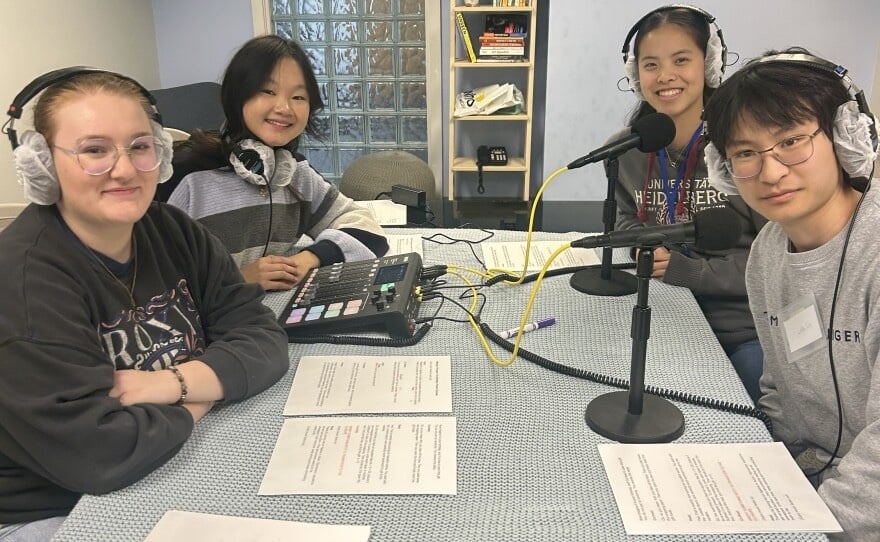
Member of WHRO's student advisory board record podcasts for the station’s new Algebra I course.
I’ve worked in public radio continuously since I was 19 years old. One refrain I’ve heard from radio mentors for decades is that public TV is just … different. For a long time, it was fashionable to joke that “TV is from Mars and radio is from Venus.” Even as the digital age has blurred formats and platforms, a cultural divide remains.
In existential moments like the loss of federal funding, institutions reach for the frame that feels like the best fit. Public television continues to highlight its educational mission through children’s programming, curricular alignment and formal learning partnerships. Public radio, by contrast, has built its identity with both music and news formats. Because most stations air the newsmagazines, journalism has been its primary justification, emphasizing local reporting and news partnerships.
This journalism focus was clear even in the final days of CPB: Many of its last grants emphasized journalism partnerships. Discussions about public media’s future, from thought-leader convenings to NPR calls with station managers, have centered almost exclusively on news. The logic is familiar: If we can just do more local journalism, the system survives.
Local journalism absolutely matters. But here is the uncomfortable truth we need to name clearly: Journalism alone is not an institutional justification for sustaining a publicly supported media institution, especially when similar journalism can also be produced by commercial, nonprofit or digital-only outlets. Education needs to be a key component of both TV and radio’s future.
This is often where the conversation breaks down in public radio. Any argument that introduces education is heard as a retreat from journalism, or worse, a dilution of editorial purpose. It isn’t. Education is the organizing principle that makes journalism legible, fundable and defensible as a public good.
It’s important to remember that education is what brought us to the dance in the first place, both as a case for support and an organizing mission. Public media did not begin as a journalism project. It began as an educational one. In a post-CPB world, reclaiming that frame is not nostalgia — it is strategy.
‘School of the sky’
In the earliest days of broadcasting, no one quite knew what to do with the strange, powerful technology that carried voices and images beyond physical walls. Like artificial intelligence of today, early broadcasting felt revolutionary but undefined.
Educational broadcasters understood its promise instinctively. If voices and images could travel, then learning could, too. Many colleges and universities moved quickly to reimagine education extending beyond the campus via broadcasting into the lives of farmers, factory workers and families. By providing free, universal access to knowledge, “educational broadcasting,” as it was called during those early years, became a “school of the sky,” a once-in-a-generation opportunity to democratize learning.
As the system evolved and matured into public broadcasting, radio and television diverged. Radio, a format-driven medium, leaned heavily into newsmagazines and local reporting as news/talk expanded to become public radio’s leading format. Over time, education receded and came to be thought of as something that happened in classrooms, not in radio broadcasts.
The consequence was a loss of educational identity, not a loss of educational activity.
Identity problem
Today, public radio often struggles to explain its utility beyond being a high-end news service. In a media environment saturated with information, audiences are frequently informed but lack a clear sense of how to navigate it. They are aware of what is broken but powerless to do anything to influence or change it.
That is not a failure of journalism. It is a failure of framing.
Journalism describes conditions. Education builds capacity. When journalism is explicitly framed as education, information becomes usable. A housing story becomes an explanation of how zoning works. Election coverage becomes a guide to civic power. Reporting does not lose rigor. It gains purpose.
The resistance to this framing is real. For many in public media, education triggers fears about mission creep, editorial independence, prestige and funding, as well as questions about whether educational work fits existing formats and user expectations. Those concerns are understandable. But they have also prevented us from effectively explaining what we are already doing and from designing for it intentionally.
The problem is not that public radio has abandoned education. The problem is that we have stopped naming it.
When stations help audiences understand ballot initiatives or school funding formulas, when they walk parents through early literacy or teach media literacy or AI fluency, that is education. When education goes unnamed, it is not planned for, funded or measured with intention. It becomes a byproduct instead of a mission.
At a moment when public media needs clarity more than ever, that ambiguity weakens us.
This is not a theoretical shift. Across the system, stations have already shown what happens when education is treated as core to their mission rather than side work. Some public television stations have seen success by building education services for learners of all ages:
- In Norfolk, Va., WHRO has long made education a strategic priority. Beyond broadcast, it offers a suite of high-school and online learning resources used by schools and educators statewide.
- Kentucky Educational Television’s FastForward initiative provides adult education and GED preparation.
- Montana PBS leveraged university partnerships to secure state research grants documenting agricultural history, converting broadcast work into permanent classroom resources.
- Vegas PBS provides extensive education resources, including K-12 educational materials, workforce training programs and a special-needs resource library for educators and families.
Some radio stations are applying this educational frame to journalism, engagement and culture:
- Civic utility reporting: New Hampshire Public Radio’s Civics 101 teaches listeners how democratic systems function in practice, turning news into usable civic knowledge.
- Curricular integration: WTJU in Charlottesville, Va., has adapted jazz history programming for classroom use, while WUOL in Louisville, Ky., extends music education into the summer through podcasts and community events.
- Audience engagement as service: LAist/KPCC transformed childcare reporting into a sustained early childhood education initiative, converting coverage into direct community support.
- Education-backed revenue: Radio-only stations are partnering with organizations like WHRO and KET to distribute existing educational courses to school districts, generating commissions that help underwrite local journalism.
Education also strengthens journalism itself.
According to data from the Center for Community News, 88% of public media organizations provide opportunities for college students to help cover their communities. Nearly 60% offer intensive, ongoing training, and 13% explicitly operate as journalism “teaching hospitals.” These stations serve rural, suburban and urban audiences and provide experiential learning for the next generation of reporters.
This role is not incidental. Roughly half of all public media stations are licensed to colleges or universities, rooting the system within the nation’s higher-education infrastructure. Since stations are already embedded where learning happens, the challenge is to organize and name that reality with intention.
This is not a departure from journalism. It is the ecosystem that can sustain it.
Education as engagement engine
Reclaiming education is not only about mission clarity; it also opens a practical path forward for engagement and sustainability.
Imagine a public radio system in which reporting and documentaries are not endpoints, but entry points. A station produces an investigation into housing affordability, climate resilience or workforce shortages. That journalism draws people in and offers them a next step: a short course on how zoning works, a guided series on preparing for clean-energy jobs, or a civic workshop developed with a local university or library.
In this model, education becomes the engagement engine. Journalism sparks curiosity and urgency; education converts that attention into learning, participation and, in some cases, revenue. Courses, workshops and facilitated learning don’t replace reporting. They extend it by giving audiences something to do with what they have learned.
This approach realigns public media with partners actively seeking learning infrastructure: colleges, libraries, workforce boards, employers and philanthropies focused on outcomes rather than outputs. It creates multiple onramps into public media — not just as listeners or viewers, but as learners.
Strongest case for survival
As federal support disappears and political pressure intensifies, public media needs a reason to exist that people who do not already love it can understand.
“Trusted journalism” is necessary, but it is not sufficient.
Libraries learned this lesson years ago. They did not abandon books, nor did they define themselves solely as content distributors. They organized around learning: digital literacy, workforce development and community access. That clarity made them easier to fund and easier to defend.
Education is a universal public good. It cuts across age, income and ideology. It aligns naturally with universities, libraries and schools. And its value shows up directly in people’s lives, not just in abstract debates about media trust.
If public media does not claim education explicitly, the alternative future is not neutral. It is a smaller, more brittle system perpetually fundraising against crisis, increasingly defined by political attack and valued primarily by those already inclined to defend it.

With CPB gone, public media can no longer afford to treat education as incidental. Reclaiming our identity as the “school of the sky” is not about turning away from journalism. It is about giving journalism a future.
If public media is to survive, and matter, it must do more than inform. It must help people learn how to navigate the world.
Michael Arnold is executive director of Indiana Public Media in Bloomington. Previously, he oversaw and directed content strategies at organizations including KUNC in Greeley, Colo.; Wisconsin Public Radio; and Public Radio International.





Sadly, my “local” station, KUT at the University of Texas at Austin, has great journalists but mainly uses them to produce podcasts, not broadcast content. That’s why, when I have access to a computer, I listen to KUHF at the University of Houston, which has come a long way since I lived there.
Most NPR stations focus on national content from NPR, PRI, or APM, which could also benefit from a more educational focus. Unfortunately, they seem to think they need to be edgy, not informative.