High-definition postcards from Seattle’s aero boutique
It's not a single, static Ansel Adams, but something else beautiful--a procession of 30 amazing frames per second as the viewer soars past the rocky peak and an extravagant new vista opens up. On the soundtrack, a brush of cymbals contributes to the visceral chill.
Two more of these sensation-packed ''new-age travelogues or music videos,'' as their executive producer calls them, premiered nationally during the last week on PBS, raising to a new level the reputation of KCTS, Seattle, as home of public TV's aerial production boutique.
After producing three aerial studies on Betacam equipment, Executive Producer Jeff Gentes and Director of Photography Marc Pingry switched to high-definition TV for ''Over California'' and ''Washington, D.C.: Our Nation's Capital.'' KCTS said the shoots were the most ambitious field production with HDTV equipment in the country so far.
Though viewers saw the pictures in HDTV's wider aspect ratio, they won't see the really dramatic visual improvement until high-def TV sets become available in a few years. By coproducing with Japan's public TV network, NHK, the Seattle station got free access to scarce HDTV equipment, including a 40-pound Sony HDC-500, which Pingry calls ''the best video camera in the world,'' as well as two weeks of on-line editing completed in Tokyo just three weeks ago.
Next month, Pingry hopes to begin shooting additional midwestern, southern, New York and Hawaiian footage to come up with ''Over America'' for broadcast during pledge drives in 1995. Canada-based Sun Life Insurance will underwrite. [Since this article was written, the KCTS team has gone on to produce other regional aerodocumentaries in cooperation with other public TV stations, including "Over Arizona," "Over St. Louis" and "Over Philadelphia," in part using outtakes from their "Over America" tour.]
The switch to HDTV grew out of seven years of meetings and alliances with NHK, promoted by KCTS President Burnie Clark. The station plans its fourth international workshop on HDTV next year, when the FCC anoints a transmission standard.
Gentes and Pingry established their successful aerial format in 1988 with ''Over Washington,'' timed to coincide with the centennial of the state and the publication of a coffee-table book by the same name. The program was planned to have extensive narration, but Gentes says, ''when we started cutting the show, the images were so powerful that people turned off the narration and watched.'' Out went much of the educational potential. ''Over Washington'' had such limited narration when first aired in Seattle that viewers demanded subtitles to identify the scenery.
''Over New England'' and ''Over Florida'' followed, establishing themselves as successful pledge-drive performers with built-in premiums: cassettes of the programs (sold to stations for $8 each) as well as separately produced Harper Collins picture books.
In each program, Pingry's cold, noisy and exhausting hours, hanging out the side door of a noisy helicopter, are converted (with the help of audio artistry) to a magical flight so silent that you can hear waves breaking on the Pacific shore, accompanied by original music from KCTS's Denny Gore and contract composers.
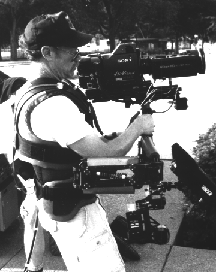
For the Washington, D.C., program, the five-person crew broke its all-aerial habit last year and included perhaps two-thirds earthbound footage, but Gentes points out that they kept up the characteristic on-rushing motion at ground level by strapping Pingry into a Steadicam. Hundreds of pounds of NHK's electronics followed the cameraman through the halls of power on a cart called ''the Beast.'' In many shots, the camera took flight alone, on a 20-foot crane. Miraculously, they managed to shoot as many as eight locations a day.
Highly restricted airspace over the Mall in D.C. required the crew to shoot with long lenses in those sweeps around the periphery of the monuments, and to minimize vibration from the copter, Pingry switched to a 35mm film camera that could fit in a gyrostabilizer.
As in the California aerial work that began immediately after D.C., they shot as much as possible during the ''golden hours'' when sunlight is warm and shadows are long. To shoot in the mountains, KCTS hired a fixed-wing plane and mounted the Sony on the wing. The crew came home with 50 hours of half-inch tape per show and edited NTSC versions of the programs off-line in Seattle before going to NHK for on-line assembly.
After learning aerial production the hard way with ''Over Washington,'' Gentes says he and his crew ''feel very much like experts in our field.'' There's talk of doing ''Over Ireland,'' and more.
''It's nice when something seems to succeed,'' he says. ''Right now, we're hitting our stride.''
Web page reposted Feb. 5, 2008
Copyright 1994 by Current Publishing Committee