
Seven public stations among 1998's DTV pioneers
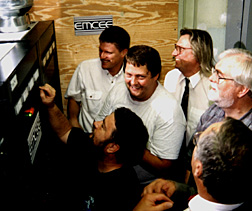
Engineers flip the switch to launch the digital channel at WITF, Harrisburg, which began testing Aug. 26 [1998].
Originally published in Current, Oct. 26, 1998
By Steve Behrens
WETA will open its inaugural DTV broadcast Nov. 9 with a scene from an earlier big day in 1961, when Elizabeth Campbell and cohorts put Washington's public TV station on one of those new UHF channels.
Then: a segue to Campbell in 1998, still active at WETA as it begins digital broadcasting.
There were few if any UHF receivers when the station began using Channel 26 back then, and now there are few DTV receivers in town, observes Terry Bryant, senior v.p. for broadcasting at the station. In each case, with Campbell's spirit, WETA is moving ahead anyway.
The receiver shortage is everywhere, says John Tollefson, PBS chief technology officer. "I think we need to keep this in perspective. When television was first introduced, there were no receivers. Likewise, when color was introduced, there were no color receivers."
"I'm amazed at the number of stations, especially public stations, that have stepped up and decided to go ahead with this."
In addition to some 30 commercial stations, pubcasters in seven cities are officially debuting DTV programming Nov. 9: Harrisburg, Pa.; Jackson, Miss.; Kansas City, Mo.; Milwaukee, Wis.; Portland, Ore.; Seattle, Wash.; and Washington, D.C.
Several turned on advanced TV transmitters many months ago--Milwaukee's WMVS/WMVT logged an HDTV broadcast in 1992, and Seattle's KCTS began using the U.S. digital standard last spring. But most have seldom if ever seen over-the-air pictures from their transmitters, because DTV receivers are only starting to emerge from factories.
"We've really stumbled in the dark," says Mike Tondreau, v.p. of engineering systems at Oregon PTV. Without any receivers, he had to call Sharp Labs, across the Columbia River, to ask if the signal was looking good.
Mere dozens of receivers will be placed in stores and other sites in time for the PBS launch, Tollefson predicts.
"The few sets in the U.S. are making a circuit and will appear for events and are gone the next day," says Burnie Clark, president of KCTS, Seattle.
WETA has been working to line up scheduled HDTV demos at electronics stores around D.C., according to Bryant. The station will publicize the demos and is distributing special logos for store windows.
PBS's icon indicating HDTV programs will appear periodically in the corner of the screen.
Digital program pipeline
The DTV audience may be small, but viewers with ordinary sets also will be able to tune in to PBS Digital Week programs, Nov. 9-12 [1998].
"Chihuly in Venice" [article] airs first on Nov. 9. PBS says it will be the first national broadcast of a program produced and aired in high-def. It's followed by Robert Cringely's "Digital TV: A Cringely Crash Course," from Oregon PTV.
Tuesday and Wednesday night, Ken Burns' "Frank Lloyd Wright" bio will demonstrate the "enhanced TV" aspects of DTV instead of the high-def glories.
"Wright" will be aired on DTV stations in a special version designed to be watched on computers equipped with Intel Corp. video receivers. Intel is fielding several dozen of those computers as an experiment, according to Tollefson. Viewers using the PC's will be able to call up additional interviews not included in the Burns film and take "virtual tours" of three Wright buildings.
In addition to PBS's first DTV feeds, several of the stations will be carrying coverage of the launch of Sen. John Glenn's NASA Space Shuttle on Oct. 29. Harris Corp., a major transmitter manufacturer, is offering the 70-minute feed to stations.
"Chihuly" and "Cringely" lead off a procession of monthly HDTV programs scheduled by PBS. For December, there's "Jesse Norman--Home for the Holidays" from Georgia PTV and Brandenburg Productions. January: Kennedy Center Presents: "A Tribute to Muddy Waters, King of the Blues" from WETA. February: three episodes of the conservative public-affairs program National Desk from Whidbey Island Films. February: "Washington the Beautiful," from KCTS, Seattle.
March (tentatively): "Over Ireland" from KCTS. April: another National Desk episode and "Fiesta in the Sky" from HD Vision. May: Great Performances: "A Tribute to Duke Ellington" from WNET.
Combining signals saves money
Faced with multi-million-dollar conversion costs, engineers at the pioneer stations are finding they can sometimes cut costs by using the same equipment to handle both their analog and digital signals.
KCPT in Kansas City didn't set out to be a DTV pioneer, but learned that it could save major money by using a single transmitter and single antenna to put out both signals, says John Long, v.p. of engineering. The key is that the two signals are on adjacent channels. The station chose an Acrodyne Industries transmitter that produces a bandpath wide enough for two channels. The combo is not only more efficient than separate transmitters, but also lets KCPT keep using its old tower instead of building a new one for $1.5 million.
The best adjacent-channel pairs have the digital below the analog channel, says Mike Tondreau at Oregon PTV. If DTV is higher, as in his Eugene station, it can interfere with the analog channel's sound, though he expects the problem can be solved.
In Washington, WETA has just gotten FCC approval to go digital on Channel 27, adjacent to its analog channel, says Joe Widoff, senior v.p. Though the station will initially beam DTV from its separate WETA-FM tower, Widoff hopes to eventually radiate Channels 26 and 27 from the same antenna.
KCTS, Seattle, isn't using adjacent channels, but found that it can emit both of its signals from the same crowded tower by acquiring a lighter-weight antenna for its analog signal, and mounting the DTV antenna on top of it, says Cliff Anderson, director of technical planning. The analog and digital signals are combined at the base of the tower and travel up the same transmission line to the separate antennas.
Like the Kansas City station, WITF in Harrisburg leapfrogged many public TV stations in DTV readiness. WITF's advantage was a low-power, 2.5 kilowatt Emcee Broadcast Products transmitter ordinarily used for translators, combined with a Harris Corp. DTV exciter.
Though underpowered by analogl TV standards, a transmitter of that size will do the job for as many as half of public TV stations that now operate on UHF channels, says John Bosak, WITF director of engineering. The FCC typically gave those stations 50-kilowatt power limits, and with robust characteristics of the digital signal, the little transmitter and a reasonably good antennta can achieve that radiated power level, Bosak told Current.
The small Harris/Emcee transmitter costs a fraction of the price of a bigger one and also costs much less to operate.
Engineering officials at the stations agree that they won't hurry to buy encoders--the key piece of equipment that lets a station originate a digital signal, which now costs some $500,000. "The only advice now is to wait as long as you can," says Tondreau at Oregon PTV. Stations can air the PBS feed, which is being transmitted by satellite in encoded form, ready for broadcast.
Connecting the various digital boxes seldom goes smoothly, according to engineers working with early DTV equipment. Interfaces aren't standardized yet.
"You buy a piece of equipment and you go to hook it up to another piece, and they're different," says Cliff Anderson at KCTS. "That's where some of the pain is." But generally he's high on DTV. "This is a great time to be in television," says Anderson. "Trying to make it work is really fun."
John Long at KCPT observes that it's been easy to be a pessimist in DTV's early days. He recalls that some digital sets displayed at the Consumer Electronics Show in February were incapable of changing channels.
Now Long's a DTV enthusiast. "There was a time I wasn't," he adds. He got the religion by reading everything he could get about the technology for two years.
"In the indecision and disarray of things, there is so much opportunity," Long adds, "my biggest concern is that we're not going to have enough money to continuously invest in it."

Related story: A look at "Chihuly Over Venice."
Outside link: PBS Online's section about DTV.
Web page revised Oct. 30, 1998
Current
The newspaper about public television and radio
in the United States
A service of Current Publishing Committee, Takoma Park, Md.
E-mail: webcurrent.org
301-270-7240
Copyright 1998

 To Current's home page