
Clash over bond referendum coverage
UNC's Tom Howe: 'There's not going to be a
firewall here'
|
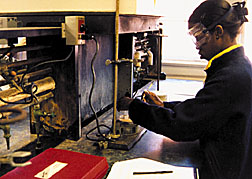
It was important for the public to know about facility needs in state colleges, according to UNC-TV managers. Pictured: a scene from "A Building Crisis" documentary. (Image courtesy of UNC-TV.) |
Originally published in Current,
Aug. 21, 2000
By Karen Everhart
Bedford
Coverage of a high-stakes bond issue on North Carolina ballots this fall ignited a debate within the statewide public TV network over its journalistic independence and management's role in editorial decision-making.
A reporter/producer who quit his job at the University of North Carolina Center for Public Television (UNC-TV) in May, John Arnold, said the network's managers violated journalistic tenets by directing his coverage of DTV conversion issues and a higher education bond issue in which its licensee has huge financial interests. Station executives say their input in editorial decisions was both appropriate and necessary.
The bond issue on North Carolina ballots in November will determine the futures of both higher education and public television in the state. If approved by voters, the $3.1 billion bond sale would fund renovation and expansion of the state's university system and community colleges, as well as UNC-TV's $65 million digital conversion. UNC-TV, a network with 11 transmitters throughout the state, is licensed to the University of North Carolina.
The dispute at UNC-TV highlights different editorial philosophies of journalists and managers at the network, as well as between public television and public radio. In public radio, journalists describe with pride the "firewall" that insulates them from the pressures of underwriters and the self-interest of the licensee university, while UNC-TV's managers say the concept doesn't apply.
 "There's
not going to be a firewall here or at any public television station I'm
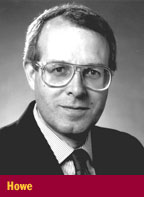
at" to separate management from reporters, said Tom Howe, executive director
of UNC-TV. "One would hope that management would be very involved in production."
"There's
not going to be a firewall here or at any public television station I'm
at" to separate management from reporters, said Tom Howe, executive director
of UNC-TV. "One would hope that management would be very involved in production."
When Howe took the job as UNC-TV's chief in 1992, it came with a mandate to improve its programming. "I've become less and less involved [in production] as things have gotten better, but I have more experience and knowledge than anyone here."
"There's a very high level of management's involvement in everything UNC-TV does," said Bob Royster, the network's production director for 20 years. "It's part of the culture" and a means to assure the center is a "growing and unified organization making the best use of the resources it has to fulfill its role as a public broadcaster."
Discomfort with "directives"
Sensitivities over UNC-TV's coverage of the university are nothing new, said Royster. "It's a challenge that any journalistic organization would face when covering its parent organization," he said. "We believe we have and will continue to work with it responsibly."
Arnold, who for two years worked as a general assignment producer/reporter for UNC-TV's weeknightly newsmagazine North Carolina Now, began to feel "uncomfortable" with management's involvement in coverage of digital TV in 1998. He was assigned regular stories on DTV that aired on North Carolina Now, and were later compiled into a stand-alone program, "DTV and You." "I know I wasn't alone in thinking this just was not right," he said. When he expressed concerns to his producer, he was told: "This is how it is. This is information that the public needs to know."
During the state legislature's recent consideration of the university's facilities needs, Arnold received explicit "directives" from management on how to cover the story, and who to interview. "The directive came through one of the show's producers," Arnold said, although he understood that it originated with Royster or Howe.
"I just felt compromised," he added. "My problem was their involvement in an issue in which UNC-TV had a direct financial stake."
The bond issue was a newsworthy topic, Arnold acknowledged, "but we needed to be very careful in how we did it. As a journalist, I felt I had another responsibility to avoid conflicts of interest like that."
"Any issue where the organization has something at stake financially, the news staff should make editorial decisions independently to avoid conflicts of interest, real or perceived."
Arnold decided to take a stand, and turned down an assignment of a bond-related story. He recalled telling Julia Cox, now manager of North Carolina Now and UNC-TV's public affairs, that he would "refuse to do any story on the bond or DTV until we get independent editorial decision-making for our newsroom."
When Arnold informed the rest of the news staff of his decision, he was cheered. He later met with Royster, and agreed to summarize his concerns in a letter.
Management's mandates for coverage of DTV and the bond issue have "intruded on an objective editorial process that is intended to present news in a fair and balanced manner," Arnold wrote in the letter May 1. "At network management's direction, issues that UNC-TV has a vested interest in have received more attention than the center's journalists would otherwise have given them. When that happens, resources must be diverted from other important issues facing our state."
"The network's management should do everything it can to stay away from the editorial decision-making process when vested interests are involved."
Arnold soon realized that he would be fired for his position, and submitted his resignation on May 3. "It was one of the hardest decisions I ever had to make," he said. "I liked working there and loved the people. It is one of the best television systems in the country." He now works for KOAT, an ABC affiliate in Albuquerque, as capitol bureau reporter.
It's unclear how widely Arnold's concerns about the editorial interference are held by other members of the UNC-TV news team. Anthony Scott, a former senior producer for North Carolina Now, told the Raleigh News & Observer that network management was "more preoccupied with giving a message to the General Assembly and the general administration than to the general public." Scott, who left the network earlier this year for a job in community development, declined to comment for this article.
"I feel like it's my job to raise these issues as a journalist," said Cox, in an interview with Current. However, she accepts management's role in decision-making and her own responsibility to implement those decisions.
"It hasn't been problematic for me," said Shannon Vichary, North Carolina Now correspondent and producer of two documentaries on the state's higher education facilities needs, referring to the issues Arnold raised. UNC-TV's managers are "not advocating one type of coverage or another — their involvement has been more as part of an editorial process, which is good."
Whenever different people review your script and offer production advice, "it only makes things better," she continued. Howe, Royster and Gail Zimmerman, associate g.m., bring a breadth of production experience to the network, and "to immediately dismiss their suggestions just because they're management, I think is short-sighted."
To cover or not?
UNC-TV's managers compare the network's relationship with its university licensee to Disney's ownership of ABC, or General Electric's ownership of NBC. "We will not shy away from issues because they're connected to the university any more than ABC News will shy away from entertainment news because of its connection to Disney," said Howe. Navigating potential conflicts of interest over editorial decisions requires a "greater level of sophistication" than less experienced members of its news staff realize, he added.
The university is a "huge newsmaker in the state" and an "important part of almost anything that happens," agreed Zimmerman. "Our coverage of the university should not be any less because they hold our license than it would be if they didn't, and our coverage should be fair and balanced."
But WUNC-FM, which is separately licensed to the Chapel Hill campus of UNC and run by different managers, has taken the opposite approach. "To be quite honest, we tend to not cover things related to our licensee, just because we want to show that we're not influenced," said Michael Arnold, program director. This approach puts the station at risk of underreporting on its parent institution, he acknowledged.
"We've never had an issue here with the university trying to affect what we're doing," nor internal pressures to cover issues such as the bond, Arnold added. "If that were to happen, a lot of people wouldn't be here."
WUNC-FM has had a "history of independence," credit for which goes to former General Manager Bill Davis, now v.p. for programming at NPR, Arnold said. A "clear statement" of a firewall "between news and where the money is coming from" has historically been "supported by the whole institution all the way up the line."
Journalists at UNC-TV apparently took the approach of not covering DTV conversion issues as the network advanced its request for state aid. After the FCC in 1997 adopted its order requiring all stations to convert to digital, Howe began a media tour of the state, explaining the network's digital funding request to editors and other opinion leaders. "We got tremendous coverage," recalled Howe, including editorials that called on the General Assembly to support UNC-TV's request.
"We'd been doing that for a couple of years when we realized there hadn't been anything on our air," he added.
Managers took a "totally hands-off role that resulted in no coverage [of DTV] for two years," said Royster. "And where did that get us? Not where the management of UNC-TV thought we should be."
"That is the point when management began to exercise greater involvement" with producers to "pay attention" to DTV, continued Royster. The request was made "not just because of its impact on UNC-TV, but on all of broadcasting, its major implications for broadcasters and their viewers and the services they could expect in the future."
North Carolina Now produced features and interviews on digital TV that were compiled into a one-hour documentary, "DTV and You." The reporting on digital topics amounted to a small percentage of UNC-TV's local production output, according to Royster, "very small numbers in management's eyes. Some staff took the fact that we were asking for coverage at all as a conflict of interest."
Coverage of the facilities needs of state universities and community colleges continued to stir dissension over potential conflicts of interest in the network's reporting.
"This bond, and whether it passes or not, will define what this state is in the future," said Zimmerman. "It will define the state's success and have an impact on every single person who lives here. The quality of life here will be affected. It is a major, major story."
"This, in management's mind, is one of most important issues before the public in quite some time," said Royster. "It is as important as any candidate on ballot — not because it affects UNC-TV and the University, but because of what it means to the people of the state." UNC-TV's managers asked the journalists on staff to "acknowledge its importance and cover it in a complete, thorough and balanced manner."
Royster said he never dictated the details of how to cover these issues on North Carolina Now. "I expected them to go off and cover it, and rarely saw anything of the coverage they did until it was going on the air." He was not aware of any involvement by managers that would be considered a breech of editorial integrity, but described their role as efforts to ensure accuracy.
"There's been no involvement that has changed the story or compromised a journalist reporting on the bonds or any aspect of digital television," Royster added.
Howe frequently offers feedback on UNC-TV's productions to Zimmerman and Royster on UNC-TV's local productions. The network's news staff are "very young people who are inexperienced and have to view this as a learning experience in their career," he explained. "The smart, good ones do; others like to be totally independent."
With the network committing so much of its underwriting and production resources to delivering a weeknightly news program, a "junior producer/reporter" is not going to decide what gets covered. "They're going to get a lot of guidance and advice."
Different expectations
As the General Assembly debated how to finance the state's higher education needs, UNC-TV management became dissatisfied with North Carolina Now's reporting on the topic. Both Howe and Royster expected significant coverage of what Howe described as an "unprecedented joint hearing" of the legislature's finance committees; Arnold filed a report for North Carolina Now that was "two minutes in length."
"The problem we've had with North Carolina Now is doing a two-minute story on an important issue, and then rushing off to see a potter somewhere," said Howe. "That's not what this is about." If two minutes on a "five-hour roll-out of the biggest issue in the General Assembly" is Arnold's idea of adequate coverage, "he needs to go and work at a commercial station."
Different philosophies about North Carolina Now's editorial mission may also have fueled disagreements at UNC-TV. Howe expected Arnold's report on the hearing to emulate the NewsHour's extended coverage of a congressional hearing. But Royster described the show as a combination of hard and soft news, "not unlike a morning news program such as Today."
The debate over editorial conflicts of interest has resulted in one policy change in UNC-TV's reporting practices. "At one point, we weren't doing disclaimers" in reporting on the bond, said Cox. "I felt it was important to press the issue." All coverage of the bond issue now includes disclosures of UNC-TV's relationship to the University and its digital funding interests.
Howe acknowledged resisting this change. "We are now doing disclaimers like crazy, and to me it's the most promotional thing that we've done."
He did not anticipate further changes to UNC-TV's editorial policies or reporting practices. "If anything, when we hire people we need to let them know that management is involved in what we do and will continue to be. They will be held to certain journalistic standards and shouldn't be surprised by suggestions from management on how long a piece should be or who should be in it."
How Maine handled a bond issue
UNC-TV's debate over editorial conflicts of interest illustrates what Al Stavitsky, associate dean of the University of Oregon's School of Journalism and Communications, describes as a "chronic problem" in both public and commercial broadcasting today. Journalists and managers find themselves at odds over stories that are "potentially embarrassing to the licensee."
"If a news organization is to be a respected news outlet with credibility, they've got to be free to cover stories that shed light on the licensee that the licensee might not be interested in."
In Independence and Integrity: A Guide Book for Public Radio Journalism, Stavitsky argued for editorial insulation that gives journalists freedom to report independently. Stavitsky wrote the guide with funding from NPR, PRI and Public Radio News Directors Inc.
"It's not an easy thing for the licensee to give journalists free license to cover them," Stavitsky said. In UNC-TV's case, with a "legitimate issue" worthy of coverage, "to maintain credibility they need to go out and cover it comprehensively, including the opposition." Viewers also need to be informed of UNC-TV's interests in the outcome.
"It's a sensitive story, and if it's not handled well and fairly, you risk alienating viewers," he commented. "It's going to be apparent to them if it's a puff piece."
Pubcasting journalists in Maine faced a similar dilemma last year when voters considered a bond referendum for digital conversion funding for the state's public TV network. "We determined we would cover it just like any other bond issue," said Mal Leary, managing editor for news at Maine Public Radio. Both the radio and TV arms of Maine Public Broadcasting hired other news organizations to produce stories on the bond for broadcast on Maine's public outlets.
As it does with all bond issues, Maine Public Radio also produced a call-in program on the DTV referendum. "It's a hassle to find someone with the skills to do a call-in program," Leary explained, so he produced and hosted the show himself. A technology editor who opposed the bond appeared on the show with Rob Gardiner, president of Maine Public Broadcasting.
Leary said he asked "tough questions" and later received a lot of complaints from non-journalists on staff. His response was, "this is what you pay me for."
"I'm a journalist first and work for you second."
Management's only involvement in the coverage was signing off on plans to hire New Hampshire Public Radio's news team to report on the bond referendum; approval came from the network's radio director.
Maine Public Radio has as much of a firewall "as you can have," Leary commented. He could recall no specific attempt by management to interfere in news coverage. "There would have been a major battle erupting on the front page of newspapers," he added. "You wouldn't be talking to me now."
Maine Public Broadcasting did successfully campaign to pass the bond issue, but did so with clearly promotional spots on its air and in paid airtime on commercial stations.
Battles over firewalls that separate advertising and business interests from editorial decisions are "constant issues" in journalism today, said Stavitsky. In public broadcasting, the principle is much more deeply rooted in public radio than TV.
"There are relatively few public TV stations with standing news organizations, and relatively few with TV newscasts," he said. "At many stations, there's a producer or two doing public affairs coverage, but they generally don't have established processes and policies."
"You need to have policies and to have thought about this so that when an issue comes up, you can refer to it."


Web page posted Aug. 28, 2000
Current
The newspaper about public television and radio
in the United States
A service of Current Publishing Committee, Takoma Park, Md.
E-mail: web
 current.org
301-270-7240
Copyright 2000