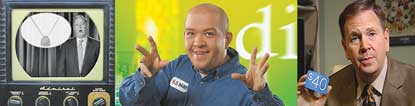
Who’s assigned by stations to educate the public about the DTV transition? In Richmond, Va., it’s Richard Arenstein, a board member (left, in a techno-flashback); in Oklahoma, actor Jon Haque; in Oregon, producer Vince Patton.
Blurry view of DTV Day, one year out
Can public TV help viewers get
clear picture of analog shutoff?
Ask Tom Howe about the digital television transition, and he’ll tell you he can already see next winter’s headlines.
Howe, executive director of North Carolina’s UNC-TV network, envisions a report of a fierce ice storm hitting his state’s rural Tyrrell County a few weeks after the feds end digital transition and what happens to a poor, elderly couple who relied on analog TV as their only source of information.
“I don’t think this country is ready,” he says.
Howe thinks the government will ultimately delay the Feb. 19, 2009, analog shut-off. People are confused and the affordable digital-to-analog converter boxes are arriving too late in the stores, he says.
Even the government’s well-intentioned converter subsidy plan has aspects that will outrage some groups: Nursing home residents can’t get discount coupons, for instance, and a nursing home qualifies for only two coupons since it has one physical address, notes Michael Soper, DTV consultant and former PBS exec.
But with little more than a year to go until DTV D-Day, the North Carolina network (separate story), other pubcasters and the rest of the TV industry are revving up public education campaigns as if the date will stick—crafting hands-on education campaigns, building websites, producing PSAs, urging consumers to apply for converter coupons and, in general, finally acting as if it’s time, ready or not, for what many are calling the most significant change in the medium’s history.
“It’s not like the switch to color—when we got color, you could still watch in black-and-white,” says Soper, who’s selling stations a DTV education package he created with Oregon Public Broadcasting. “In this case—you either have digital or you don’t have TV.”
Public TV is ready for the switch, for the most part. Of 364 total transmitters in the system, 345, or nearly 95 percent, are broadcasting in digital, according to the Association of Public Television Stations.
But the receiving side is another story. Depending on which poll you prefer, anywhere from less than a quarter to more than half of all Americans aren’t even aware a transition is happening, and those who’ve heard about it are still confused about its consequences.
With around 20 percent of its audience relying on over-the-air reception, according to PBS, public TV should be especially motivated to help its viewers understand what’s happening and how it affects them, say system execs.
Over the past few months, PBS and others have been researching the best ways to show public TV fans how to prepare for the DTV transition. PBS will kick off its multiplatform education campaign later this month with new locally customizable spots for member stations, featuring Norm Abram and Kevin O’Connor from This Old House, says Kelly Chmielewski, director of brand strategy and promotion.
Stations can win even more of viewers’ goodwill by helping them through what is bound to be a confusing transition, observers say, but they need to get a plan in place sooner rather than later.
“We’re burning daylight, and we’re not going to get it back,” Soper says. “I don’t think it’s going to be one of those times where Congress says, ‘Oh, we’ll give them another year.’”
Opportunity in chaos
Officially, the shut-off date is carved in stone. A House Energy and Commerce Committee spokeswoman last week said there are no plans to push the deadline.
And now that cheap converter boxes are headed to the stores, the government can offer a way for people to get “free TV” after the analog shutoff. The National Telecommunications and Information Administration kicked off its converter subsidy program last month, and the FCC plans to order broadcasters to carry increasing numbers of 15-second DTV education spots in coming months, rising to six a day as the shut-off date approaches, said Lonna Thompson, general counsel of APTS.
As of last week, around 2.1 million households had applied for a total of 4 million of the $40 coupons for digital-to-analog converter boxes (limit two per household), says Bart Forbes, public affairs specialist at NTIA. A total of up to 33.5 million coupons will be available.
The electronics industry has pledged to have the boxes on shelves by the end of this month, and viewers with many recent TV sets don’t need them. The Consumer Electronics Association announced in early January that more than half of U.S. households have sets with digital tuners.
Millions of converter applications suggest that at least some consumers are paying attention to the DTV transition. But surveys come up with varying estimates of how many people are hip to the big shift—and how much they actually understand:
- A National Association of Broadcasters survey released last week found that 79 percent of the respondents were aware of the DTV transition, a figure that has doubled in the past year.
- Consumer Reports, however, found that 64 percent of its respondents were aware that a digital transition was happening. More importantly, 74 percent of those folks had “major misconceptions” about what it actually involved. For example, 24 percent of the respondents believed that they would need to chuck all of their analog TV sets after February 2009.
- Public TV’s own survey work, which is a few months older, found that just under half of the public — 49 percent — is aware of the transition, Mark Erstling, APTS executive v.p. and c.o.o., told station staffers at last month’s National Educational Telecommunications Association Conference in Columbus, Ohio.
Whichever cluelessness quotient turns out to be the most accurate, the general confusion creates an opportunity for public TV stations to serve as a trusted advisor to viewers, in contrast with campaigns by groups who want to sell something, such as the cable and consumer electronics industries, Soper says.
According to PBS focus-group research conducted in December, viewers crave as much straightforward, spin-free information about the transition as possible, Chmielewski says. Public TV faces an added challenge because consumers already have plenty of misinformation about, for example, the difference between DTV and HDTV, she says.
If stations are up to the challenge, they can build deeper community ties and possibly expand their member base in the process, says OPB President Steve Bass. OPB has aired its locally produced DTV spots more than 500 times since it launched its readiness campaign in December. (Becky Chinn, membership director, tells why the campaign gets high priority at OPB.) Along the way, the state network has heard from plenty of nonmembers who were happy to share their contact information in order to receive updates about the analog shutoff. OPB plans to include membership messages with the DTV content, Bass says.
“At the end of the day, we hope that people become much more bonded to us for having gone the extra mile to help make this as painless as possible,” Bass says.
It won’t be easy. There are no simple answers to questions from apartment dwellers who want to know how to prepare for DTV, he says.
Since the FCC hasn’t yet ruled on when analog translators will be shut down, OPB has to specially target rural viewers with mailouts designed to ensure they buy one of the three types of converter boxes — out of 32 certified so far — that allow analog pass-through in addition to digital conversion.
But at this point, Bass says, stations don’t have a choice but to do everything they can to get the word out.
“If we don’t take care of our customers on a local basis,” he asks, “who’s going to?”
This Old TV
The good news is that stations that have aggressively pursued their DTV education efforts have seen positive results.
Like OPB, Oklahoma’s pubTV network, OETA, has been heavily pushing DTV preparedness. The network won a NETA award for its DTV awareness program OETA & The Digital Revolution, produced in HD, and actor Jon Haque, who hosted the half-hour show, won a regional Emmy.
As of last week, Oregon and Oklahoma, respectively, had the two highest per capita rates of converter-box coupon applications, according to NTIA.
OETA’s object was to tell viewers that the network offers services that viewers can’t get until they switch to digital reception, says Bill Thrash, station manager.
The network also offers DTV conversion info to viewers and plans to publish four booklets tailored to their present kind of reception—specialized for households with over-the-air analog reception, over-the-air digital, analog cable or satellite, and digital cable, says Ashley Barcum, public information manager.
PBS’s Chmielewski cited other effective station efforts, such as Iowa PTV’s DTV blog and spots by KUED in Salt Lake City, which the pubcaster produced in conjunction with local commercial stations. The spots featured on-air talent from all the stations, but the broadcasters shot different endings so that each station’s version appeared to be anchored by its own host.
As for national efforts, PBS will debut rough cuts of the first This Old House spots at its General Managers’ meeting in Washington Feb. 9-10, Chmielewski says. The spots will be fed to stations by satellite later this month.
The first phase of the network’s education campaign, running until the fall, will primarily seek to educate viewers about the transition and include spots, related web content and articles for inclusion in station newsletters, including direct mail targeted to members that will describe in more detail the transition and what viewers need to do to prepare.
In the campaign’s second phase this fall, the messages will start to include “a more compelling call to action,” Chmielewski says.
“As the election winds down, we’ll recommend that stations really ramp up their DTV messaging,” she says.
PBS is also offering stations a PowerPoint presentation and lists of talking points that station leaders can use both internally and with their local communities, Chmielewski says. The network is also talking to the American Library Association about partnering to offer help in local branches.
Keep it simple, spin-free
Before it began to draw up its education campaign, PBS aimed to determine the most effective way to communicate with public TV’s audience, Chmielewski says.
PBS and consultant Chris Schiavone, who worked on CPB’s primetime research, recruited typical public TV viewers, with an emphasis on those who depend on over-the-air TV, for focus groups in Philadelphia, Albuquerque, N.M., and Jackson, Miss.
Viewers heard various talking points and liked the direct approach best, Chmielewski says. Less effective were pitches that lauded the higher technical quality of digital TV, emphasized the affordability of subsidized converters, or celebrated public TV’s “we’re here for you” altruism, she says.
“They gave us very clear directions that they prefer straightforward information that doesn’t spin the facts,” she says.
For the inevitable viewer question—“Why is this happening?”—PBS found that about the only thing that “softened the blow” was to talk about how the transition would clear spectrum for first responders, says Jan McNamara, a member of PBS’s DTV committee. Public TV viewers are smart, Chmielewski notes—many understand that the government is counting on billions from auctioning off spectrum freed up by the DTV transition.
But focusing on the government-mandated aspect of the analog shut-off made people angry and was a “springboard to a negative reaction,” she says.
Bass doesn’t see the education plan OPB crafted with Soper as competing with PBS’s efforts.
“I think it’s all going to fit together nicely,” he says.
A key point of Soper’s plan is to emphasize how much digital TV is already freely available to anyone who gets a converter, he says.
“While some of the research says consumers won’t make the switch until the very end, I think it’s because lots of people believe some switch has to be thrown,” Soper says. “Everybody’s focused on Feb. 17, 2009, but the point is digital is here right now.”
Bass recalls the old ad campaign by the Florida Orange Juice Growers Association that aimed to boost sales by claiming that OJ was “not just for breakfast anymore.”
In a similar fashion, public TV should try to save stations and viewers from a mad panic next winter by convincing people that they don’t have to wait until then to get digital TV, he says.
“I think we’ve got to spur people to action sooner rather than later,” he says.
With reporting by Steve Behrens at the NETA Conference.
Web page posted Feb. 5, 2008
Copyright 2008 by Current Publishing Committee
