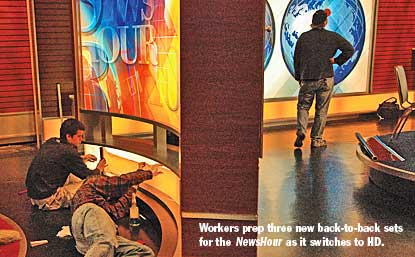
NewsHour gets widescreen HD makeover, new sets and lighting
When viewers tune into NewsHour this week, they’ll see more vibrant colors, wider shots, and maybe even Gwen Ifill’s eyelashes. The program’s new high-definition format — shot with HD cameras and transmitted from an HD control room — is arriving with three new sets that can stand closer scrutiny.
The NewsHour’s transition bolsters PBS’s plan to have all primetime shows in HD by late next year. Converting to HD has been up to the producers, and WETA, whose suburban Virginia studio houses the NewsHour, used a federal Public Telecommunications Facilities Program grant to help buy the hardware. WETA received a $1 million PTFP grant in 2006 to cover half of its project costs.
Steve Howard, the broadcast’s director, says it was time to upgrade the show’s gear anyhow — some was 30 years old. WETA bought six new HD cameras (the show had eight for standard-definiton) and hopes to buy three more soon. HD studio cameras cost between $50,000 and $75,000.
Viewers with HD receivers will see the NewsHour filling their wide 16:9 screens; Jim Lehrer junkies with old 4:3 screens will see the wider picture in a “letterbox,” leaving black areas above and below. Howard says the wider screen will help immerse viewers in interviews. He’ll begin experimenting with more multiperson shots rather than showing one talking head at time.
Some of the program’s news footage will still be in standard definition, and viewers will see it “pillar-boxed,” with blank bands right and left, to accommodate the 4:3 shape.
Chris Dee, the program’s director of production operations, says they hope the broadcast product created by all this new technology attracts a younger audience. “Kids see this kind of television,” he says, pointing to an old 4:3 monitor, “and think it’s a little old-fashioned.”
Regular viewers will notice that Lehrer has been anchoring from a café-size round table on a temporary set while the regular studio was being fitted with two sets for up to five people each and a third set that seats three. All are trimmed in reddish wood with richly colored NewsHour graphics.
The hosts will be able to check computer monitors hidden under their glass desktops, and all will be cooler and less dazzled by the lighting, which can be dimmer than the old cameras required. Being flourescent, the bulbs also use far less electricity.
Howard and his crew have just moved to a new HD control room seemingly twice the size of their old haunt. He’s been setting up shots from black-and-white monitors for 44 years. Now he’ll watch an expanse of three 70-inch Barco projection monitors mounted seamlessly side-by-side. Their display can be configured to show Howard’s familiar layout of incoming and outgoing video — or whatever the HD future requires.
Web page posted Feb. 5, 2008
Copyright 2007 by Current Publishing Committee